
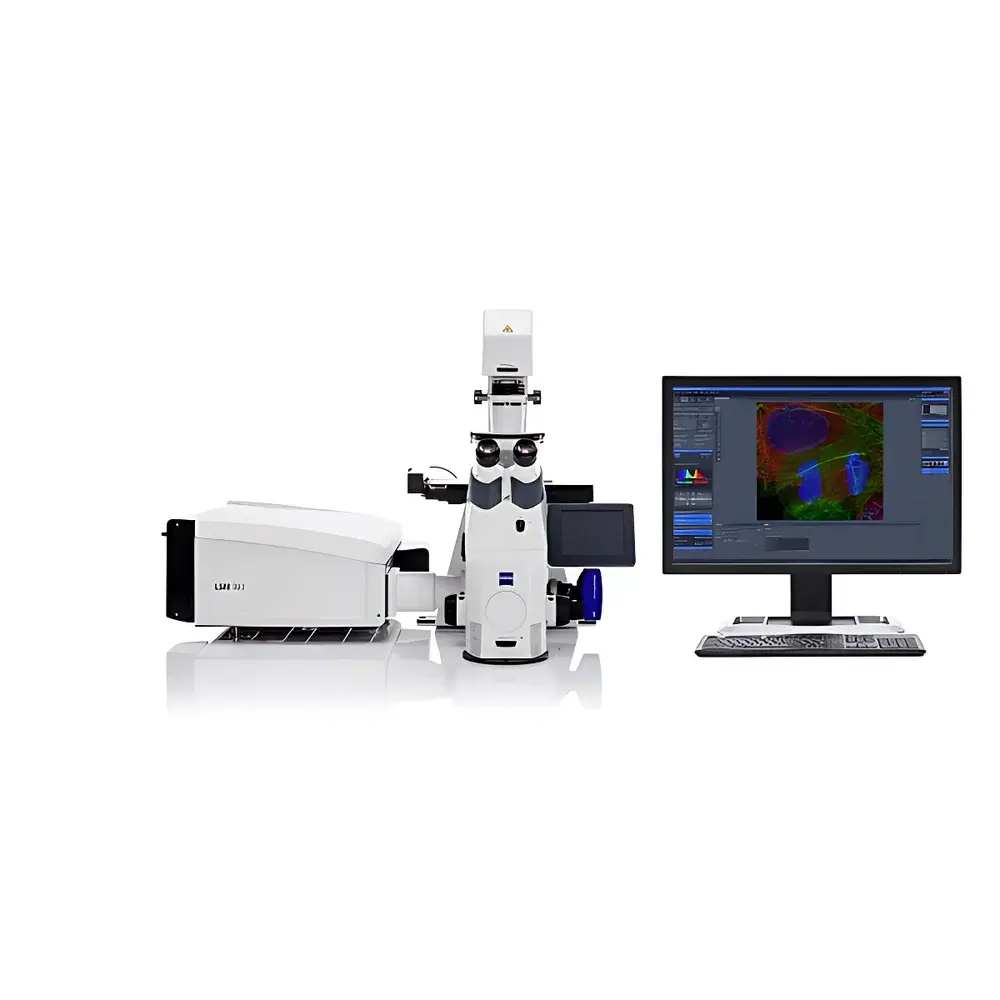
ZEISS LSM 9 Series Laser Scanning Confocal Microscope with Airyscan 2 Technology
| Brand | ZEISS |
|---|---|
| Origin | Germany |
| Model | LSM 9 Series with Airyscan 2 |
| Detection Principle | Scanning Laser Confocal Microscopy with Pixel-Reassignment Super-Resolution |
| Resolution (XY) | Up to 90 nm |
| SNR Improvement | 4–8× vs. conventional confocal |
| Imaging Modes | Standard Confocal, Airyscan 2 Multiplex, Airyscan 2 Fast, Lambda Spectral Acquisition, Dynamics Profiler |
| Software Platform | ZEN Blue/Black (GLP-compliant workflow support, audit trail, user access control) |
| Compliance | ISO 13485–certified manufacturing, FDA 21 CFR Part 11–ready configuration available |
Overview
The ZEISS LSM 9 Series Laser Scanning Confocal Microscope equipped with Airyscan 2 technology represents a paradigm shift in high-fidelity, low-phototoxicity fluorescence imaging for life science laboratories. Built upon the foundational principles of point-scanning confocal microscopy—where a focused laser beam raster-scans the specimen and emitted photons are filtered through a spatially matched pinhole—the LSM 9 integrates Airyscan 2’s advanced detector array and pixel-reassignment algorithm to surpass the classical Abbe diffraction limit without requiring specialized fluorophores or complex sample preparation. Unlike single-molecule localization techniques (e.g., PALM/STORM), Airyscan 2 achieves isotropic super-resolution (≤90 nm lateral, ≤270 nm axial) through hardware-based signal reweighting across 32-channel GaAsP detector elements, delivering quantitatively reliable intensity data compatible with ratiometric analysis, FRET, and colocalization studies. The system is engineered for precision in demanding applications such as long-term live-cell dynamics, multicolor spectral unmixing, and correlative light-electron microscopy (CLEM) workflows.
Key Features
- Up to 8× improvement in signal-to-noise ratio (SNR) compared to standard confocal detection—enabling shorter dwell times, reduced laser power, and extended viability of sensitive specimens including primary neurons and embryonic tissues.
- Airyscan 2 Multiplex mode: Simultaneous acquisition of spatial and temporal information at up to 30 fps in full-frame mode (512 × 512), supporting real-time tracking of subcellular trafficking events without compromising resolution.
- Dynamics Profiler module: Quantifies molecular mobility parameters—including diffusion coefficients, confinement zones, and transient binding kinetics—directly from time-series Airyscan data using model-free spatiotemporal autocorrelation analysis.
- Compact optical architecture: Optimized footprint (W × D × H: 720 × 690 × 620 mm) minimizes benchtop occupancy while maintaining full motorized XYZ stage, piezo Z-focus, and integrated environmental chamber compatibility (37°C, 5% CO₂, humidity control).
- ZEN software suite: Offers dual-interface operation (ZEN Blue for routine acquisition; ZEN Black for advanced scripting, batch processing, and metadata-rich experiment logging). All acquisitions support MIAME/MINSEQE-compliant metadata embedding.
Sample Compatibility & Compliance
The LSM 9 Series accommodates diverse specimen formats—from glass-bottom dishes and multiwell plates to thick cleared tissues (up to 500 µm) and whole-mount embryos—via interchangeable objectives (10×–100×, NA 0.45–1.46, correction collars for immersion media). Its spectral detection unit (32-channel lambda mode, 400–900 nm range) enables linear unmixing of up to 8 spectrally overlapping fluorophores (e.g., Hoechst, Alexa Fluor 488/568/647, Abberior STAR Red, Cy7) without crosstalk. System validation adheres to ISO/IEC 17025 guidelines for calibration traceability; optional IQ/OQ/PQ documentation packages support GLP and GMP-regulated environments. When configured with ZEN Black and enabled audit trail features, the platform meets FDA 21 CFR Part 11 requirements for electronic records and signatures.
Software & Data Management
ZEN software provides native support for open-format data exchange (OME-TIFF, HDF5) and integrates with third-party analysis platforms including Fiji/ImageJ, Imaris, and MATLAB via documented APIs. All raw datasets retain embedded acquisition parameters (laser power, gain, pinhole size, z-step, objective ID), ensuring full experimental reproducibility. Time-lapse series include automatic drift correction, adaptive focus stabilization (Colibri LED-based), and hardware-synchronized external device triggering (e.g., perfusion pumps, electrophysiology rigs). Data security protocols include role-based user permissions, encrypted local storage, and DICOM-SR export for cross-platform archival.
Applications
- Cell biology: Quantitative analysis of organelle motility, mitotic spindle dynamics, and endosomal trafficking under physiological illumination conditions.
- Developmental biology: High-resolution 4D imaging of gastrulation, neural tube closure, and vascular plexus formation in zebrafish and mouse embryos.
- Neuroscience: Subsynaptic mapping of receptor clusters (e.g., PSD-95/GluA1), dendritic spine turnover, and axonal transport kinetics in primary cortical cultures.
- Oncology: Single-cell tracking of metastatic invasion through collagen I matrices and collective migration in spheroid models.
- Plant science: In vivo imaging of plasmodesmata connectivity, chloroplast repositioning, and root cap statolith dynamics with minimal photobleaching.
FAQ
What distinguishes Airyscan 2 from Airyscan 1?
Airyscan 2 doubles the detector area and introduces a new multiplex acquisition mode that decouples spatial and temporal sampling—enabling simultaneous high-resolution and high-speed imaging without trade-offs.
Can the LSM 9 be integrated into existing CLEM pipelines?
Yes. The system supports fiducial marker-based coordinate registration, cryo-compatible sample holders, and seamless export of stage coordinates and image stacks for correlation with TEM/SEM datasets.
Is ZEN software validated for regulated environments?
ZEN Black v3.6+ includes configurable audit trail, electronic signature, and change control modules—validated per Annex 11 and aligned with ALCOA+ data integrity principles.
What objective corrections does the system support?
All ZEISS Plan-Apochromat and LD LCI objectives with adjustable correction collars for water, glycerol, oil, and silicone immersion media are fully supported, including chromatic aberration compensation across visible-NIR bands.
How is phototoxicity minimized during long-term live imaging?
Through combined use of Airyscan 2’s high quantum efficiency, adaptive illumination (region-of-interest scanning), and Dynamics Profiler’s sparse-sampling reconstruction—reducing total photon dose by up to 75% versus conventional confocal.




