
Optical Fibers – Comprehensive Portfolio from Global Leading Manufacturers
No specifications available.
Overview
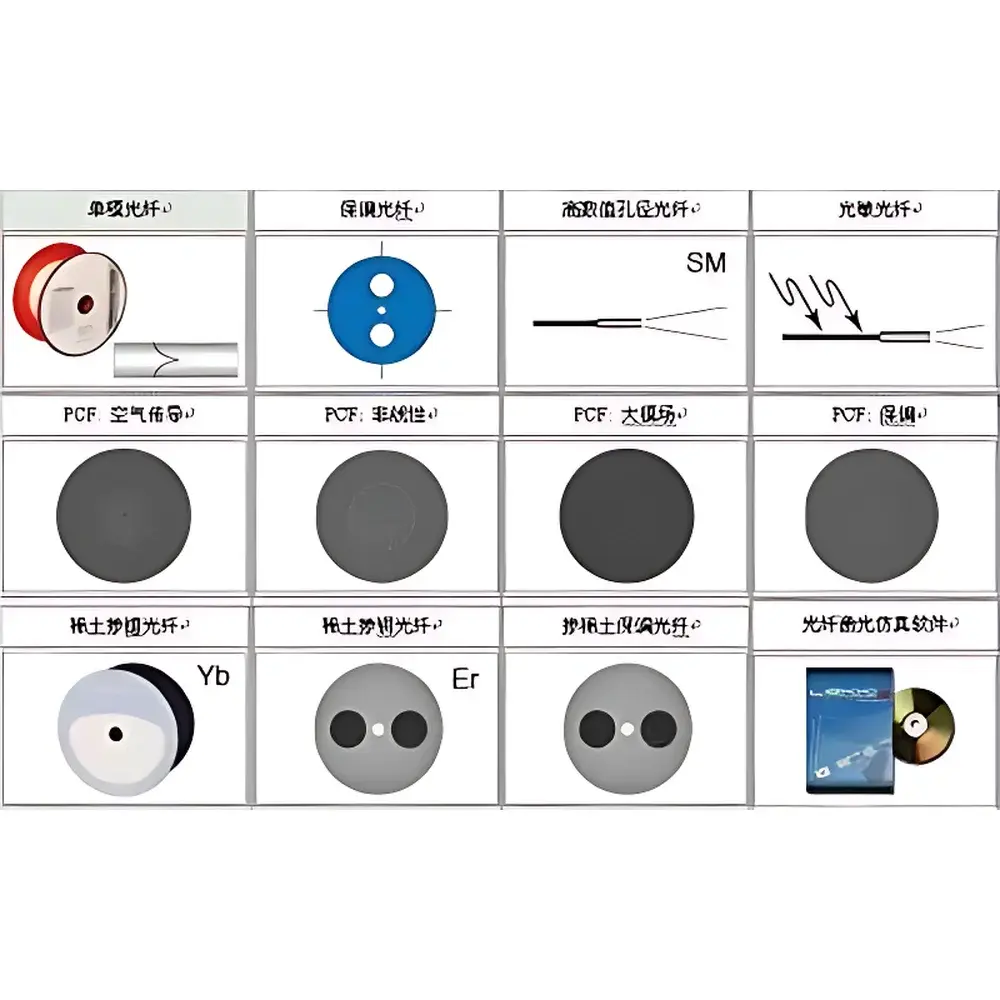
This product portfolio represents a rigorously curated selection of optical fibers sourced directly from internationally recognized manufacturers specializing in high-performance photonic components for research, industrial, and defense applications. The fibers are engineered to meet stringent requirements in wavelength-specific transmission, polarization maintenance, nonlinear optical response, thermal and radiation stability, and power-handling capability. Core measurement principles underlying fiber selection and qualification include modal propagation analysis (LP-mode cutoff, MFD), polarization extinction ratio (PER) evaluation, attenuation spectroscopy (ITU-T G.650.1), chromatic dispersion profiling, and bend-induced loss characterization per IEC 60793-1-40. These fibers serve as foundational elements in interferometric sensing, fiber-optic gyroscopes (FOGs), ultrafast laser delivery, broadband supercontinuum generation, distributed temperature/strain sensing (DTS/DSS), and high-power laser systems operating from UV to mid-IR spectral bands.
Key Features
- Multi-vendor sourcing from Crystal Fiber (now NKT Photonics), Fibercore, INO, MPB Communications, OZ Optics, ITF Technologies, LXSIX Photonics, and Liekki — all ISO 9001-certified manufacturers with traceable process control
- Comprehensive polarization-maintaining (PM) fiber offerings: Panda-type, Bow-tie, elliptical-core, and PANDA-PM designs optimized for 980 nm, 1310 nm, and 1550 nm telecom and FOG applications; PER ≥ 25 dB over 1 m length
- Specialty single-mode fibers: 980 nm, 1060 nm, and 1550 nm optimized variants with tailored mode field diameter (MFD), dispersion slope, and cutoff wavelength per ITU-T G.652/G.657 standards
- Photonic crystal fibers (PCFs): Hollow-core PCFs for low-latency, low-nonlinearity transmission; solid-core highly nonlinear PCFs for supercontinuum generation; large-mode-area (LMA) PCFs for high-peak-power pulse delivery
- Doped active fibers: Erbium-doped (EDF), ytterbium-doped (EYDF), thulium-doped (TDF), and erbium–ytterbium co-doped (EYDF) fibers; double-clad designs (DCYB) with NA > 0.46 for high-efficiency pump absorption
- Environmentally robust fibers: Radiation-hardened variants compliant with MIL-STD-883H Method 1019.2; high-temperature fibers rated up to 300 °C continuous operation; bend-insensitive fibers meeting ITU-T G.657.A1/A2 specifications
Sample Compatibility & Compliance
All fibers are supplied with full material declarations, batch-specific test reports (including attenuation, cut-off wavelength, numerical aperture, and geometry measurements), and RoHS/REACH compliance documentation. PM fibers are qualified per Telcordia GR-1221-CORE for polarization stability under thermal cycling (−40 °C to +85 °C) and mechanical stress. Active fibers intended for EDFA and fiber laser integration conform to IEC 61290-1-3 for gain measurement and IEC 61291-1 for amplifier safety. Radiation-tolerant fibers undergo gamma irradiation testing per ASTM E1249-16. Traceability supports GLP-compliant lab environments and FDA 21 CFR Part 11–aligned data integrity workflows where fiber-based instrumentation is used in regulated analytical systems.
Software & Data Management
Liekki’s proprietary fiber simulation suite (LiekkiApp) is available for modeling mode propagation, gain saturation, ASE spectrum, and thermal load distribution in doped fibers—enabling predictive design of amplifiers and lasers prior to hardware integration. MPB Communications provides system-level modeling tools for Raman amplifier gain flattening and noise figure optimization. All vendor-provided software supports export of simulation results in CSV and HDF5 formats, compatible with MATLAB, Python (NumPy/SciPy), and LabVIEW for automated data ingestion into laboratory information management systems (LIMS). Audit trails, user access controls, and electronic signatures are supported where integrated with validated enterprise platforms.
Applications
- Fiber-optic gyroscopes (FOGs) requiring ultra-low polarization cross-talk and long-term phase stability
- High-power CW and pulsed fiber lasers (10–500 W average power) using LMA and DCYB fibers
- Supercontinuum sources based on highly nonlinear PCFs pumped by femtosecond Yb-fiber lasers
- Distributed acoustic sensing (DAS) and Brillouin optical time-domain analysis (BOTDA) systems utilizing standard and specialty SMF
- Fiber Bragg grating (FBG) sensor arrays fabricated on photosensitive and radiation-hardened fibers
- Mid-IR laser delivery (2–5 µm) using fluoride or chalcogenide-based specialty fibers
- Quantum optics experiments requiring ultra-low-noise, polarization-maintained, and vacuum-compatible fiber pigtails
FAQ
Are these fibers supplied with certification of conformance (CoC) and test reports?
Yes — each shipment includes a CoC referencing the manufacturing lot, along with wavelength-dependent attenuation, geometry, and (where applicable) PER and MFD measurement reports.
Can you supply custom fiber lengths with connectorized terminations?
Custom cutting, cleaving, and connectorization (FC/APC, SC/APC, SMA905) are available upon request, subject to minimum order quantities and lead time confirmation.
Do you support fiber splicing and fusion parameters for specialty fibers?
Vendor-recommended splicing programs and arc discharge settings are provided for all active and PM fibers; splice loss validation protocols follow IEC 61300-3-34.
Is there technical support for fiber integration into laser cavity or amplifier designs?
Application engineering support is coordinated directly with manufacturer technical teams (e.g., Liekki, MPB, Fibercore) for system-level design review and performance modeling.
Are samples available for evaluation prior to bulk procurement?
Evaluation lengths (typically 1–5 m) are available under NDA for qualified institutional and industrial end-users upon submission of technical use case documentation.




