
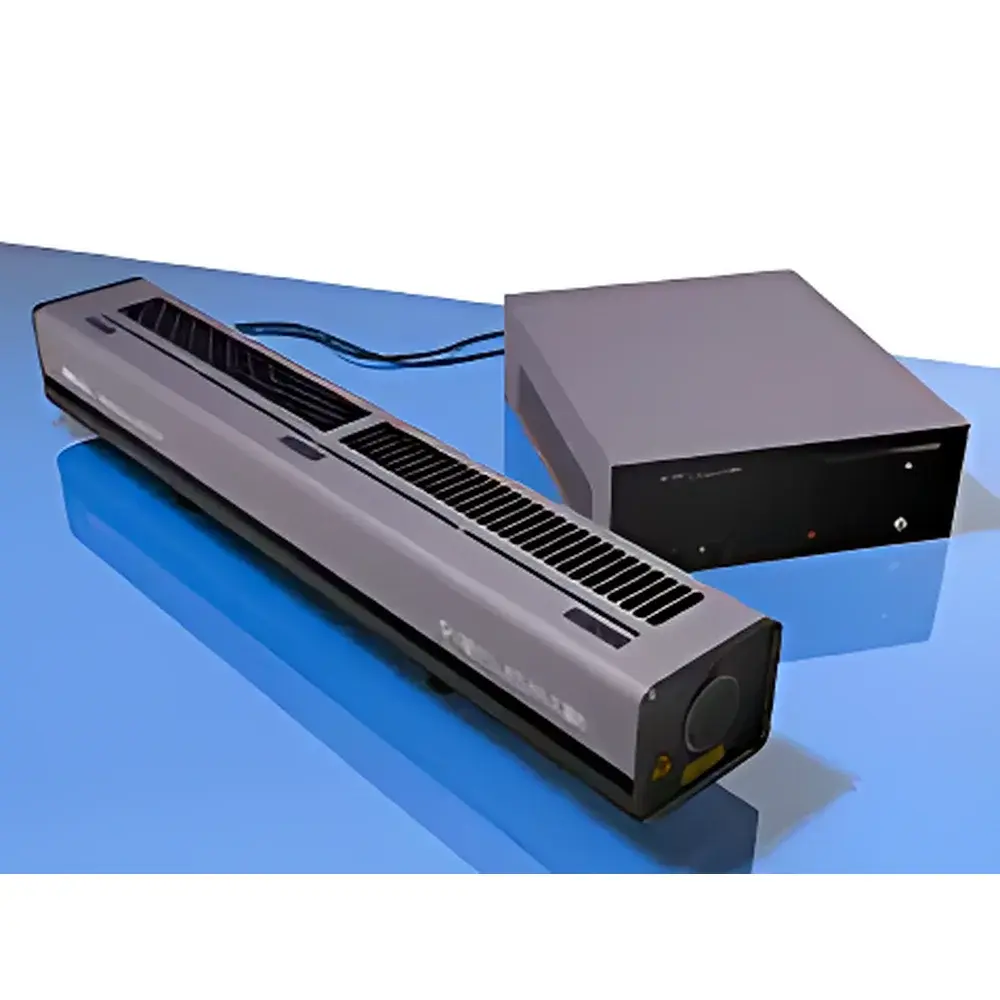
Plasma HCL-100U(I) Helium-Cadmium Laser System
| Brand | Rayscience |
|---|---|
| Origin | Shanghai, China |
| Manufacturer Type | Authorized Distributor |
| Country of Origin | China |
| Model | HCL-100U(I) |
| Laser Type | Gas Laser (He-Cd) |
| Output Wavelength | 325 nm (UV) and/or 441.6 nm (blue) |
| Nominal Output Power | Up to 100 mW (at 441.6 nm), up to 30 mW (at 325 nm) |
| Beam Diameter | ≤1.2 mm |
| Beam Divergence | ≤1.5 mrad |
| Polarization | Linear, >100:1 |
| Warm-up Time | <15 min |
| Lifetime | ≥10,000 hours (typical) |
| Cooling | Air-cooled |
| Power Supply | AC 220 V ±10%, 50/60 Hz |
Overview
The Plasma HCL-100U(I) Helium-Cadmium (He-Cd) Laser System is a continuous-wave (CW), gas-discharge laser engineered for high spectral purity, long-term power stability, and reliable operation in demanding optical metrology, spectroscopy, and lithography applications. Based on the well-established He-Cd plasma discharge principle—where helium atoms transfer excitation energy to cadmium ions via collisional pumping—the system emits coherent radiation at two primary wavelengths: 325 nm (ultraviolet) and 441.6 nm (visible blue), with optional dual-line or single-line configurations. Unlike solid-state or diode-pumped alternatives, He-Cd lasers offer intrinsic narrow linewidth (<3 GHz), excellent spatial coherence (M² < 1.3), and low amplitude noise (<0.5% RMS over 1 hour), making them indispensable for interferometric calibration, fluorescence excitation, and holographic recording where wavelength-defined photon energy and beam quality are critical.
Key Features
- Stable dual-wavelength output: Simultaneous or selectable emission at 325 nm (UV) and 441.6 nm (blue), enabling multi-modal experimental setups without hardware reconfiguration.
- High-power UV capability: Delivers up to 30 mW at 325 nm—among the highest commercially available outputs for air-cooled He-Cd lasers—supporting efficient photochemical activation and UV Raman excitation.
- Extended operational lifetime: Plasma’s proprietary cathode design and optimized Cd vapor pressure control ensure ≥10,000 hours of rated service life under standard operating conditions (25°C ambient, 70% duty cycle).
- Air-cooled architecture: Eliminates requirement for external chillers or recirculating coolant systems, reducing footprint and total cost of ownership while maintaining thermal stability within ±0.05°C of setpoint.
- Integrated beam conditioning: Includes collimated output with adjustable divergence (≤1.5 mrad), linear polarization ratio >100:1, and beam diameter ≤1.2 mm (1/e²), compatible with standard Ø25 mm optical mounts and spatial filters.
- Compliance-ready interface: RS-232 and analog TTL modulation inputs support integration into automated test benches and GLP-compliant workflows requiring external trigger synchronization and power ramping.
Sample Compatibility & Compliance
The HCL-100U(I) is designed for use with standard optical components rated for UV–visible transmission (e.g., fused silica lenses, MgF₂-coated mirrors, quartz cuvettes). Its 325 nm output is suitable for excitation of common fluorophores (e.g., DAPI, Hoechst stains) and photoresists (e.g., Shipley S1800 series). The system conforms to IEC 60825-1:2014 Class 3B laser safety requirements when operated with appropriate interlocks and beam enclosures. It supports traceable calibration via NIST-traceable photodiode sensors and meets mechanical and electromagnetic compatibility standards per EN 61326-1:2013 (industrial environments). For regulated laboratories, the laser’s analog modulation port enables audit-trail-capable power logging when paired with compliant data acquisition systems adhering to FDA 21 CFR Part 11 principles.
Software & Data Management
While the HCL-100U(I) operates as a stand-alone instrument, its RS-232 serial interface allows bidirectional communication with host PCs running custom LabVIEW, Python (PySerial), or MATLAB scripts for remote power control, temperature monitoring, and fault logging. Optional OEM firmware upgrades provide extended diagnostic registers—including cathode voltage history, discharge current waveform snapshots, and cumulative runtime counters—enabling predictive maintenance scheduling. All operational parameters are stored in non-volatile memory and persist across power cycles. No proprietary software suite is required; configuration and monitoring rely on industry-standard terminal emulators or SCPI-compatible command sets.
Applications
- UV fluorescence microscopy and flow cytometry source for DNA-binding dyes requiring 325 nm excitation.
- Calibration reference for spectroradiometers and monochromator wavelength accuracy verification (NIST SRM 2034 traceable).
- Interferometric surface profiling and gravitational wave detector alignment due to high temporal coherence and low phase noise.
- Laser-induced breakdown spectroscopy (LIBS) pre-ionization source for enhanced plasma initiation in conductive samples.
- Holographic data storage development, leveraging the 441.6 nm line’s high diffraction efficiency in photopolymer media.
- Photoelectron spectroscopy (PES) light source in ultra-high vacuum (UHV) chambers with differential pumping stages.
FAQ
What is the typical warm-up time before stable output is achieved?
The laser reaches thermal equilibrium and achieves power stability within 12–15 minutes after cold start, with output drift <±1.5% over the subsequent hour.
Can the 325 nm and 441.6 nm lines be used simultaneously?
Yes—the HCL-100U(I) supports simultaneous dual-line operation; optional internal dichroic beam combiners or external prism-based separation enable independent path routing.
Is ozone generation a concern during prolonged 325 nm operation?
Negligible ozone is produced under normal lab ventilation (≥4 air changes/hour); no dedicated ozone scrubber is required per ISO 15714:2020 guidelines for enclosed UV laser enclosures.
Does the system include a beam shutter or safety interlock interface?
A TTL-compatible shutter driver output is provided on the rear panel; external mechanical shutters or interlock relays may be connected to the designated EMO (Emergency Off) terminals per IEC 61508 SIL2 recommendations.
How is cathode wear monitored during service life?
Discharge voltage rise rate (dV/dt) is logged via RS-232; a sustained increase >0.8 V/1000 h indicates approaching end-of-life and triggers preventive maintenance alerts.




