
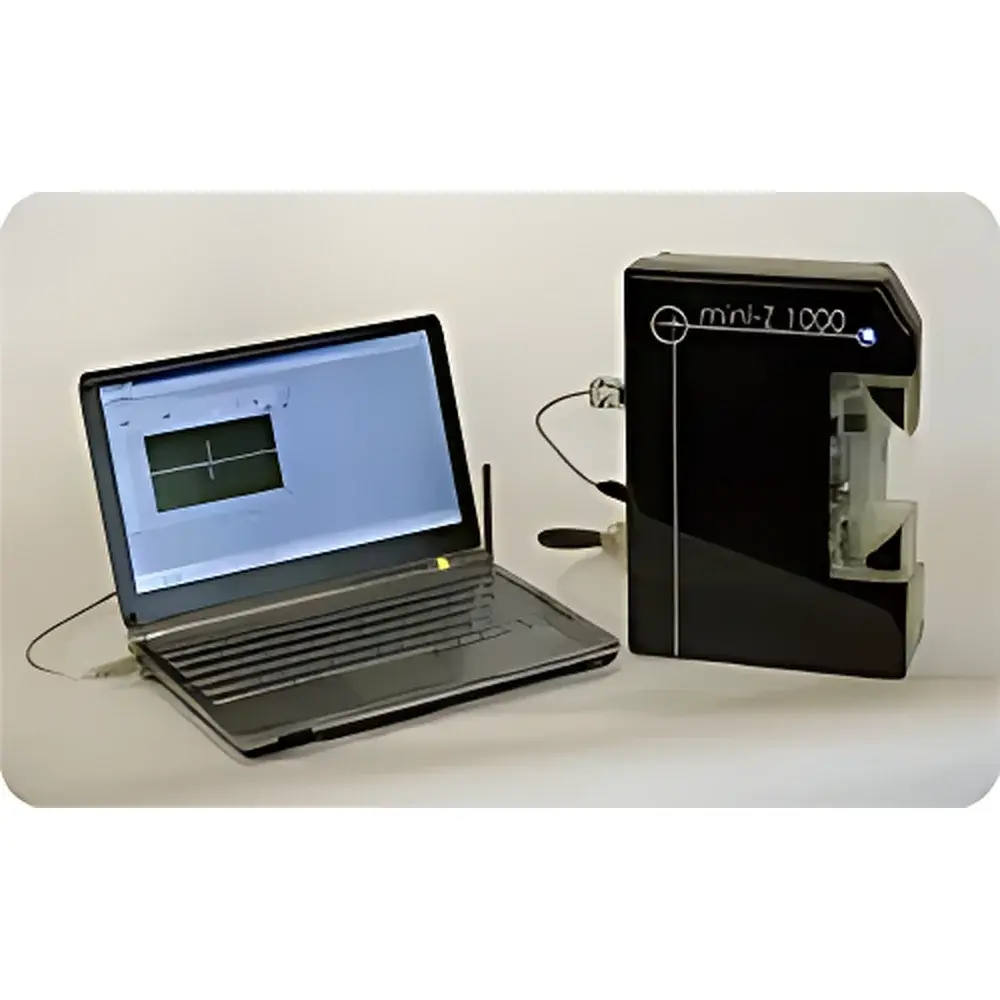
Rayscience THz-TDS Compact Terahertz Time-Domain Spectroscopy System
| Brand | Rayscience |
|---|---|
| Origin | Imported |
| Manufacturer Type | Authorized Distributor |
| Model | THz |
| Spectral Range | 0.1–4.0 THz |
| Spectral Resolution | <50 GHz (after FFT) |
| Dynamic Range | >70 dB (at peak) |
| Operation Modes | Transmission or Reflection |
| Sample-to-Source Distance | 1–40 cm |
| Emitter | Photoconductive Antenna |
| Detector | ZnTe Electro-Optic Crystal |
| Control Software | LabVIEW-based GUI |
| Interface | USB 2.0 & Bluetooth |
| Dimensions | 10.5" × 6.25" × 2.75" (267 × 159 × 70 mm) |
| Weight | <4.2 lbs (1.9 kg) |
Overview
The Rayscience THz-TDS Compact Terahertz Time-Domain Spectroscopy System is a benchtop, fiber-coupled instrument engineered for precision broadband characterization of materials in the 0.1–4.0 THz spectral window. Based on ultrafast photoconductive generation and electro-optic sampling principles, the system employs femtosecond laser pulses to excite a low-temperature-grown GaAs photoconductive antenna for coherent THz pulse emission, while phase-resolved detection is achieved via optical rectification and electro-optic sampling in a ZnTe crystal. This time-domain architecture enables direct measurement of both amplitude and phase of the THz electric field, permitting simultaneous extraction of complex optical constants—refractive index n(ν) and absorption coefficient α(ν)—without Kramers–Kronig transformation. The system supports both transmission and reflection geometries, making it suitable for non-destructive evaluation of dielectrics, polymers, pharmaceuticals, semiconductors, and layered structures under ambient or controlled environments.
Key Features
- Compact, integrated optomechanical design with rigid aluminum housing and vibration-damped baseplate—optimized for stability in shared laboratory spaces without active isolation;
- Real-time spectral acquisition at up to 20 Hz scan rate, enabling rapid parameter sweeps and kinetic monitoring of dynamic processes;
- Dual-mode operation (transmission/reflection) with adjustable sample positioning stage (1–40 cm path length range), supporting thickness-dependent analysis and thin-film metrology;
- LabVIEW-based control software with intuitive graphical interface, synchronized waveform visualization, and built-in FFT processing pipeline;
- USB 2.0 and Bluetooth connectivity for local control and remote supervision; Ethernet-ready architecture supports integration into centralized lab networks;
- Dedicated I/O ports (TTL-compatible) for external triggering, synchronization with pump-probe setups, or integration with environmental chambers and motorized stages;
- Factory-calibrated spectral response traceable to NIST-traceable reference standards; full system alignment pre-verified prior to shipment.
Sample Compatibility & Compliance
The THz-TDS system accommodates solid, liquid, and gaseous samples across diverse material classes—including crystalline organics, amorphous polymers, hydrated biomolecules, semiconductor wafers, and packaged pharmaceutical tablets. Its non-ionizing, low-energy (meV-scale) radiation ensures safe, label-free interrogation without photodamage or thermal loading. The system complies with IEC 61000-6-3 (EMC emissions) and IEC 61000-6-2 (immunity) standards. While not certified for GMP manufacturing environments, its software architecture supports audit-ready data logging—including timestamped raw time traces, processed spectra, and metadata—with optional export to CSV, HDF5, or MATLAB formats for downstream analysis per ASTM E2918 and ISO/IEC 17025 guidelines.
Software & Data Management
The bundled LabVIEW application provides comprehensive instrument control, real-time oscilloscope-style time-domain display, and automated frequency-domain conversion via zero-padded fast Fourier transform. Users can define custom acquisition protocols—including variable delay line stepping, averaging cycles, and background subtraction routines. All acquired datasets include embedded metadata (laser power, ambient temperature, humidity, operator ID, and calibration timestamps). Export functions support FAIR (Findable, Accessible, Interoperable, Reusable) data principles, with optional encryption and digital signature modules available for regulated workflows. Though native support for FDA 21 CFR Part 11 compliance requires third-party validation packages, the software’s deterministic execution and immutable log structure facilitate GLP/GMP audit preparation.
Applications
- Pharmaceutical solid-state analysis: polymorph identification, hydrate/dehydrate kinetics, tablet coating uniformity assessment;
- Security screening: concealed substance discrimination (e.g., explosives, narcotics) via spectral fingerprinting in opaque packaging;
- Materials science: carrier dynamics in 2D materials, phonon resonances in perovskites, interfacial polarization in multilayer dielectrics;
- Quality control: moisture content mapping in paper, polymer crosslink density quantification, delamination detection in composites;
- Fundamental physics: ultrafast carrier relaxation in topological insulators, magneto-optical THz spectroscopy under cryogenic conditions.
FAQ
What laser source is required to operate this system?
The system is designed for use with a standard Ti:sapphire oscillator (780–800 nm, <100 fs pulse width, 80 MHz repetition rate) or a fiber-based femtosecond laser meeting equivalent temporal and spectral specifications.
Can the system be upgraded for cryogenic or vacuum operation?
Yes—customizable vacuum-compatible sample chambers and cryostat-integrated delay lines are available as OEM options; contact technical support for mechanical interface drawings and thermal budget constraints.
Is phase information preserved in the final spectrum?
Yes—both real and imaginary components of the complex dielectric function are directly retrievable from the time-domain electric field waveform without approximation.
Does the software support batch processing of multiple samples?
Yes—the LabVIEW environment includes scripting tools for automated sequential measurement, baseline correction, and comparative spectral library matching.
What maintenance is required for long-term stability?
Annual recalibration of time-delay line linearity and ZnTe crystal alignment is recommended; no consumables or routine optical realignment is needed under normal operating conditions.





