
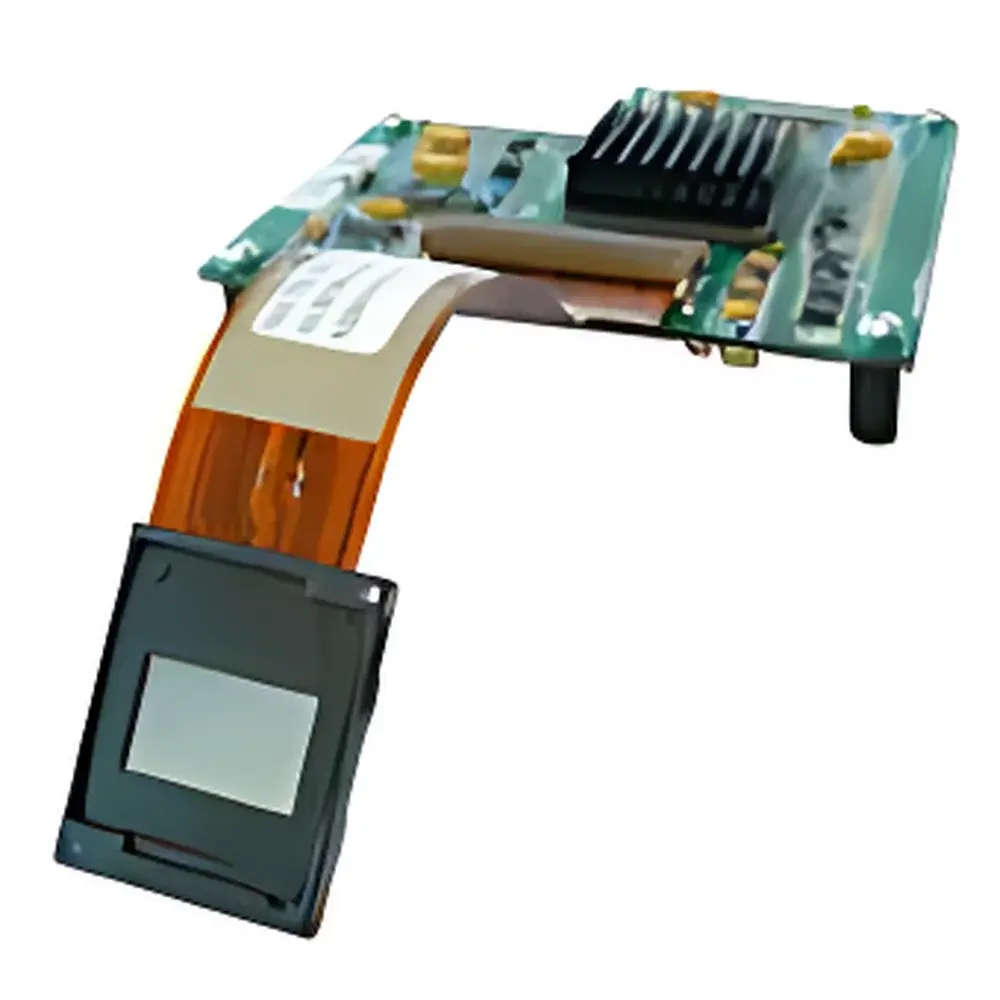
HOLOEYE LCOS Microdisplay Module (OEM Silicon-Based Reflective Spatial Light Modulator)
| Key | Brand: HOLOEYE |
|---|---|
| Origin | Germany (Design & Core IP), Manufactured under license in Shanghai, China |
| Model | LCOS Series |
| Display Size | 0.55″–0.72″ diagonal |
| Resolution | 1280×768 (WXGA) to 1920×1080 (Full HD) |
| Frame Rate | 60–180 Hz |
| Drive Interface | Digital (LVDS, HDMI, or custom FPGA-compatible) |
| Modulation Mode | Amplitude, Phase, and Polarization |
| Pixel Architecture | Reflective CMOS-integrated liquid crystal on silicon |
| Fill Factor | >92% |
| Application Class | OEM Spatial Light Modulator (SLM) for coherent optical systems |
Overview
The HOLOEYE LCOS Microdisplay Module is a high-performance reflective spatial light modulator (SLM) engineered for precision wavefront control in advanced optical systems. Based on liquid-crystal-on-silicon (LCOS) architecture, it integrates a monocrystalline silicon backplane with CMOS driver circuitry and a high-reflectivity aluminum mirror layer, enabling sub-micron pixel pitch and exceptional optical fill factor (>92%). Unlike transmissive LCDs or DMD-based devices, the LCOS design places all active electronics beneath the liquid crystal layer—eliminating pixel aperture obstruction and suppressing the “screen-door” effect. This architecture supports both analog (phase/amplitude) and digital (field-sequential color) modulation schemes, making it suitable for applications requiring deterministic, pixel-level phase retardation—such as adaptive optics, holographic beam shaping, optical trapping, and ultrafast pulse shaping. The module operates in reflective mode with polarized input light, leveraging inherent compatibility with laser sources (e.g., DPSS, diode, and ultrafast Ti:sapphire lasers) across visible and near-infrared wavelengths (400–1100 nm).
Key Features
- High-Fidelity Wavefront Control: Designed for quantitative phase modulation with <1° RMS phase error repeatability under stable thermal conditions; calibrated gamma curves available per unit.
- OEM-Optimized Integration: Compact form factor (standardized mechanical footprint compatible with C-mount and M32 threading) and flexible digital interface options—including LVDS, HDMI, and FPGA-tethered parallel bus—for seamless integration into custom optical engines.
- Modulation Flexibility: Supports amplitude-only, phase-only, and hybrid polarization-amplitude modulation modes via configurable voltage addressing and temporal sequencing.
- Thermally Stable Architecture: Monolithic silicon substrate provides low coefficient of thermal expansion (CTE ≈ 2.6 ppm/K), minimizing pixel drift during extended operation; optional thermoelectric stabilization kits available.
- Scalable Resolution & Frame Rate: Multiple configurations spanning WXGA (1280×768) to Full HD (1920×1080), with native frame rates up to 180 Hz at reduced bit-depth or 60 Hz full-bit-depth for high-fidelity interferometric applications.
- Low-Cost Production Pathway: Leverages mature 0.18 µm CMOS fabrication processes, enabling volume scalability without compromising pixel uniformity or inter-pixel crosstalk performance.
Sample Compatibility & Compliance
The HOLOEYE LCOS module is compatible with collimated, linearly polarized illumination sources ranging from continuous-wave lasers (e.g., 532 nm, 633 nm, 780 nm) to pulsed femtosecond systems (with appropriate average power derating). It meets RoHS 2015/863/EU compliance for hazardous substances and conforms to IEC 61000-4-2 (ESD immunity) and IEC 61000-4-3 (radiated RF immunity) standards. For regulated environments—including medical device development (IEC 62304) and aerospace-grade optical subsystems—the module supports traceable calibration reports and can be supplied with documentation packages aligned with ISO 9001:2015 quality management system requirements. While not intrinsically certified for FDA 510(k) or DO-160G, its modular design facilitates third-party system-level qualification when integrated into end-user platforms governed by those frameworks.
Software & Data Management
HOLOEYE provides the SLM Display Software Suite (v5.x), a cross-platform (Windows/Linux/macOS) application enabling real-time pattern loading, phase map generation (including Gerchberg-Saxton, direct binary search, and Zernike decomposition tools), and hardware synchronization via external TTL triggers. All firmware updates and configuration profiles are stored in non-volatile memory with version-controlled checksums. For automated test environments, a documented C/C++ SDK and Python API (PyHOLOEYE) support integration with LabVIEW, MATLAB, and Python-based control stacks. Audit trails—including pattern upload timestamps, modulation depth settings, and thermal sensor logs—are exportable in CSV/JSON format to support GLP/GMP-aligned data integrity workflows. No cloud connectivity or remote telemetry is embedded; all data remains local unless explicitly exported by the user.
Applications
- Adaptive Optics: Real-time correction of atmospheric turbulence in astronomical observatories and retinal imaging systems.
- Holographic Optical Tweezers: Dynamic multi-trap generation and reconfiguration for single-cell manipulation and micro-rheology.
- Laser Beam Shaping: Generation of Bessel, Airy, vortex, and flat-top intensity profiles for materials processing and lithography.
- Quantum Optics: Programmable mode sorting in orbital angular momentum (OAM) multiplexing and entanglement distribution setups.
- Head-Up Display (HUD) Development: High-resolution, low-speckle projection engine core for automotive and avionic HUD prototypes.
- Pulse Compression & Shaping: Fourier-domain spectral phase modulation in chirped pulse amplification (CPA) and coherent control experiments.
FAQ
Is this device a display panel or a spatial light modulator?
It is an OEM-grade reflective spatial light modulator (SLM) optimized for coherent optical modulation—not a consumer display. Its design prioritizes phase fidelity, polarization extinction ratio (>500:1), and low inter-pixel crosstalk over color gamut or viewing angle.
Can I use it with femtosecond laser pulses?
Yes, provided average power remains within specified limits (≤500 mW for 0.72″ models, derated for shorter wavelengths); damage threshold is validated for 100-fs pulses at 800 nm with >1 J/cm² fluence.
Does HOLOEYE provide calibration certificates?
Standard units ship with factory-measured reflectivity maps and phase response curves; NIST-traceable calibration is available as an optional service with documented uncertainty budgets.
What driver electronics are required?
HOLOEYE offers reference driver boards (e.g., HEO-1000 series) supporting HDMI 1.4 or LVDS input; custom FPGA-based drivers can be co-developed under NDA for volume production.
Is Linux support available for the control software?
Yes—SLM Display Software Suite includes native Linux binaries and command-line utilities for headless operation in embedded optical platforms.




