
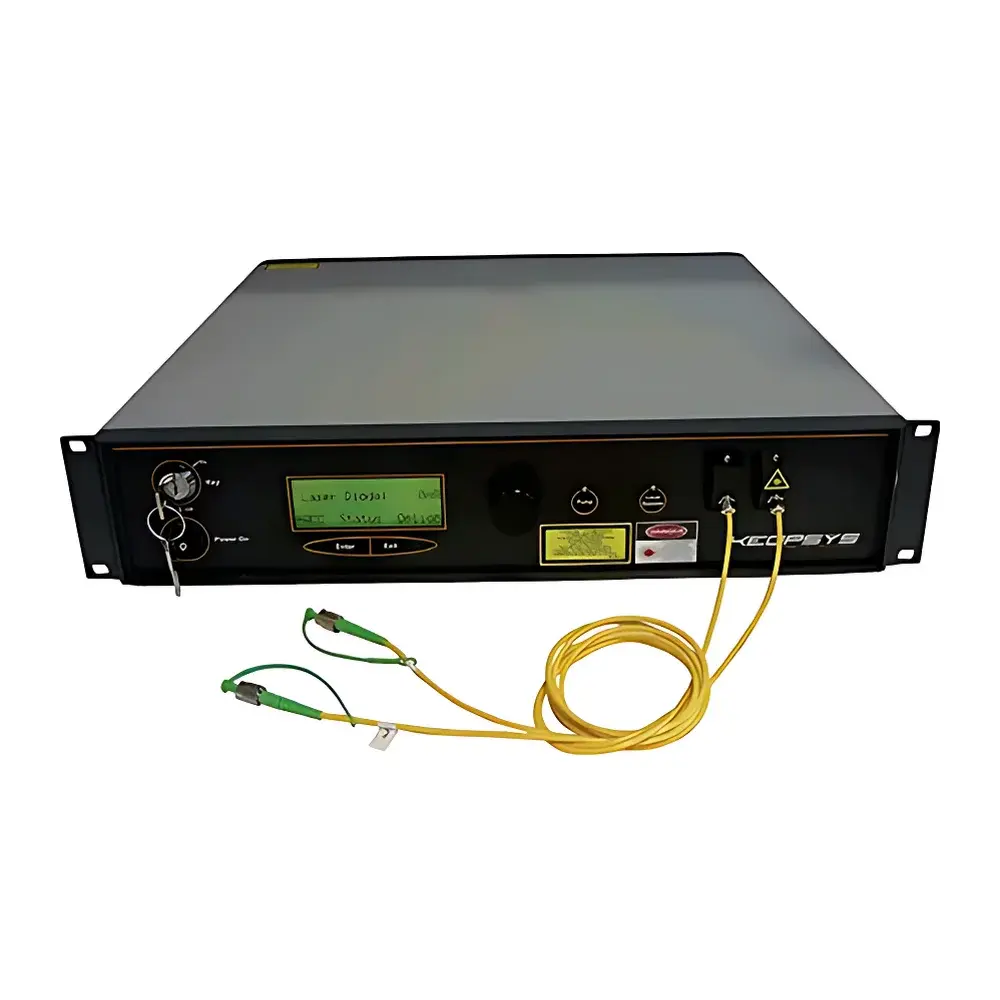
Keopsys CEFA-C-HG High-Gain Continuous-Wave Erbium-Doped Fiber Amplifier
| Brand | Keopsys |
|---|---|
| Origin | France |
| Model | CEFA-C-HG |
| Operating Band | C-band (L-band optional) |
| Small-Signal Input Sensitivity | −50 dBm |
| Small-Signal Gain | ≥ 50 dB |
| Noise Figure | Near Quantum Limit (~3–4 dB) |
| Polarization-Maintaining Output | Optional |
| Form Factor | Rack-Mount or OEM Module |
| Compliance | RoHS, CE, IEC 61300-3-35 (Fiber Optic Device Reliability) |
Overview
The Keopsys CEFA-C-HG is a high-performance, continuous-wave (CW), erbium-doped fiber amplifier (EDFA) engineered for ultra-low-noise optical signal amplification in the C-band (1530–1565 nm), with L-band (1565–1625 nm) variants available upon request. Based on double-clad, polarization-insensitive pump architecture and optimized rare-earth doping profiles, the CEFA-C-HG delivers exceptional small-signal gain (>50 dB) while maintaining noise figures approaching the quantum limit—typically 3.0 to 3.8 dB under standardized test conditions (ITU-T G.663 compliant measurement setup). Its design targets applications requiring high dynamic range, long-haul transmission fidelity, and compatibility with coherent detection systems, including distributed fiber sensing, optical time-domain reflectometry (OTDR), low-light interferometry, and seed-stage amplification for pulsed laser systems.
Key Features
- Ultra-high small-signal gain of ≥50 dB at −50 dBm input, enabling direct amplification of weak signals from photodetectors or low-power lasers
- Noise figure optimized to near quantum-limited performance (≤3.8 dB), critical for preserving optical signal-to-noise ratio (OSNR) in cascaded amplification chains
- Stable, low-ripple output power (<±0.05 dB over 8 hours at constant temperature), achieved via integrated thermoelectric cooler (TEC) and closed-loop pump current control
- Optional polarization-maintaining (PM) output configuration with >20 dB PM extinction ratio, supporting interferometric and polarization-sensitive metrology setups
- Flexible mechanical integration: available as 19″ rack-mount unit (1U height) or compact OEM module (120 × 90 × 25 mm) with FC/APC or PM-fiber pigtails
- Comprehensive safety and monitoring: built-in photodiode-based input/output power monitoring, over-temperature lockout, and pump laser end-of-life prediction algorithm
Sample Compatibility & Compliance
The CEFA-C-HG is compatible with standard single-mode fiber (SMF-28, ITU-T G.652.D) and polarization-maintaining fiber (PANDA or Bow-tie type) inputs. It supports CW, pseudo-CW, and low-duty-cycle modulated signals up to 1 MHz modulation bandwidth without gain transient distortion. The device complies with European Union directives for electromagnetic compatibility (EN 61326-1), laser safety (IEC 60825-1 Class 1M), and hazardous substance restriction (RoHS 2015/863/EU). All units undergo burn-in testing per Telcordia GR-468-CORE and are qualified for operation in controlled laboratory and telecom-grade environments (IEC 60068-2-1/2/14). Documentation includes full traceability of fiber splices, pump diode lots, and calibration certificates aligned with ISO/IEC 17025-accredited procedures.
Software & Data Management
The CEFA-C-HG integrates a dual-interface control system: analog (0–5 V) for simple gain setpoint adjustment and digital (RS-232 or USB-C) for full parameter interrogation. Keopsys’ proprietary EDFA Control Suite (v3.2+) provides real-time logging of input/output power, pump current, TEC voltage, and internal temperature—with timestamped CSV export and configurable alarm thresholds. Audit trails comply with GLP/GMP data integrity requirements: all parameter changes are logged with user ID, timestamp, and pre-/post-value (21 CFR Part 11-ready when deployed with validated authentication layer). Remote monitoring via Modbus RTU over RS-485 is supported for integration into SCADA or automated test benches.
Applications
- Low-noise pre-amplification in optical coherence tomography (OCT) systems requiring sub-pW-level sensitivity
- Boosting weak backscattered signals in phase-sensitive OTDR (φ-OTDR) for distributed acoustic sensing (DAS)
- Seed amplification stage for narrow-linewidth fiber lasers used in gravitational wave interferometers (e.g., LIGO-style cavities)
- Signal conditioning in quantum key distribution (QKD) receiver modules where excess noise directly impacts secure key rate
- Calibration reference chain in national metrology institutes performing absolute optical power measurements traceable to NIST or LNE standards
- Field-deployable amplification in airborne or maritime LiDAR receivers operating under thermal and vibration stress
FAQ
What is the minimum recommended input power for optimal noise performance?
For operation within 0.3 dB of specified noise figure, input power should be ≤−45 dBm. At −50 dBm, gain remains stable but noise figure increases by ≤0.4 dB due to ASE dominance.
Can the CEFA-C-HG be operated in automatic gain control (AGC) mode?
Yes—AGC is enabled via external feedback loop using the analog monitor output; full digital AGC with programmable setpoint is available in firmware v3.1+.
Is L-band operation available as a factory-configured option?
Yes—CEFA-L-HG variant uses optimized EDF composition and pump wavelength (1480 nm) for 1570–1610 nm operation; gain flatness ±1.2 dB across 40 nm.
Does the unit support synchronization with external TTL triggers?
No native TTL sync; however, gain can be modulated externally via the analog control input with bandwidth up to 100 kHz.
What documentation is provided for regulatory validation in pharmaceutical or medical device labs?
Includes Declaration of Conformity (DoC), traceable calibration report, risk analysis summary (ISO 14971), and software validation protocol template for 21 CFR Part 11 compliance.




