
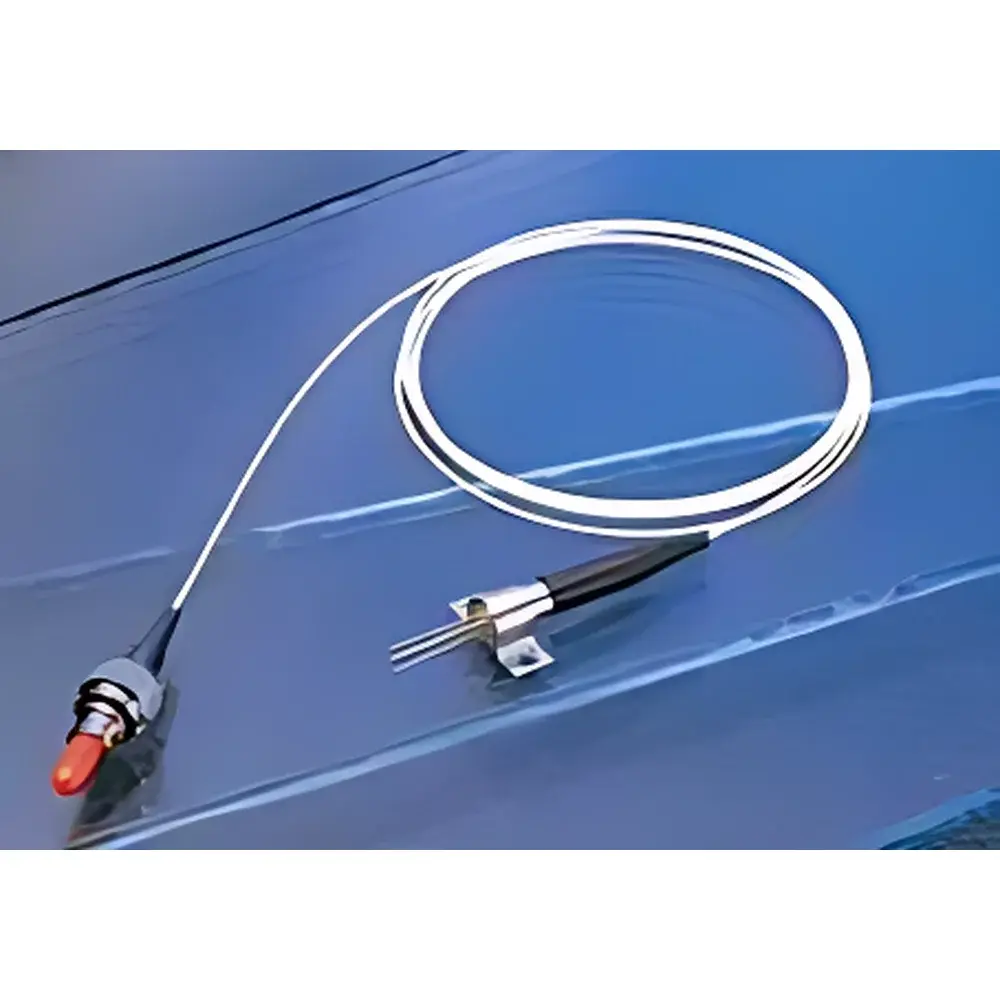
Rayscience C00122 850 nm VCSEL Coaxial Laser Diode Module
| Brand | Rayscience |
|---|---|
| Model | C00122 |
| Wavelength | 850 nm (typ.) |
| Output Power | 0.1–1.5 mW (CW) |
| Spectral Width | ≤0.85 nm (FWHM) |
| Threshold Current | 3–6 mA |
| Operating Current | 12 mA (typ.) |
| Forward Voltage | 1.9–2.1 V @ 10 mA |
| Rise/Fall Time | ≤150 ps |
| Operating Temperature | −20 to +65 °C |
| Storage Temperature | −40 to +85 °C |
| Package | 4-pin coaxial, 62.5 µm multimode fiber-coupled |
| Pinout | 1=GND, 2=Anode (+), 3=NC, 4=Cathode (−) |
| Forward Current Limit | 20 mA |
| Reverse Voltage Limit | 10 V |
Overview
The Rayscience C00122 is a high-reliability, fiber-pigtailed vertical-cavity surface-emitting laser (VCSEL) module engineered for precision optical sensing and short-reach data transmission applications. Operating at a nominal wavelength of 850 nm—optimized for peak coupling efficiency into 62.5/125 µm graded-index multimode fiber—the device leverages monolithic VCSEL architecture to deliver stable, low-noise, single longitudinal mode emission under continuous-wave (CW) operation. Its coaxial hermetic package integrates a thermally matched lensed fiber ferrule and internal monitor photodiode (not electrically accessible in this variant), ensuring consistent beam alignment and long-term power stability across industrial temperature ranges. Unlike edge-emitting lasers, the VCSEL’s circular, low-divergence output beam enables >70% coupling efficiency into standard multimode fiber without complex collimation optics—reducing system integration complexity and alignment sensitivity in OEM instrumentation platforms.
Key Features
- VCSEL-based architecture with inherent single-mode spectral purity and low relative intensity noise (RIN)
- Optimized 850 nm emission aligned to the low-loss, high-bandwidth window of OM1/OM2 multimode fiber infrastructure
- Low threshold current (3–6 mA) and high wall-plug efficiency, minimizing thermal load in compact, uncooled modules
- Sub-150 ps electrical rise/fall time supports modulation bandwidths exceeding 2 GHz—suitable for time-of-flight (ToF) sensing and high-speed digital links
- Hermetically sealed coaxial TO-can package with integrated 62.5 µm multimode fiber pigtail and factory-verified pointing stability
- Robust operating envelope: −20 °C to +65 °C ambient, qualified per Telcordia GR-468-CORE for passive optical components
Sample Compatibility & Compliance
The C00122 is designed for integration into Class 1 laser systems compliant with IEC 60825-1:2014 and FDA 21 CFR 1040.10/1040.11. Its fixed 0.1–1.5 mW CW output falls within safe-accessible emission limits when coupled into fiber with ≥1 m length and standard connectorization (e.g., FC/PC or ST). The device meets RoHS 2015/863/EU and REACH SVHC requirements. While not certified to ISO 13485 or IEC 62304, its construction and test protocol align with GLP-aligned manufacturing practices for laboratory-grade optical sources. No user-serviceable parts; intended for board-level solder-mount integration only. Not suitable for free-space imaging or direct ocular exposure scenarios without external attenuation and interlock circuitry.
Software & Data Management
As a purely analog optical source, the C00122 requires external current control via constant-current driver circuitry (e.g., Thorlabs LDCxx series or custom PCB-mounted drivers with <±0.1% current regulation). It does not incorporate digital interfaces (I²C, UART, or USB), nor does it support firmware updates or embedded telemetry. For traceable calibration workflows, users are advised to pair the module with NIST-traceable optical power meters (e.g., Newport 818-BB-20 or Ophir PD300) and log drive current, case temperature, and output power at defined intervals. Audit-ready records should include batch-specific L-I-V characterization curves provided in the manufacturer’s Certificate of Conformance (CoC), which documents wafer lot, test date, and binning parameters per MIL-STD-883H Method 5005.
Applications
- Fiber-optic current sensors (FOCS) and distributed temperature sensing (DTS) systems using Raman or Brillouin scattering interrogation
- Industrial encoder feedback systems requiring high-speed, low-jitter light sources for position resolution down to sub-micron levels
- Lab-based optical coherence domain reflectometry (OCDR) and low-coherence interferometry setups
- OEM integration into portable spectrophotometers, particle counters, and flow cytometers where size, power efficiency, and EMI resilience are critical
- Calibration reference sources for photodetector linearity verification across the 800–900 nm band
FAQ
Is the C00122 compatible with standard SFF-8472-compliant transceiver host controllers?
No—this is a bare VCSEL module without integrated driver, monitoring photodiode interface, or digital diagnostics. It requires discrete current source design.
Can the output be modulated at 10 Gbps?
Not natively. While small-signal bandwidth exceeds 2 GHz, achieving 10 Gbps NRZ requires impedance-matched RF packaging, pre-emphasis, and thermal management beyond the coaxial TO-can mechanical form factor.
Does Rayscience provide aging data or MTTF estimates?
Yes—accelerated life testing (at 70 °C, 12 mA) indicates >200,000 hours MTTF for median population, per Arrhenius-model extrapolation per IEC TR 62380 Annex D.
What fiber connector types are supported?
The module ships with unterminated 62.5/125 µm multimode fiber. Customers must terminate with FC/PC, ST, or SC connectors using industry-standard epoxy-polish or hot-melt processes.
Is electrostatic discharge (ESD) protection built in?
No. The device is rated to Class 1B per ANSI/ESDA/JEDEC JS-001 (250 V HBM); handling requires grounded workstations and ionized air environments.



