
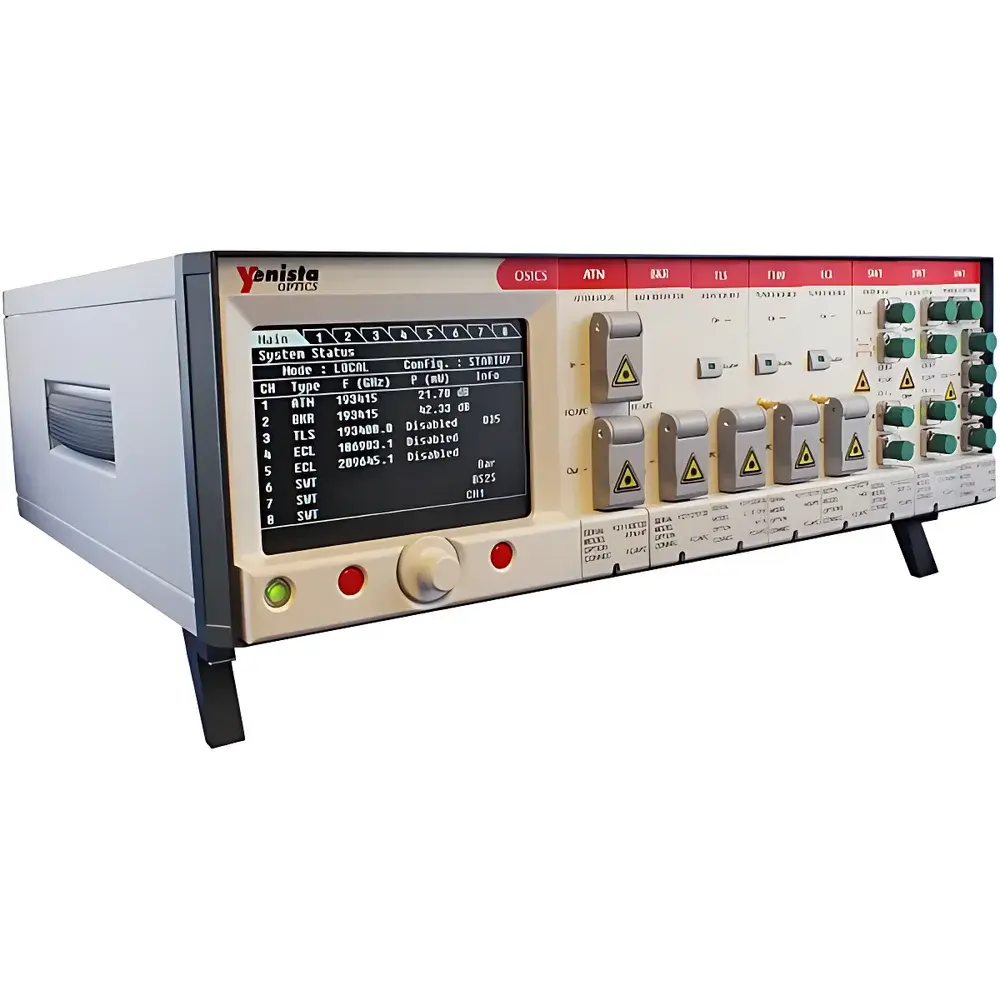
Yenista OSICS FBL Full-Band Tunable Laser Platform
| Brand | Yenista |
|---|---|
| Origin | France |
| Model | OSICS FBL |
| Wavelength Range | 1260–1680 nm |
| Output Power | ≥ 0 dBm (typ.) |
| Side-Mode Suppression Ratio (SMSR) | > 90 dB/0.1 nm |
| Architecture | Modular, integrated optical switch |
| Output | Single-fiber, polarization-maintaining (PM) or standard SMF optional |
| Compliance | CE, RoHS, IEC 61326-1 (EMC for laboratory equipment) |
Overview
The Yenista OSICS FBL (Full-Band Laser) is a high-precision, modular tunable laser platform engineered for broadband spectral coverage across the entire telecommunications optical window—from 1260 nm to 1680 nm. Based on Yenista’s proprietary T100 optical cavity architecture, the OSICS FBL eliminates broadband amplified spontaneous emission (ASE) and suppresses side modes to < −90 dB relative to the main lasing line within a 0.1 nm resolution bandwidth. This ultra-low spontaneous source emission (SSE) performance enables high-dynamic-range measurements essential for characterizing low-loss photonic devices, dense wavelength-division multiplexing (DWDM) components, and silicon photonics interfaces. Unlike conventional external-cavity lasers (ECLs), the OSICS FBL achieves continuous, mode-hop-free tuning across O-, E-, S-, C-, L-, and U-bands without mechanical reconfiguration—leveraging four synchronized T100 modules and an integrated high-reliability optical switch. Its single-fiber output interface ensures compatibility with automated test systems, optical wafer probers, and benchtop characterization setups used in R&D, manufacturing, and standards laboratories.
Key Features
- Full-band coverage from 1260 nm to 1680 nm in a single instrument—no manual module swapping or recalibration required.
- Ultra-low SSE: < −90 dB/0.1 nm, achieved via monolithic T100 cavity design; eliminates spectral contamination common in multi-laser combiners.
- Modular scalability: Initial deployment can include 1–4 T100 modules; additional modules may be added later without hardware replacement or firmware overhaul.
- Backward compatibility: Integrates seamlessly with legacy OSICS modules (e.g., T100-S, T100-L), preserving prior capital investment.
- Front-panel touchscreen interface with real-time status display of all active modules, wavelength lock state, power stability, and thermal feedback—reducing dependency on external PCs in lab environments.
- Output stability: < ±5 pm wavelength drift over 8 hours (23 ± 2 °C ambient); power repeatability < ±0.02 dB over 24 h at fixed setpoint.
- Robust mechanical design: Proven motion-chain architecture inherited from telecom-grade production testers—qualified for > 50,000 hours MTBF under continuous operation.
Sample Compatibility & Compliance
The OSICS FBL supports both polarization-maintaining (PM) and standard single-mode fiber (SMF-28) output configurations, enabling direct interfacing with integrated photonic circuits, arrayed waveguide gratings (AWGs), micro-ring resonators, and fiber Bragg grating (FBG) sensors. Its spectral purity meets the stringent requirements of ITU-T G.694.1 channel plan verification, IEEE 802.3ah PON component testing, and ISO/IEC 17025-accredited calibration labs. The system complies with IEC 61326-1 (EMC for laboratory equipment), CE marking directives, and RoHS 2011/65/EU. While not FDA 21 CFR Part 11–certified out-of-the-box, audit-ready logging capabilities—including timestamped wavelength/power records and user-access logs—are supported via optional Ethernet-based remote control protocols (SCPI over TCP/IP), facilitating GLP/GMP-aligned data integrity workflows.
Software & Data Management
The OSICS FBL operates natively via its embedded Linux-based controller and supports multiple control layers: local touchscreen, USB-C serial (VT100 terminal), Ethernet (TCP/IP + SCPI), and optional LabVIEW™, Python (PyVISA), and MATLAB® drivers. All firmware updates are signed and validated to prevent unauthorized modification. Measurement data—including swept-wavelength transmission spectra, power-vs.-wavelength traces, and module health metrics—are exportable in CSV, HDF5, and S2P formats. The system logs all parameter changes with UTC timestamps and operator IDs (when authenticated), supporting traceability per ISO/IEC 17025 Clause 7.7. Optional software packages enable automated pass/fail reporting against user-defined mask templates (e.g., IL ripple < 0.3 dB over C-band), batch processing of wafer-level test maps, and integration with enterprise MES platforms via RESTful API endpoints.
Applications
- Telecom Component Validation: High-accuracy insertion loss, polarization-dependent loss (PDL), and return loss measurements of isolators, circulators, and thin-film filters across full O-to-U bands.
- Silicon Photonics Characterization: On-wafer testing of Mach-Zehnder modulators, grating couplers, and directional couplers requiring sub-picometer wavelength resolution and ASE-free excitation.
- Gas Sensing & Spectroscopy: Wavelength-scanned absorption spectroscopy of methane (1650–1670 nm), ammonia (1510–1540 nm), and water vapor (1360–1410 nm) with calibrated scan rates up to 10 nm/s.
- Photonic Crystal & Metamaterial Analysis: Resonance mapping of defect modes and bandgap edges with dynamic range > 70 dB—enabled by suppression of background ASE floor.
- Research & Standards Metrology: Reference source for NIST-traceable spectral responsivity calibration of optical power meters and spectrometers.
FAQ
What wavelength accuracy and repeatability does the OSICS FBL achieve?
Wavelength accuracy is ±2.5 pm (calibrated against internal reference etalon), with 24-hour repeatability better than ±1 pm under stabilized thermal conditions.
Can the OSICS FBL be integrated into automated wafer probe stations?
Yes—via Ethernet SCPI commands and TTL-compatible trigger I/O; full support for SEMI E54 (GEM) protocol extensions is available upon request.
Is optical isolation included in the output path?
An integrated 30 dB optical isolator is standard on all PM-fiber variants; optional 40 dB isolators are available for high-reflection device testing.
Does the system support external wavelength locking to a gas cell or interferometer?
Yes—via analog voltage input (0–10 V) for closed-loop stabilization; digital lock-in capability is enabled through optional firmware upgrade.
How is calibration maintained over time?
The OSICS FBL performs automatic self-calibration every 24 hours using its internal Fabry–Pérot reference cavity; calibration certificates (traceable to LNE, France) are issued with each unit and annually renewable.




