
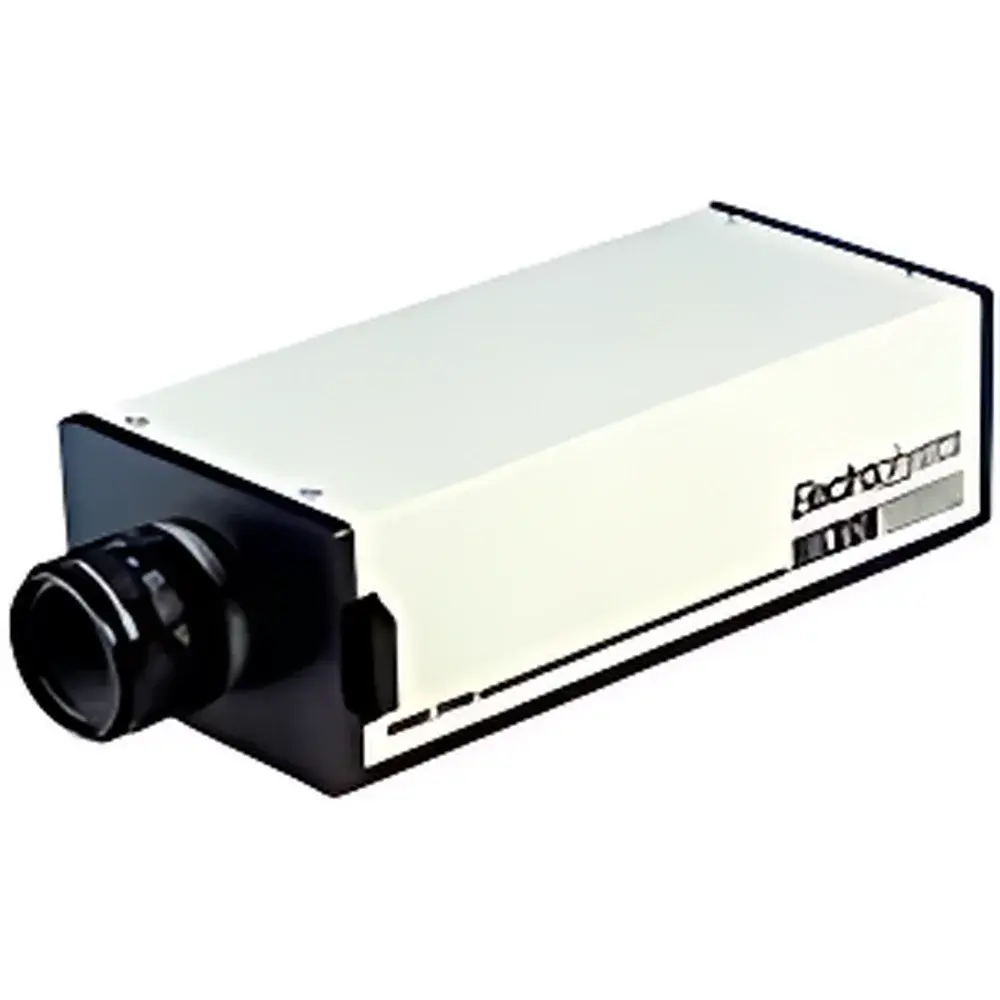
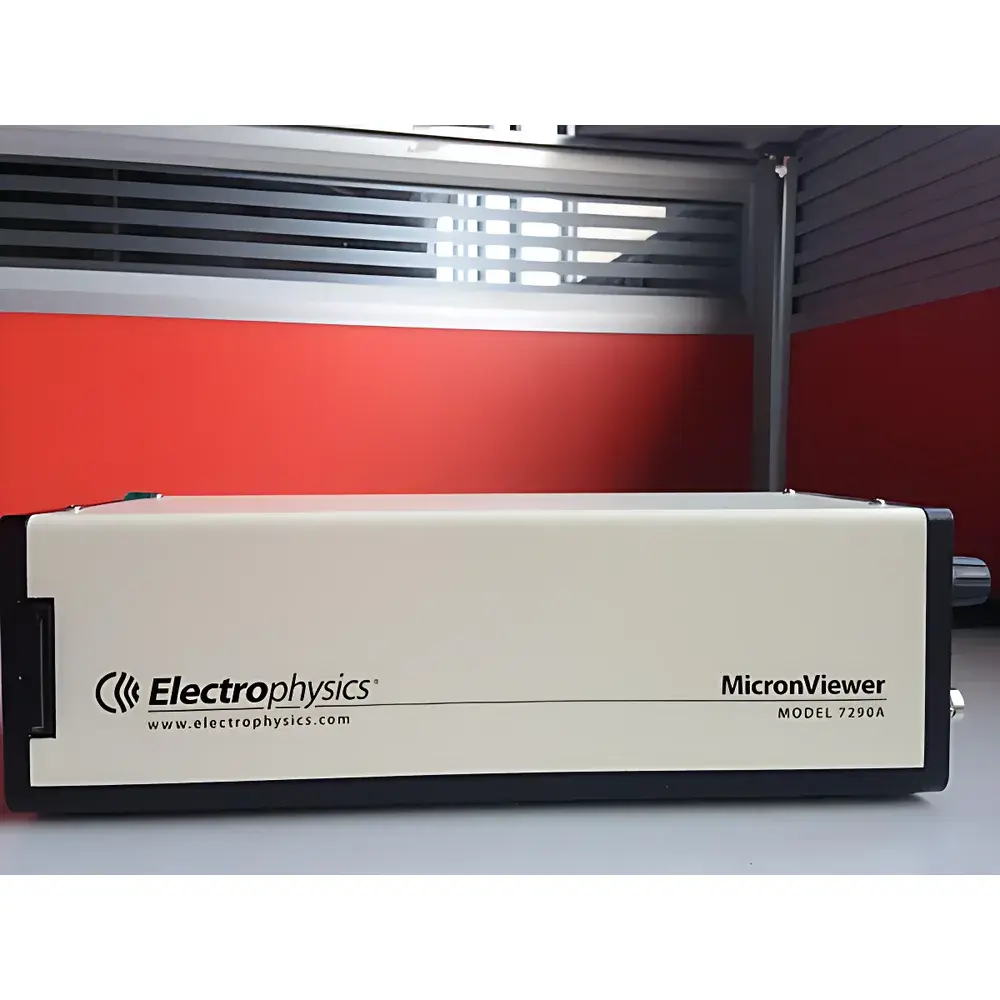
Electrophysics 7290A-E Uncooled Microbolometer Infrared Camera
| Brand | Electrophysics |
|---|---|
| Origin | USA |
| Model | 7290A-E |
| Detector Type | Uncooled Microbolometer |
| Spectral Range | 7–14 µm |
| Resolution | 640 × 480 pixels |
| Frame Rate | 30 Hz |
| Thermal Sensitivity (NETD) | ≤ 80 mK |
| Dynamic Range | 12 bits |
| Interface | USB 2.0 with Internal/External Sync Support |
| Dimensions (L×W×H) | 140 × 114 × 114 mm |
| Lens Mount | 2″–32 TPI Threaded |
| Compliance | RoHS, CE, FCC Class B |
Overview
The Electrophysics 7290A-E is a high-performance uncooled microbolometer infrared camera engineered for precision thermal imaging in industrial R&D, predictive maintenance, electronics inspection, and academic research environments. Operating in the long-wave infrared (LWIR) spectral band (7–14 µm), it leverages a thermally stable, vacuum-packaged vanadium oxide (VOx) microbolometer focal plane array (FPA) to deliver non-contact surface temperature mapping without cryogenic cooling. Its 640 × 480 pixel resolution provides spatial fidelity sufficient for identifying sub-millimeter thermal anomalies on PCBs, heat sinks, or composite materials, while the 30 Hz full-frame acquisition rate supports real-time dynamic thermal profiling of transient events—such as power cycling, thermal runaway in battery cells, or convective airflow patterns.
Key Features
- Uncooled VOx microbolometer detector with factory-calibrated radiometric output, eliminating operational downtime associated with Stirling coolers or liquid nitrogen systems.
- True 12-bit digital output enabling high-fidelity thermal contrast discrimination across wide dynamic ranges—critical for multi-zone thermal analysis in heterogeneous assemblies.
- USB 2.0 interface with integrated hardware-level synchronization (trigger-in/trigger-out), supporting time-aligned acquisition with external sensors (e.g., voltage probes, strain gauges) in multiphysics test benches.
- Modular lens system with standardized 2″–32 TPI threaded mount, compatible with industry-standard LWIR lenses (e.g., f/1.0, f/1.2, f/1.6) for field-of-view customization from macro-scale component inspection to wide-area surveillance.
- Ruggedized aluminum housing rated IP52 for dust resistance and limited moisture exposure; optimized thermal mass design minimizes self-heating drift during extended acquisitions (>30 min).
Sample Compatibility & Compliance
The 7290A-E is designed for non-destructive, emissivity-compensated surface temperature measurement across diverse material classes—including metals, ceramics, polymers, and printed circuit substrates—provided appropriate emissivity values (0.1–0.99) are configured in software. It meets electromagnetic compatibility requirements per FCC Part 15 Subpart B (Class B) and EU Directive 2014/30/EU (EMC Directive). RoHS 2011/65/EU compliance ensures restricted substance control in manufacturing. While not certified for intrinsically safe environments, its low-power USB bus operation (<2.5 W) and absence of active cooling reduce ignition risk in controlled laboratory settings. The device supports traceable calibration via NIST-traceable blackbody references (e.g., CI Systems CB-500 series), facilitating ISO/IEC 17025-compliant thermal measurement workflows.
Software & Data Management
Bundled with Electrophysics’ IRWorx™ software suite (v5.x), the 7290A-E enables real-time radiometric video streaming, region-of-interest (ROI) temperature statistics (min/max/mean/std dev), isotherm overlay, and emissivity correction maps. Data export formats include CSV (time-stamped pixel arrays), TIFF (16-bit radiometric), and AVI (lossless MJPEG-encoded thermal video). The SDK provides C/C++, .NET, and Python APIs for integration into custom QA/QC automation platforms. Audit trail functionality logs user actions, calibration timestamps, and configuration changes—supporting GLP/GMP-aligned documentation requirements under FDA 21 CFR Part 11 when deployed in regulated manufacturing environments.
Applications
- Electronics reliability testing: Detection of solder joint defects, current leakage paths, and thermal crosstalk in high-density IC packages.
- Materials science: Quantification of thermal diffusivity in thin films via lock-in thermography (requires external modulated illumination source).
- Mechanical engineering: Frictional heating analysis in bearing assemblies, gear meshing, and brake pad wear evaluation.
- Building diagnostics: Moisture intrusion detection behind façades and insulation integrity assessment per ASTM C1060 standards.
- Academic teaching labs: Visualization of Fourier’s law conduction, Stefan–Boltzmann radiation principles, and convective boundary layer development.
FAQ
Does the 7290A-E provide calibrated radiometric data out of the box?
Yes—each unit ships with individual detector response calibration coefficients embedded in firmware, enabling direct conversion of raw digital counts to absolute temperature (°C) when emissivity and ambient background parameters are specified.
Can it be synchronized with high-speed visible-light cameras?
Yes—via TTL-compatible trigger input/output lines, enabling frame-locked bimodal (IR + visible) capture for correlative thermal-optical analysis.
Is third-party lens compatibility guaranteed?
The 2″–32 TPI mechanical interface conforms to common LWIR lens mounting standards; however, optical performance (e.g., MTF, vignetting) must be verified per lens model using Electrophysics’ lens validation toolkit.
What is the typical measurement uncertainty under laboratory conditions?
±2 °C or ±2% of reading (whichever is greater) at 30 °C ambient, assuming proper focus, stable emissivity assignment, and use of a NIST-traceable reference source within ±5 °C of target temperature.
Is firmware update support available post-purchase?
Yes—Electrophysics provides quarterly firmware releases via secure customer portal access, including enhancements to noise reduction algorithms, USB enumeration stability, and SDK feature parity.




