
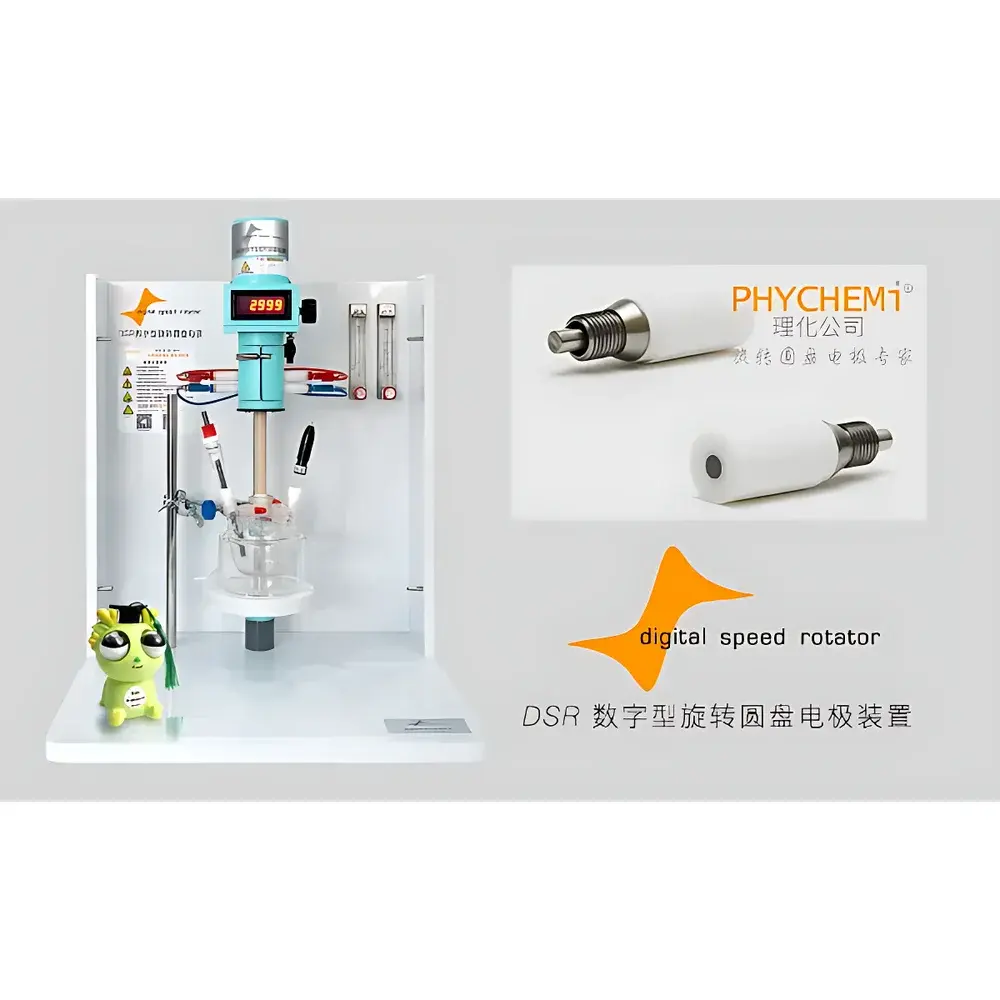
dc-energies DSR-M Rotating Disk Electrode (RDE) and Rotating Ring-Disk Electrode (RRDE) System
| Brand | dc-energies |
|---|---|
| Model | DSR-M |
| Type | Rotating Disk Electrode (RDE) and Rotating Ring-Disk Electrode (RRDE) Apparatus |
| Rotation Speed Range | 0–10,850 rpm |
| Motor Power | 20 W |
| Speed Control | Analog voltage input (0–10 V), LED digital display with manual knob adjustment |
| Contact Method | Silver-plated carbon brushes |
| Disk Electrode Material | Glassy carbon |
| Ring Electrode Material | Platinum |
| Disk Diameter | 5.61 mm |
| Ring Inner Diameter | 6.25 mm |
| Ring Outer Diameter | 7.92 mm |
| Gap Between Disk and Ring | ≤320 µm |
| Collection Efficiency | 37% |
| Rotating Shaft Length | 170 mm |
| Shaft Outer Diameter | 15 mm |
| Housing Material | Chemical-resistant polypropylene |
| Compliance | Designed for inert-atmosphere operation (glovebox-compatible), explosion-proof enclosure per IEC 60079-0 general requirements |
Overview
The dc-energies DSR-M Rotating Disk Electrode (RDE) and Rotating Ring-Disk Electrode (RRDE) System is an engineered electrochemical hydrodynamic measurement platform designed for quantitative kinetic and mechanistic studies under controlled mass transport conditions. Based on the Levich and Koutecký–Levich formalisms, the system enables precise determination of electron transfer kinetics, diffusion-controlled current densities, reaction intermediates, and catalyst selectivity—particularly in multi-step redox processes such as oxygen reduction (ORR), oxygen evolution (OER), hydrogen evolution (HER), and CO2 electroreduction (CO2RR). Its modular architecture supports both standalone operation and seamless integration with commercial potentiostats, including those compliant with ASTM E2759 and ISO 17475 standards for electrochemical sensor validation. The DSR-M operates via controlled laminar flow at the electrode surface, where rotation induces a well-defined convective-diffusive boundary layer—enabling reproducible current normalization and rigorous Tafel analysis.
Key Features
- High-precision rotational control: 0–10,850 rpm range with <1% speed deviation at 1 rpm (1 mV/rpm default scaling); analog voltage input (0–10 V) enables dynamic waveform-synchronized speed modulation (sine, square, ramp)
- Low-noise electrical interface: Silver-plated carbon brushes ensure contact resistance <50 mΩ and minimal current signal distortion—critical for low-current (<10 nA) detection in kinetic studies
- Glovebox-ready modular design: Detachable controller and rotating shaft (170 mm length, 15 mm OD, internal thread) facilitate inert-atmosphere installation and electrolyte compatibility with non-aqueous systems (e.g., Li–O2, Na–CO2)
- Explosion-proof housing: Conforms to IEC 60079-0 general safety principles for use with flammable solvents or reactive gas environments (e.g., H2, O2, CO)
- Interchangeable electrode assemblies: U-CUP–compatible disk holder allows rapid replacement of disk materials (glassy carbon, Pt, Au, Ni, etc.) and custom ring configurations; reduces consumable cost and expands applicability across catalytic material screening
- Dual-output signaling: Real-time tachometer voltage output (0–10 V) for external synchronization with oscilloscopes or data acquisition systems; supports GLP-compliant timestamped rotational metadata logging
Sample Compatibility & Compliance
The DSR-M accommodates standard three-electrode electrochemical cells with diameters up to 50 mm and heights ≥80 mm. Its polypropylene base resists corrosion from strong acids (e.g., 6 M H2SO4), alkalis (e.g., 1 M KOH), and organic electrolytes (e.g., 0.1 M TBAPF6 in acetonitrile). Disk and ring geometries meet ASTM D1141–22 specifications for electrode dimensional tolerance (±0.01 mm), ensuring consistent collection efficiency (N = 37%) and validated Levich slope linearity (R² > 0.999 over 100–5,000 rpm). The system supports FDA 21 CFR Part 11–compliant workflows when paired with audit-trail-enabled potentiostat software (e.g., BioLogic EC-Lab, Pine AfterMath), enabling traceable calibration records, user access logs, and electronic signatures for regulated battery R&D.
Software & Data Management
While the DSR-M operates independently via its front-panel controller, full bidirectional integration is supported through analog I/O ports compatible with third-party electrochemical workstations. Rotation speed can be modulated in real time using external TTL or analog signals—enabling synchronized chronoamperometric sweeps, rotating ring-disk voltammetry (RRDV) protocols, and hydrodynamic impedance spectroscopy. When used with compliant software platforms, raw tachometer outputs are time-stamped and archived alongside current/potential data, satisfying GLP/GMP documentation requirements for catalyst qualification reports. Calibration certificates—including speed verification against NIST-traceable optical tachometers—are provided with each unit shipment.
Applications
- Quantitative ORR mechanism analysis: Discrimination between 2e⁻ vs. 4e⁻ pathways via ring current integration and H2O2 yield calculation
- Fuel cell catalyst evaluation: Accelerated stress testing (AST) under rotating conditions per DOE Hydrogen Program guidelines
- Electrocatalyst stability assessment: In situ monitoring of activity decay during prolonged potential holds at fixed rotation rates
- Corrosion science: Determination of limiting diffusion currents for inhibitor adsorption modeling (ASTM G102)
- CO2RR product distribution mapping: Coupling RRDE detection with online GC/MS for C1–C2 speciation
- Electrodeposition kinetics: Mass-transport-corrected nucleation overpotential analysis in metal plating baths
FAQ
What is the certified collection efficiency of the DSR-M RRDE assembly?
The nominal collection efficiency is 37%, verified via K3[Fe(CN)6] oxidation/reduction calibration in 1 M KNO3 at 1,600 rpm per ASTM E2759 Annex A2.
Can the DSR-M be operated inside an argon-filled glovebox?
Yes—the fully detachable controller, low-outgassing polypropylene housing, and sealed brush assembly enable safe operation in O2/H2O < 0.1 ppm environments.
Is firmware or driver software required for computer control?
No—rotation is controlled solely via analog voltage (0–10 V); no USB, Ethernet, or proprietary drivers are needed.
What electrode materials are available as factory-installed options?
Standard configurations include glassy carbon disk + platinum ring; optional disks: Pt, Au, Ni, Cu, and boron-doped diamond (BDD); custom ring materials (e.g., Ag, IrOx) available upon request.
Does the system include calibration documentation?
Each unit ships with a factory calibration report detailing speed linearity (0–10,850 rpm), brush contact resistance, and mechanical runout (<5 µm at 10,000 rpm), traceable to internal metrology standards.




