
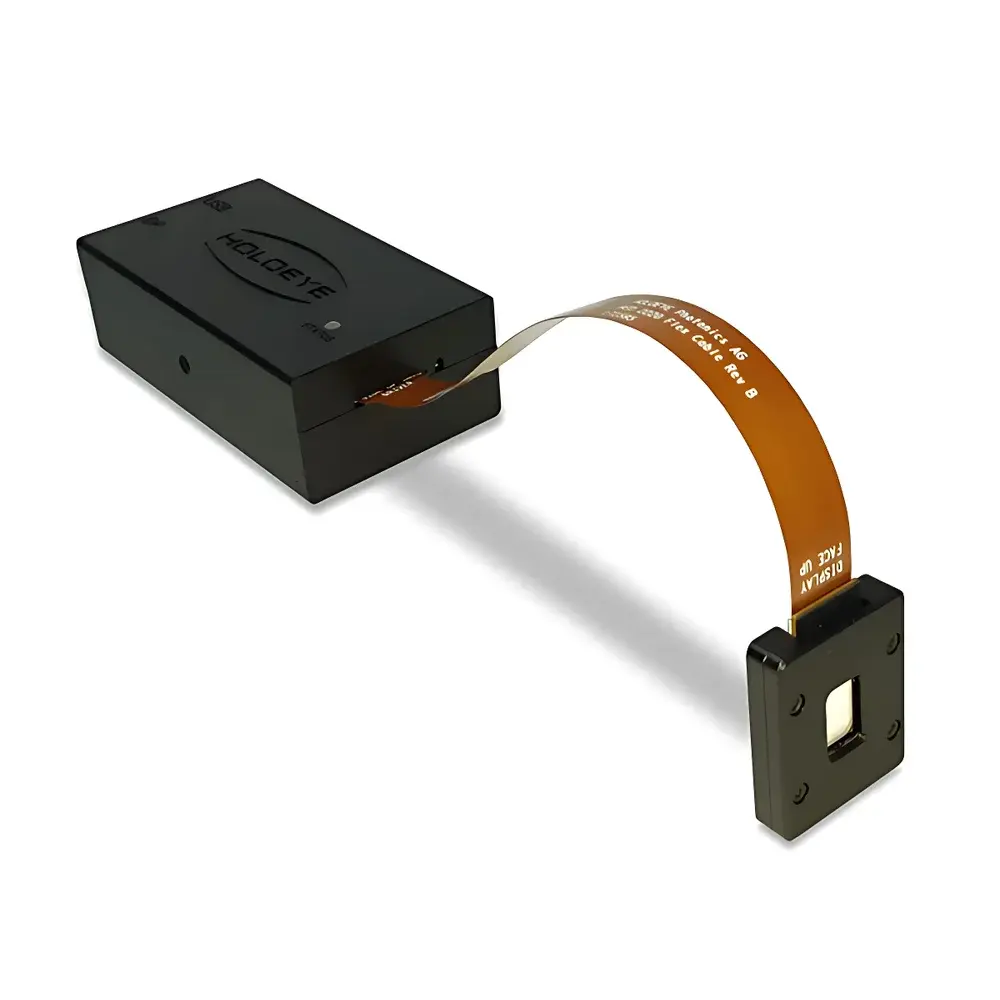
HOLOEYE LUNA+DPE+RGB Integrated Color-Sequential Holographic Light Field System
| Brand | HOLOEYE |
|---|---|
| Origin | Germany |
| Model | LUNA+DPE+RGB |
| Liquid Crystal Type | Reflective Silicon-Based Liquid Crystal on Silicon (LCoS) |
| Resolution | 1920 × 1080 pixels |
| Pixel Pitch | 4.5 µm |
| Fill Factor | >91% |
| Maximum Spatial Resolution | 111 lp/mm |
| Addressing Depth | 8-bit |
| Signal Interface | DisplayPort (DP) |
| Input Frame Rate | 60 Hz |
| Active LC Area | 8.64 × 4.86 mm |
| Driver Electronics Dimensions | 44 × 85 × 23.5 mm |
| Response Time | ~20 ms |
| System Architecture | Integrated Diffractive Projection Engine (DPE) + RGB Multi-Wavelength Laser Source |
| Compliance | CE-marked, RoHS-compliant, ISO 9001-manufactured components |
Overview
The HOLOEYE LUNA+DPE+RGB is a fully integrated, color-sequential holographic light field system engineered for high-fidelity spatial light modulation outside traditional optical benches. Unlike conventional SLM-based setups requiring manual alignment of lasers, beam expanders, and relay optics, the LUNA platform embeds a diffractive projection engine (DPE), reflective silicon-based liquid crystal on silicon (LCoS) microdisplay, and FISBA multi-wavelength laser source into a single mechanically stable enclosure. Its core operational principle relies on phase-only modulation via a high-fill-factor reflective LCoS panel, enabling precise wavefront shaping across red, green, and blue wavelengths in rapid sequence—supporting full-color holographic reconstruction with minimal temporal crosstalk. Designed explicitly for deployment beyond research laboratories, the system meets stringent requirements for thermal stability, mechanical robustness, and electromagnetic compatibility (EMC), making it suitable for integration into industrial inspection stations, automotive HUD calibration rigs, and compact AR/VR optical engines.
Key Features
- Monolithic integration of DPE, LCoS modulator, and RGB laser source—eliminates free-space optical alignment and reduces sensitivity to vibration and thermal drift
- Reflective LCoS panel with 1920 × 1080 resolution, 4.5 µm pixel pitch, and >91% fill factor—enabling high diffraction efficiency and low zero-order leakage
- Sub-20 ms pixel response time—supports high-frame-rate holographic rendering and dynamic structured illumination protocols
- DisplayPort 1.2 interface with native 60 Hz input frame rate—ensures deterministic timing for synchronized color-sequential operation
- Compact driver electronics (44 × 85 × 23.5 mm) with embedded FPGA-based timing controller—facilitates OEM integration into space-constrained enclosures
- Phase modulation depth calibrated to λ/20 RMS over visible spectrum (450–650 nm)—validated per ISO 10110-5 surface form specifications
Sample Compatibility & Compliance
The LUNA+DPE+RGB operates with standard DP-compatible graphics sources and supports common hologram encoding formats including Gerchberg-Saxton, direct binary search, and deep-learning-generated complex amplitude maps. It is compatible with industry-standard optical materials (e.g., BK7, fused silica, and polymer-based waveguides) used in HUD combiners and AR eyepiece assemblies. All subsystems comply with CE Directive 2014/30/EU (EMC), 2011/65/EU (RoHS), and IEC 60825-1:2014 (laser safety Class 3R). The LCoS panel is manufactured under ISO 9001-certified processes; its thermal coefficient of phase response (<0.005 rad/°C) has been characterized per ASTM E2847 for stability validation in ambient temperature ranges from 15 °C to 35 °C.
Software & Data Management
HOLOEYE provides the LunaControl SDK (Windows/Linux, C/C++/Python bindings) for low-level phase map loading, gamma correction, and real-time DPE synchronization. The SDK supports audit-trail logging compliant with GLP/GMP documentation workflows and includes optional FDA 21 CFR Part 11–ready modules for electronic signatures and user-access control. Phase patterns can be loaded directly from .bin or .tif files with metadata embedding (wavelength, polarization state, target diffraction order). Integration with MATLAB, Python (NumPy/SciPy), and Zemax OpticStudio is validated through official API wrappers. Firmware updates are delivered via signed .hex packages with SHA-256 checksum verification.
Applications
- Automotive head-up display (HUD) development—generating dynamic virtual image planes with adjustable eyebox and focus cues
- AR/VR near-eye display prototyping—enabling pupil-tracking–adaptive holographic wavefront generation
- Structured light 3D metrology—projecting high-contrast, speckle-free fringe patterns for sub-micron surface profiling
- Holographic optical trapping—spatially resolving multiple optical tweezers in aqueous media with programmable trap geometry
- Biomedical imaging—supporting computational adaptive optics and multi-plane fluorescence sectioning via synthetic aperture synthesis
- Education and training platforms—providing turnkey access to Fourier optics, diffraction theory, and holography fundamentals without alignment overhead
FAQ
Is the LUNA+DPE+RGB compatible with third-party hologram generation software?
Yes—via the LunaControl SDK, users can integrate custom algorithms written in Python or C++, including those exported from commercial tools such as MATLAB’s Holography Toolbox or Synopsys VirtualLab Fusion.
What laser safety class applies to the integrated RGB source?
The FISBA laser module is certified Class 3R per IEC 60825-1:2014; nominal output powers are ≤5 mW per wavelength at the system exit port.
Can the system operate in continuous-wave (CW) mode for monochromatic applications?
Yes—user-selectable color sequencing modes include RGB sequential, single-wavelength lock, and pseudo-white simultaneous emission using time-multiplexed drive.
Does the driver electronics support external trigger synchronization?
Yes—the DP interface includes dedicated GPIO lines for TTL-compatible frame sync, shutter control, and camera trigger output.
Is calibration data provided for phase-to-voltage response?
Each unit ships with factory-measured LUTs (Look-Up Tables) for R/G/B channels, traceable to NIST-traceable interferometric phase measurement standards.




