
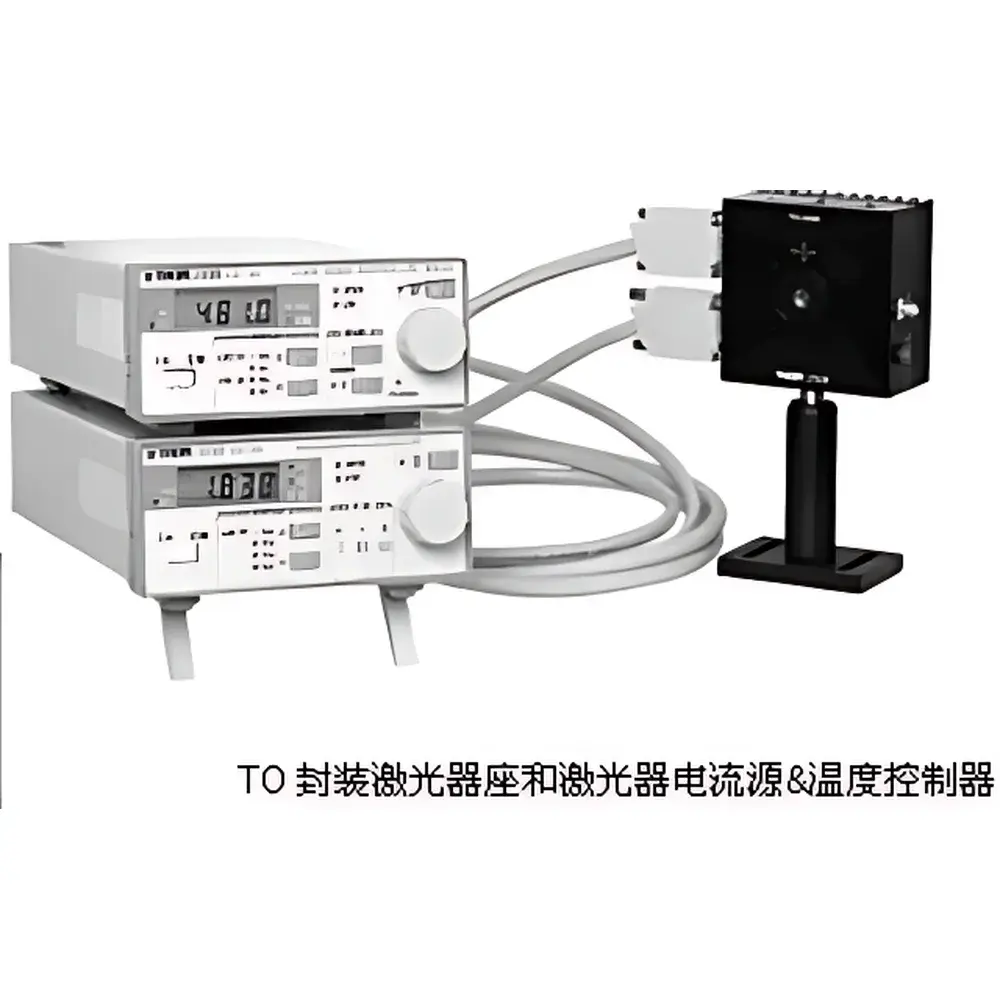
Thorlabs LDC200CV–LDC3065-488 Series Laser Diode Current Sources and TED Temperature Controllers
| Origin | USA |
|---|---|
| Manufacturer Type | Authorized Distributor |
| Origin Category | Imported |
| Model | 115 |
| Pricing | Available Upon Request |
| Current Ranges | 0–20 mA to 0–65 A |
| Current Resolution | 1 µA to 10 mA |
| Current Accuracy | ±20 µA to ±100 mA |
| Compliance Voltage | >2.5 V to >6 V |
| Control Modes | Constant Current (CC), PID Temperature Feedback |
| Protection Features | Soft Start, Open-Circuit Detection, Short-Circuit Cutoff, Laser Current Limiting, Overtemperature Shutdown, Internal Interlock |
Overview
The Thorlabs LDC200CV–LDC3065-488 Series comprises a family of precision laser diode current sources and thermoelectric cooler (TEC) temperature controllers engineered for stable, low-noise operation of semiconductor lasers in research, industrial metrology, and photonics development environments. These instruments operate on the fundamental principle of regulated constant-current sourcing for laser diode biasing—ensuring minimal current ripple (<10 µA RMS typical) and high long-term stability (<±0.01% per hour)—while integrating closed-loop PID-controlled TEC drivers to maintain laser junction temperature within ±0.01 °C under dynamic thermal loads. Designed for compatibility with a broad spectrum of edge-emitting laser diodes, distributed feedback (DFB) lasers, and quantum cascade lasers (QCLs), the series supports applications demanding stringent wavelength stability, mode-hop-free tuning, and reproducible optical power output—critical for interferometry, spectroscopy, optical coherence tomography (OCT), and quantum optics experiments.
Key Features
- Multi-range current sourcing architecture: Models span 0–20 mA (LDC200CV) to 0–65 A (LDC3065-488), enabling selection matched to laser threshold and operating currents without over-specification.
- High-resolution digital control: Current resolution from 1 µA (microampere-grade models) to 10 mA (high-power variants), supporting fine-tuning of lasing threshold and output power calibration.
- Low-noise analog current regulation: Optimized feedback topology minimizes broadband current noise, critical for reducing relative intensity noise (RIN) in sensitive detection schemes.
- Integrated dual-channel functionality: Select models (e.g., LDC340, LDC3065-488) support independent or synchronized control of laser current and TEC current, eliminating external synchronization overhead.
- Comprehensive hardware protection suite: Soft-start sequencing prevents inrush-induced facet damage; open-circuit and short-circuit detection triggers immediate current disablement; programmable laser current limits enforce safe operating area (SOA) compliance; overtemperature shutdown responds to TEC or heatsink thermal runaway.
- Front-panel and remote interface flexibility: Standard RS-232, USB, and analog voltage input (0–5 V or 0–10 V) for external modulation; compatible with Thorlabs’ Kinesis® and APT™ software platforms for automated test sequences.
Sample Compatibility & Compliance
The LDC/TED platform is designed for direct integration with Thorlabs’ modular laser mounting ecosystem—including kinematic laser diode mounts (e.g., LDM9LP, TCLDM9), butterfly-packaged laser carriers, and fiber-pigtailed modules. All units comply with IEC 61000-6-3 (EMI emission) and IEC 61000-6-2 (immunity) standards. Firmware implements non-volatile parameter storage with write-protection options, supporting audit-ready configuration management under GLP/GMP frameworks. While not FDA-cleared as medical devices, the LDC series meets essential electrical safety requirements per UL 61010-1 and EN 61010-1 for laboratory instrumentation. Traceable calibration documentation is available upon request for ISO/IEC 17025-accredited laboratories.
Software & Data Management
Thorlabs’ Kinesis® software provides full graphical configuration of current setpoints, PID temperature parameters (P/I/D gains, integral windup limits), ramp rates, and protection thresholds. Real-time monitoring includes dual-channel oscilloscope-style plotting (laser current vs. time, TEC current vs. time), data logging at up to 1 kHz sampling rate (CSV export), and script-based automation via .NET API or Python bindings (thorlabs_kinesis package). Audit trail functionality records all parameter changes with timestamp, user ID (when authenticated), and pre-/post-value states—supporting 21 CFR Part 11 compliance when deployed with validated system configurations and electronic signature workflows.
Applications
- Stabilized seed laser operation in fiber amplifier chains and MOPA systems
- Temperature- and current-tuned wavelength scanning for absorption spectroscopy (TDLAS, QCL-based gas sensing)
- Low-noise pump source control in ultrafast optical parametric oscillators (OPOs)
- Calibration-grade current sourcing for photodiode responsivity characterization
- Long-duration reliability testing of laser diodes under accelerated thermal stress
- Integration into OEM photonic subsystems requiring compact, rack-mountable, or benchtop current/temperature co-control
FAQ
Can the LDC series drive pulsed laser diodes?
No—these are DC current sources optimized for continuous-wave (CW) operation. Pulsed drivers require specialized fast-switching architectures not present in this series.
Is remote interlock functionality supported?
Yes—models feature a hardware interlock input (3.3 V TTL-compatible) that disables output immediately upon signal loss, satisfying laser safety Class 3B/4 enclosure requirements per IEC 60825-1.
What is the maximum allowable thermal load for TED-series controllers?
Maximum heat pumping capacity depends on model-specific TEC current/voltage ratings and ambient conditions; consult individual datasheets for Qmax curves versus ΔT.
Are factory calibrations NIST-traceable?
Standard units ship with internal calibration coefficients; NIST-traceable calibration certificates with uncertainty budgets are available as an optional service.
Can multiple LDC units be synchronized for multi-laser arrays?
Yes—using external trigger inputs and shared clock signals via BNC connectors, precise timing alignment (sub-microsecond jitter) is achievable across up to 8 units in a master-slave configuration.





