
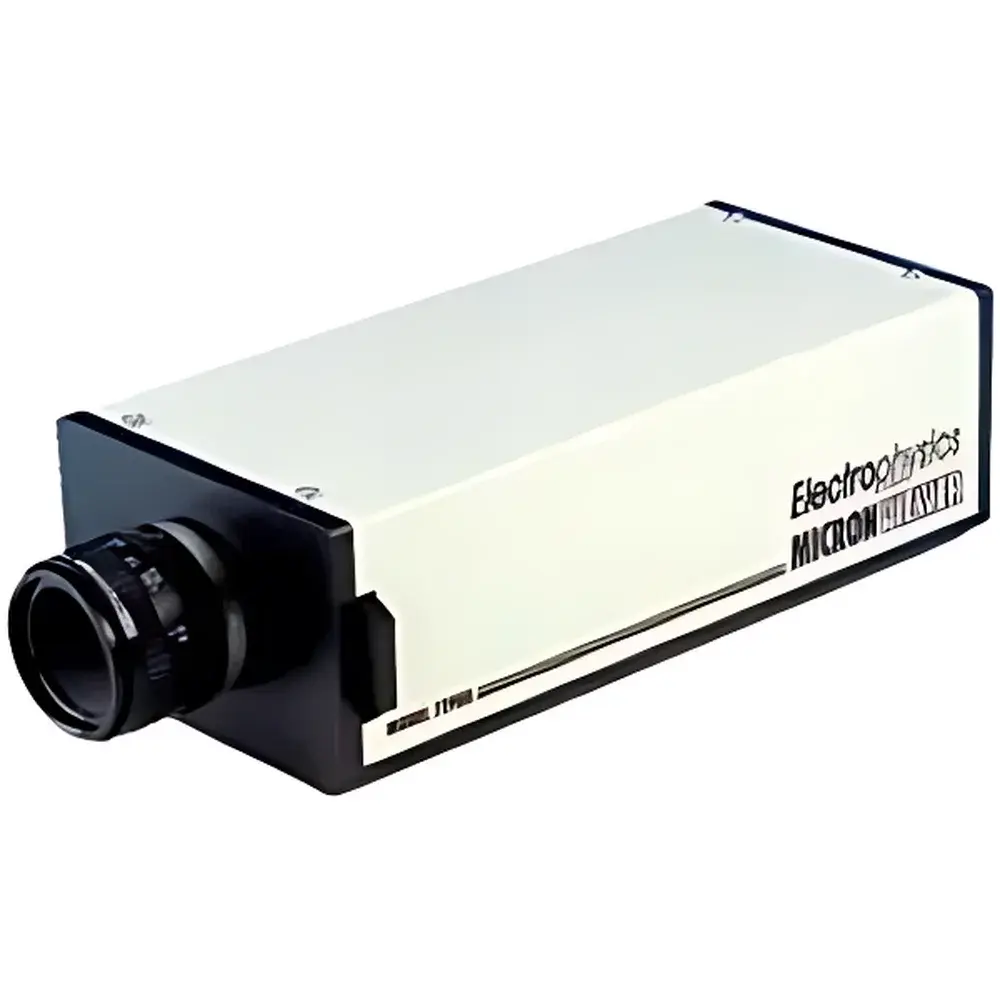
Electrophysics MicronViewer 7290 Near-Infrared Intensified Camera
| Brand | Electrophysics |
|---|---|
| Origin | USA |
| Model | FLIR3 |
| Spectral Range | 0.4–1.9 μm (2.2 μm optional) |
| Sensor Type | Lead Oxysulfide (PbS) Vidicon Tube |
| Active Area | 9.5 × 12.7 mm |
| Interface | C-mount lens mount |
| Filter Holder | 1-inch threaded |
| Gain Control | 3-step manual or auto |
| Video Output | RS-170 (60 Hz) / CCIR (50 Hz) |
| Sync Input | Composite sync coupling |
| Mounting | Standard 1/4"-20 tripod thread |
| Compliance | RoHS-compliant design |
Overview
The Electrophysics MicronViewer 7290 is a high-sensitivity, near-infrared (NIR) intensified camera engineered for low-light imaging applications where conventional silicon-based CCD or CMOS sensors lack sufficient quantum efficiency beyond 1.0 μm. Unlike cooled InSb or MCT focal plane arrays, this system employs a thermoelectrically stabilized lead oxysulfide (PbS) vidicon tube — a mature, robust photoconductive imaging detector with intrinsic responsivity extending from visible (400 nm) through short-wave infrared (SWIR) up to 1.9 μm (with optional 2.2 μm extended response). Its analog video architecture delivers real-time, noise-optimized imaging without digitization latency, making it particularly suitable for dynamic optical alignment, laser beam profiling, semiconductor wafer inspection, and fiber-optic component characterization. The compact, modular housing enables seamless integration into OEM instrumentation, vacuum-compatible optical benches, or portable field-deployable test setups.
Key Features
- Extended spectral sensitivity from 400 nm to 1900 nm (2200 nm optional), optimized for NIR/SWIR photon detection where silicon detectors fall short
- High-resolution PbS vidicon tube with 9.5 × 12.7 mm active imaging area and inherent analog gain linearity
- C-mount lens interface compatible with industry-standard optics, supporting both fixed-focal and zoom NIR lenses
- Dedicated 1-inch threaded filter holder enabling rapid insertion of bandpass, longpass, or neutral density filters without mechanical realignment
- Three-position manual gain switch plus automatic gain control (AGC) mode for adaptive exposure in variable illumination environments
- Standard analog video output conforming to RS-170 (NTSC, 60 Hz) or CCIR (PAL, 50 Hz) broadcast specifications — fully compatible with frame grabbers, oscilloscopes, and legacy lab monitors
- Composite sync input for external triggering and multi-camera synchronization in time-resolved optical experiments
- Robust aluminum chassis with 1/4″-20 tripod thread and standardized mounting holes for rigid optical table integration
Sample Compatibility & Compliance
The MicronViewer 7290 is designed for non-contact, non-destructive imaging of optically emissive or reflective samples emitting or reflecting within its operational spectral window. It supports qualitative and semi-quantitative analysis of laser diodes (780–1550 nm), VCSEL arrays, LED phosphor decay, photovoltaic cell defects, and IR-transparent materials (e.g., Si, Ge, CaF₂, ZnSe). No sample preparation is required; operation is compatible with ambient, darkroom, or nitrogen-purged enclosures. The device complies with RoHS Directive 2011/65/EU for hazardous substance restrictions and meets IEC 61000-6-3 emission standards for industrial electromagnetic compatibility. While not certified for medical or aerospace-grade qualification, its analog signal chain and traceable calibration path support GLP-aligned documentation workflows when paired with NIST-traceable reference sources.
Software & Data Management
As an analog-output camera, the MicronViewer 7290 does not include embedded firmware or proprietary drivers. Video signals are acquired via standard frame grabbers compliant with IEEE 1394, USB3 Vision, or CoaXPress interfaces. Integration with third-party platforms — including MATLAB Image Acquisition Toolbox, LabVIEW IMAQ, HALCON, or Python-based OpenCV pipelines — is straightforward using supported video capture APIs. Timestamped frame logging, region-of-interest (ROI) intensity averaging, and real-time histogram generation are achievable through host-side software. For regulated environments requiring audit trails, the analog nature eliminates concerns related to FDA 21 CFR Part 11 electronic signature compliance — raw video streams may be archived in uncompressed AVI or TIFF sequence formats with metadata embedded per ISO/IEC 11172-2 (MPEG-1) or SMPTE ST 296-2008 conventions.
Applications
- Laser beam profiling and alignment verification for 808 nm, 980 nm, 1064 nm, and 1550 nm sources
- Non-destructive testing (NDT) of silicon wafers and compound semiconductors under NIR illumination
- Characterization of optical coatings, anti-reflective films, and IR filter transmission uniformity
- Thermal emission mapping of low-temperature (<200°C) objects via blackbody radiation in SWIR
- Fluorescence lifetime imaging (FLIM) support in conjunction with gated intensifiers and pulsed excitation sources
- Educational demonstration of NIR optics principles, including chromatic aberration correction and lens transmission limits
FAQ
Is the MicronViewer 7290 compatible with modern USB or GigE Vision frame grabbers?
Yes — provided the frame grabber accepts composite analog video input (RS-170/CCIR) and supports genlock or external trigger synchronization.
Does the camera require liquid nitrogen or thermoelectric cooling?
No — the PbS vidicon operates at ambient temperature with integrated thermal stabilization; no cryogenic or Peltier cooling is necessary.
Can I use standard visible-light lenses with this camera?
C-mount lenses designed for visible light will transmit partially in NIR but may exhibit focus shift and reduced contrast; NIR-optimized lenses are recommended for critical resolution applications.
What is the typical modulation transfer function (MTF) performance?
Measured MTF exceeds 30% at 20 lp/mm under 1064 nm illumination with matched optics; exact values depend on lens quality and gain setting.
Is factory recalibration available?
Electrophysics offers periodic radiometric recalibration services traceable to NIST standards, including responsivity mapping across the full spectral range.




