
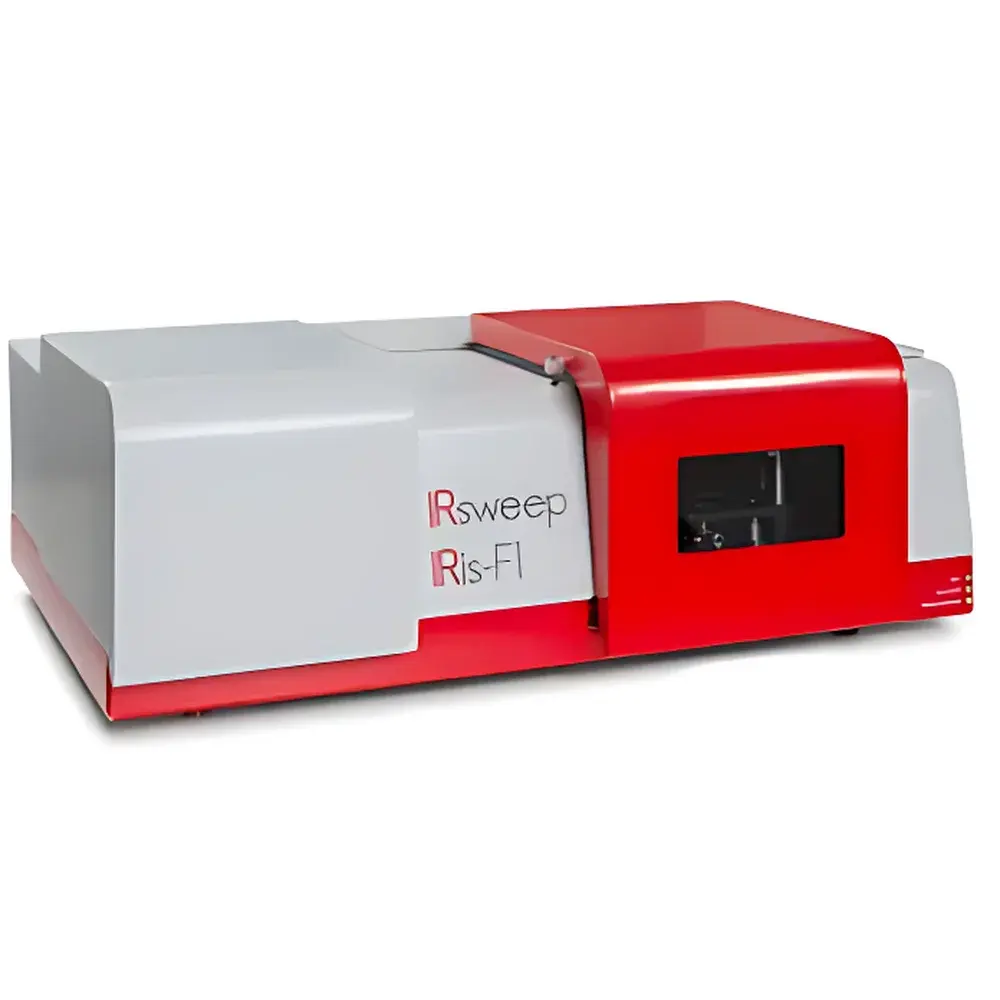
IRsweep IRis-F1 Microsecond-Resolution Ultra-Sensitive Dual-Comb Infrared Spectrometer
| Brand | Spectrolight |
|---|---|
| Origin | Switzerland |
| Model | IRsweep IRis-F1 |
| Instrument Type | Laboratory Benchtop Laser-Based Infrared Spectrometer |
| Light Source Technology | Dual Quantum Cascade Laser (QCL) Frequency Comb |
| Time Resolution | 1 µs |
| Spectral Resolution | 0.25–0.5 cm⁻¹ |
| Spectral Range | Mid-Infrared (Typical 1,200–3,000 cm⁻¹, configurable) |
| Compliance | CE, RoHS, ISO 9001-certified manufacturing |
| Software Environment | IRsweep Control Suite v4.x (Windows-based, FDA 21 CFR Part 11-ready audit trail option) |
Overview
The IRsweep IRis-F1 is a laboratory-grade dual-comb infrared spectrometer engineered for microsecond-scale time-resolved spectroscopy in the mid-infrared (MIR) region. Unlike conventional Fourier-transform infrared (FTIR) or dispersive spectrometers—whose acquisition times are constrained by mechanical scanning or detector integration limits—the IRis-F1 leverages two actively stabilized quantum cascade laser (QCL) frequency combs to enable asynchronous optical sampling (ASOPS). This architecture eliminates moving parts and replaces interferometric delay scanning with rapid electronic timing control, enabling full broadband spectral acquisition in as little as 1 µs per spectrum. The instrument delivers simultaneous high temporal resolution (1 µs), high spectral resolution (0.25–0.5 cm⁻¹), and broad spectral coverage (typically spanning 1,200–3,000 cm⁻¹), making it uniquely suited for capturing transient molecular vibrational signatures during ultrafast chemical transformations, photoinduced reactions, or biological conformational changes.
Key Features
- Microsecond time resolution: Full interferogram acquisition and spectral reconstruction in ≤1 µs—enabling real-time observation of reaction intermediates and short-lived species.
- Dual QCL frequency comb architecture: Two mutually coherent, electronically tunable mid-IR combs provide high spectral brightness (>10 mW average power per comb), intrinsic wavelength calibration, and immunity to environmental drift.
- High signal-to-noise ratio (SNR): Achieves >10,000:1 SNR (rms, 1000 scans) in standard configuration due to coherent detection and shot-noise-limited photoreceiver design.
- Robust optical alignment: Monolithic beam path with fiber-coupled input/output interfaces minimizes sensitivity to vibration and thermal perturbation—critical for long-term stability in shared lab environments.
- Modular integration capability: Designed for seamless coupling with external sample chambers, flow cells, cryostats, or pump-probe laser systems via standardized SMF-28 or hollow-core fiber interfaces.
- Lab-grade form factor: Compact benchtop footprint (450 × 400 × 180 mm) with integrated temperature-stabilized electronics and passive cooling—no liquid nitrogen or chiller required.
Sample Compatibility & Compliance
The IRis-F1 supports transmission, reflection, and attenuated total reflection (ATR) measurements across solid, liquid, and gas-phase samples. Its high brightness and low noise floor facilitate trace-level analysis—detection limits reach sub-ppb for targeted gas-phase analytes (e.g., CO, NO, CH₄) when paired with the optional IRcell long-path multipass cell. All firmware and control software comply with GLP/GMP documentation requirements; optional 21 CFR Part 11 compliance package includes electronic signature support, user role management, and immutable audit trails for raw data acquisition metadata. The system conforms to IEC 61000-6-3 (EMC emission) and IEC 61000-6-2 (immunity), and is CE-marked per Directive 2014/30/EU (EMC) and 2014/35/EU (LVD).
Software & Data Management
The IRsweep Control Suite provides a native Windows application for instrument control, real-time spectral visualization, and batch processing. Core capabilities include: live time-series spectral stacking, kinetic trace extraction at user-defined wavenumbers, automated baseline correction using asymmetric least squares (AsLS), and export of calibrated absorbance/intensity data in HDF5, CSV, and JCAMP-DX formats. Raw interferograms are stored with full metadata (timestamp, laser current, cavity temperature, trigger source). For regulated environments, the optional Compliance Edition adds electronic signature workflows, change control logs, and IQ/OQ documentation templates aligned with ASTM E2500 and ISO/IEC 17025 guidelines.
Applications
- Ultrafast reaction kinetics: Monitoring bond cleavage, isomerization, or proton transfer in catalytic cycles with µs temporal fidelity.
- Photochemical dynamics: Resolving vibrational relaxation pathways following pulsed laser excitation in photocatalysts or photoswitches.
- Biological transient spectroscopy: Capturing early folding events in proteins or ligand-binding kinetics in membrane receptors.
- Process analytical technology (PAT): Real-time monitoring of gas-phase composition in semiconductor etch chambers or pharmaceutical fluidized-bed dryers.
- Trace gas sensing: Quantitative detection of isotopic species (e.g., ¹³CO₂, NH₃ isotopologues) in breath analysis or atmospheric simulation chambers.
- Method development for USP , EP 2.2.42, and ISO 14687-2 compliant MIR spectroscopy protocols.
FAQ
What spectral range does the IRis-F1 cover?
The standard configuration operates between 1,200 cm⁻¹ and 3,000 cm⁻¹ (3.3–8.3 µm), with custom modules available for extended ranges down to 600 cm⁻¹ or up to 4,000 cm⁻¹ upon request.
Is external triggering supported?
Yes—the instrument features TTL-compatible trigger inputs for synchronization with external lasers, mass spectrometers, or fast-switching sample actuators.
Can the IRis-F1 be integrated into vacuum or controlled-atmosphere systems?
Absolutely. It supports vacuum-compatible optical feedthroughs (CF35/KF25) and offers purge-compatible front panels for operation under N₂ or dry air environments.
Does the system require cryogenic cooling?
No—all detectors and lasers are thermoelectrically cooled; no LN₂ or mechanical cryocoolers are needed.
How is spectral calibration maintained over time?
Each frequency comb provides intrinsic absolute wavelength calibration via its repetition rate and carrier-envelope offset frequency—traceable to primary RF standards—eliminating the need for periodic recalibration with reference gases or polystyrene films.





