
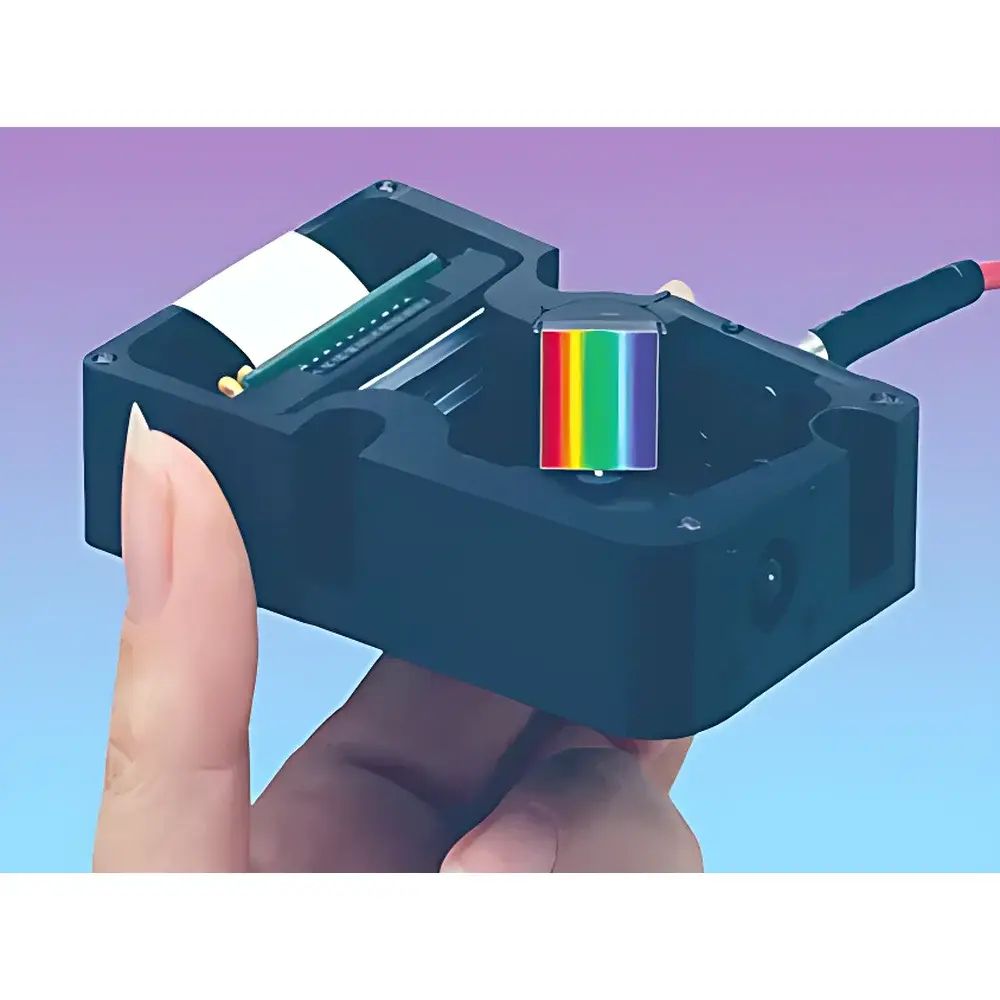
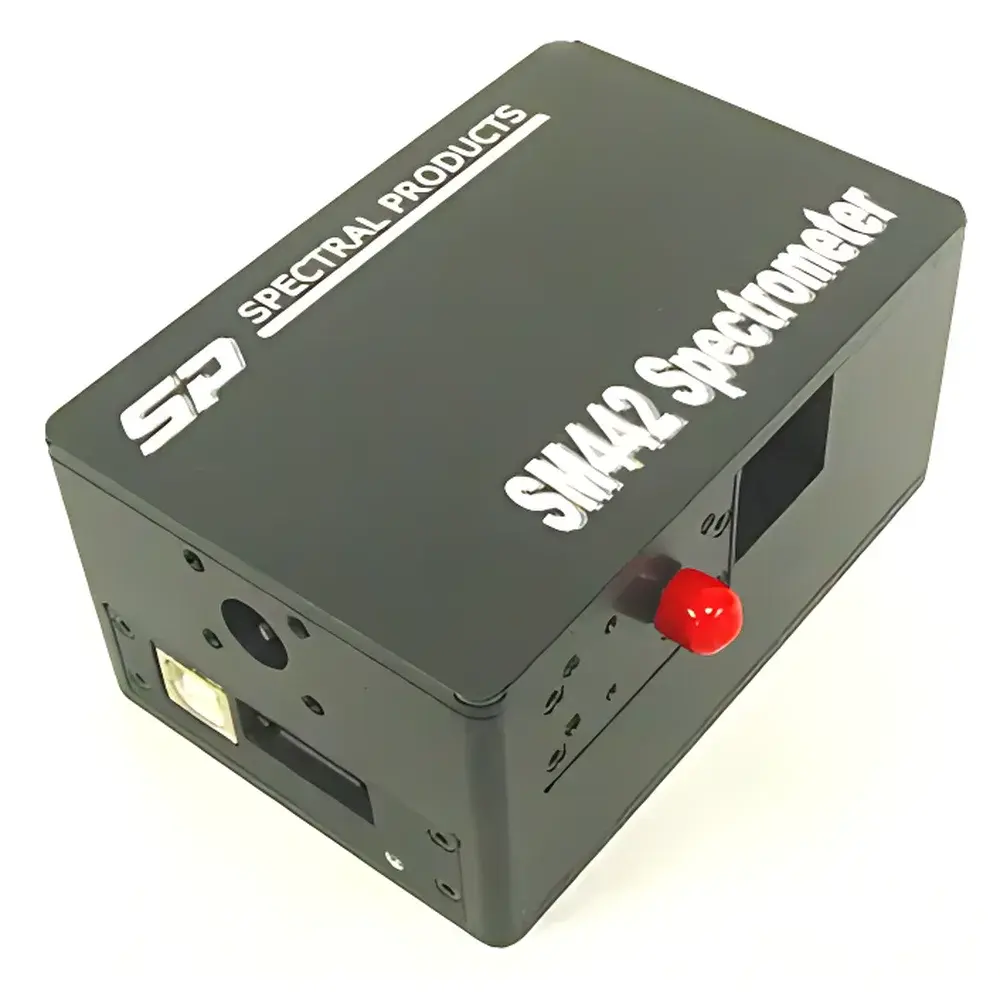
SP SM200/400/240/440/242/442 Fiber Optic CCD Spectrometer
| Brand | SP (Spectral Products) |
|---|---|
| Origin | USA |
| Detector Type | CCD |
| Spectral Range | 200–1050 nm |
| Optical Resolution | 0.15–10 nm (FWHM, configuration-dependent) |
| Stray Light | <0.05% at 632 nm (<0.1% across full range) |
| Sensitivity | High quantum efficiency (QE >60% typical in 350–800 nm) |
| Signal-to-Noise Ratio | ≥300:1 (full well, 1 s integration) |
| Dynamic Range | >10,000:1 (with 16-bit digitization and on-board baseline correction) |
Overview
The SP SM-Series Fiber Optic CCD Spectrometers are laboratory-grade, modular optical spectrometers engineered for precision spectral acquisition across the ultraviolet, visible, and near-infrared (UV-VIS-NIR) spectrum (200–1050 nm). Based on a Czerny-Turner optical bench architecture with optimized reflective coatings and thermally stabilized mounts, these instruments employ front-illuminated or back-thinned CCD detectors to deliver high photon collection efficiency and low read noise. The core measurement principle relies on wavelength-dispersive detection: incoming light—delivered via SMA905-compatible fiber optic cables—is collimated, diffracted by a ruled or holographic grating, and focused onto the linear CCD array. Pixel-to-wavelength calibration is factory-performed using NIST-traceable mercury-argon emission lines, ensuring spectral accuracy within ±0.2 nm across the operating range. Designed for integration into automated analytical platforms or standalone benchtop use, the SM-Series supports real-time spectral acquisition, dark current compensation, and hardware-triggered synchronization—making it suitable for time-resolved fluorescence, plasma monitoring, and process analytical technology (PAT) applications compliant with ICH Q8/Q9 frameworks.
Key Features
- Modular optical design with interchangeable gratings and slit options (10–200 µm), enabling resolution tuning from 0.15 nm to 10 nm FWHM
- Thermoelectrically cooled CCD detector (–5 °C typical stabilization) to suppress dark current drift and improve long-integration stability
- Low-stray-light optical path: <0.05% at 632 nm (verified per ASTM E275-21 Annex A3), minimizing spectral crosstalk in high-dynamic-range measurements
- 16-bit analog-to-digital conversion with on-board FPGA-based signal processing, including real-time dark subtraction and pixel binning
- USB 2.0 interface with vendor-neutral SDK (C/C++, Python, LabVIEW, MATLAB APIs) and support for third-party DAQ systems
- Robust aluminum housing with EMI-shielded electronics, rated for continuous operation in ISO Class 7 cleanroom-adjacent environments
Sample Compatibility & Compliance
The SM-Series interfaces seamlessly with standard 200–600 µm core diameter silica optical fibers and accepts input from integrating spheres, cuvette holders, collimating lenses, and plasma probes. It is routinely deployed in GLP-compliant QC laboratories performing ASTM E308-20 (colorimetry), USP (spectrophotometric absorbance), and ISO 13406-2 (fluorescence quantum yield) protocols. Firmware and driver software support audit trail logging and user-access controls aligned with FDA 21 CFR Part 11 requirements when used with validated host software (e.g., OceanView v2.3+ or custom LIMS-integrated applications). All units ship with NIST-traceable calibration certificates and comply with CE, RoHS, and FCC Part 15 Subpart B electromagnetic compatibility standards.
Software & Data Management
SP provides SpectraWiz—a cross-platform application supporting real-time spectral display, multi-curve overlay, peak identification (with Gaussian/Lorentzian fitting), and export to CSV, TXT, or HDF5 formats. Raw data includes calibrated wavelength arrays, intensity vectors, integration time metadata, and temperature-stamped detector status logs. For enterprise deployment, the SDK enables integration with SCADA systems, MES platforms, and cloud-based analytics pipelines (e.g., AWS IoT Core or Azure Time Series Insights). All spectral acquisitions retain full bit-depth fidelity; no lossy compression is applied during onboard buffering or USB transfer.
Applications
- Semiconductor manufacturing: In-situ plasma emission monitoring during etching and deposition (OES), bandgap analysis of thin-film photovoltaics
- Pharmaceutical development: Quantitative UV-Vis assay validation per ICH Q2(R2), dissolution profile tracking, excipient fluorescence screening
- Environmental analysis: Multi-element water quality assessment via atomic emission (e.g., Na, K, Ca lines at 589 nm, 766 nm, 393 nm)
- Agricultural science: Leaf chlorophyll index (NDVI, PRI) derivation from reflectance spectra; grain protein content prediction via NIR regression models
- Materials R&D: Photoluminescence quantum efficiency (PLQE) measurement of perovskites and quantum dots; polymer degradation kinetics under UV exposure
- Clinical research: Flow cytometry spectral unmixing support, LED-based phototherapy source characterization, and endoscope-compatible spectral biopsy tools
FAQ
What grating options are available for the SM242 model, and how do they affect resolution and sensitivity?
The SM242 supports up to four user-swappable gratings (e.g., 300, 600, 1200, 2400 grooves/mm), each optimized for specific trade-offs between resolution and throughput. Higher groove density increases dispersion but reduces étendue; resolution is further modulated by entrance slit width and pixel binning settings.
Is spectral recalibration required after field installation or temperature shifts?
No routine recalibration is needed. The thermally stabilized optical bench and on-board reference LED enable automatic wavelength drift correction every 30 minutes (configurable); NIST traceability remains valid for 12 months under documented storage and usage conditions.
Can the SM-Series operate in triggered acquisition mode synchronized with external equipment?
Yes—hardware TTL trigger input (rising-edge sensitive) allows precise synchronization with pulsed lasers, shutter controllers, or motion stages, with jitter <100 ns and latency <5 µs.
Does the system support radiometric calibration for absolute irradiance measurements?
Radiometric calibration is optional and performed separately using NIST-traceable tungsten-halogen or deuterium lamps; calibration files are loaded directly into SpectraWiz or SDK-based applications.
How is detector linearity verified across the dynamic range?
Linearity is characterized per ANSI PH2.25-2021 using neutral density step filters and verified to ±0.5% deviation over 99% of full scale (16-bit range) at all integration times ≥10 ms.





