
PV Measurements Calibrated Photovoltaic Reference Solar Cell (Model: CELL)
| Brand | PV Measurements |
|---|---|
| Origin | USA |
| Type | Import |
| Model | CELL |
| Automation Level | Fully Automatic |
| Active Area | 1 cm² |
| Voltage Measurement Accuracy | ±1% |
| Current Measurement Accuracy | ±1% |
Overview
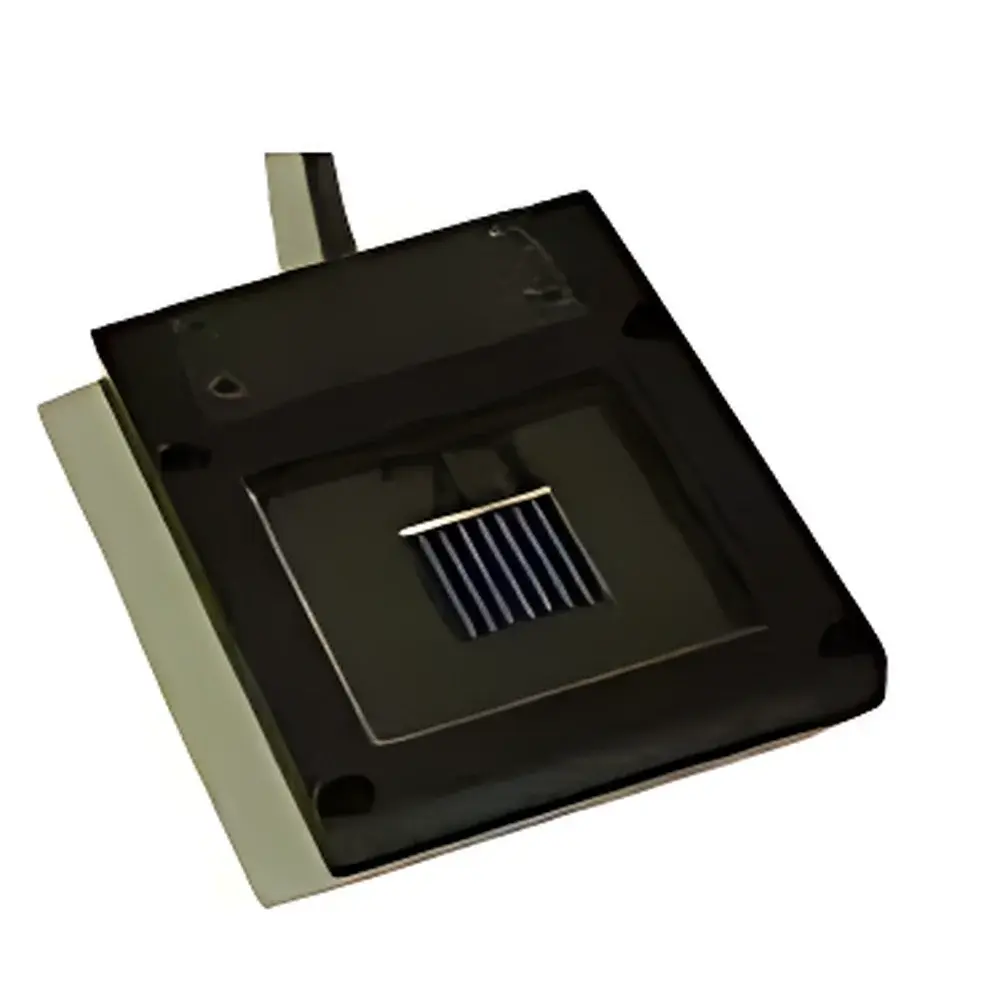
The PV Measurements Calibrated Photovoltaic Reference Solar Cell (Model: CELL) is a traceable, NIST- and NREL-certified primary standard device engineered for absolute irradiance calibration of solar simulators and photovoltaic (PV) characterization systems. Operating on the fundamental principle of photovoltaic conversion under standardized spectral and thermal conditions, this reference cell serves as a metrological anchor in I–V testing workflows—enabling accurate determination of power conversion efficiency (η), short-circuit current (Isc), open-circuit voltage (Voc), fill factor (FF), and maximum power point (Pmax). Each unit is calibrated against the National Renewable Energy Laboratory (NREL) reference scale or China’s National Institute of Metrology (NIM), with full uncertainty budgeting and ISO/IEC 17025-compliant documentation. The cell is designed for use under AM1.5G (1000 W/m², 25 °C) illumination and provides stable, repeatable output over extended operational life when handled per GLP-aligned protocols.
Key Features
- Primary calibration traceable to NREL or NIM, with documented uncertainty budgets and full spectral responsivity (R(λ)) data across 400–1100 nm
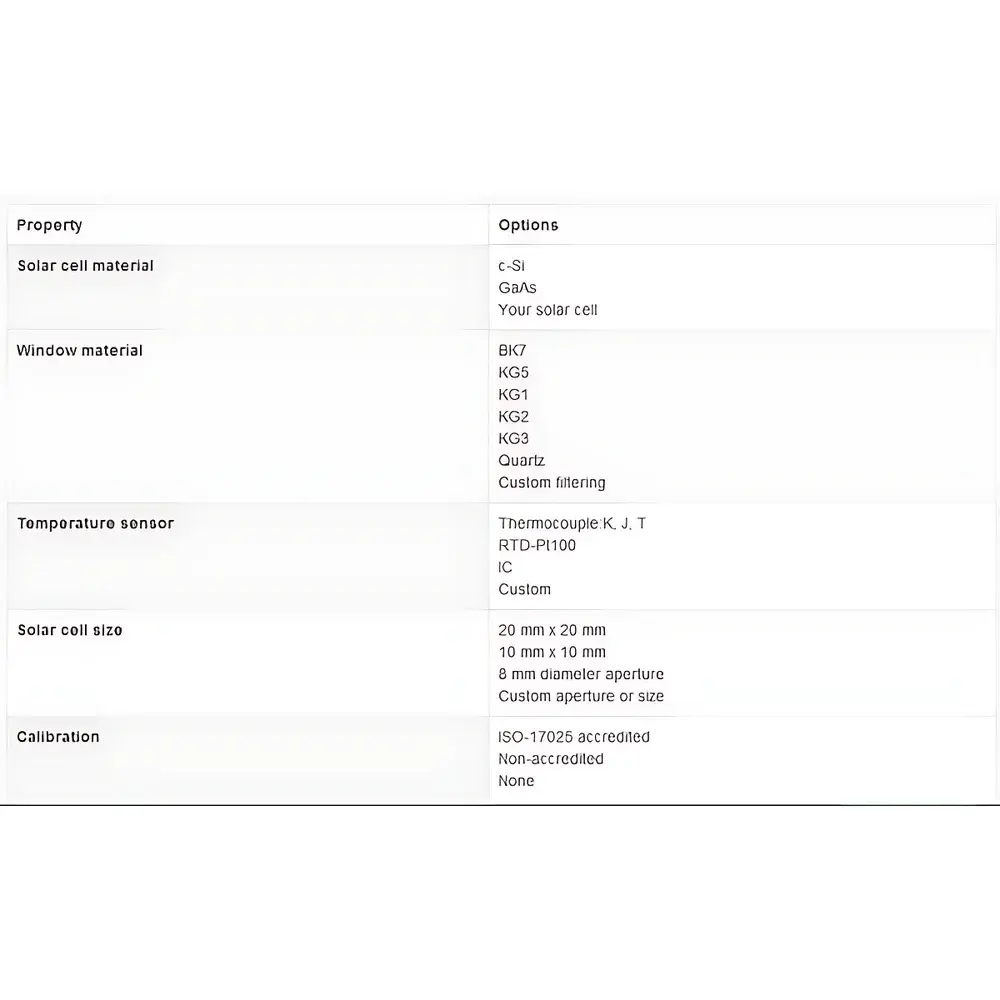
- Monocrystalline or multicrystalline silicon active layer (20 mm × 20 mm effective area), aged and selected for long-term stability and spatial uniformity
- Hermetically sealed in an anodized aluminum housing (70 mm × 70 mm × 20 mm) with BK7 anti-reflective coated window and space-grade radiation-hardened glass
- Integrated 100 Ω Pt RTD temperature sensor mounted in direct thermal contact with the cell substrate; four-terminal sensing minimizes lead resistance error
- LEMO connectors for both electrical (I/V) and temperature outputs—ensuring low-noise, reproducible signal transmission
- Compliant with WPVS (World Photovoltaic Scale) mechanical mounting specifications and ASTM E927–22 requirements for solar simulator calibration
Sample Compatibility & Compliance
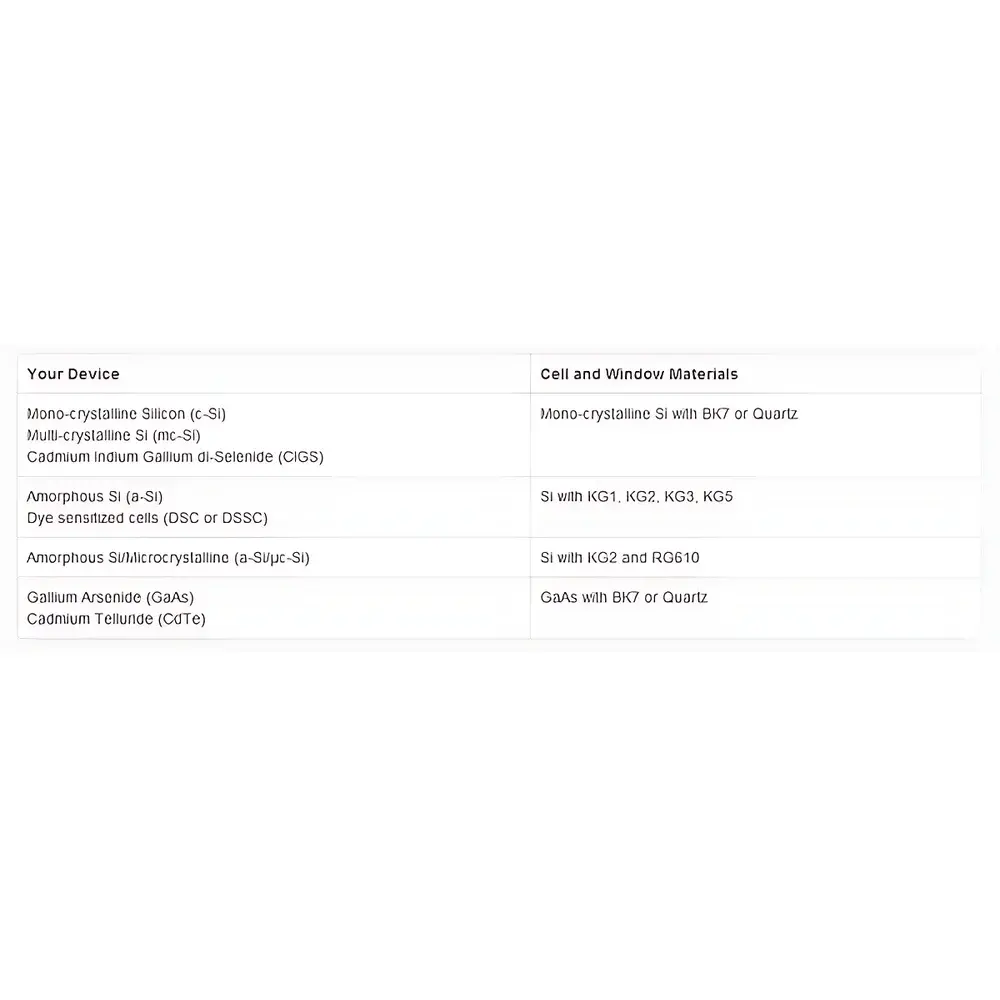
This reference cell supports calibration of Class AAA solar simulators, xenon-arc, LED-based, and filtered halogen sources used in R&D and production-line PV testing. It is compatible with standard I–V curve tracers, source meters (e.g., Keysight B2900 series), and automated test stations. Optional configurations include GaAs or CdTe reference cells for multi-junction device characterization, quartz windows for UV-enhanced applications, and custom active areas or mounting hole patterns. All units comply with ISO 17025:2017 (calibration laboratory competence), IEC 60904-2 (requirements for reference solar cells), and IEC 60904-3 (spectral mismatch correction). Traceability statements explicitly cite NREL SRM 2231 or equivalent national standards.
Software & Data Management
Each delivered unit includes a digital calibration certificate containing: spectral responsivity (A/W), quantum efficiency (QE), I–V curves at STC (AM1.5G, 1000 W/m², 25 °C), temperature coefficients (α for Isc, β for Voc), and expanded uncertainties (k = 2). Certificates are issued in PDF format with embedded metadata compliant with FDA 21 CFR Part 11 (electronic records and signatures) upon request. Raw spectral data (R(λ)) and irradiance integration scripts (e.g., Jsc = ∫R(λ)·S(λ)dλ) are provided for integration into LabVIEW, Python, or MATLAB-based QA/QC pipelines. Audit trails, version-controlled certificates, and calibration history logs are supported in enterprise LIMS environments.
Applications
- Absolute irradiance calibration of solar simulators prior to PV device efficiency measurement
- Spectral mismatch correction in multi-junction or thin-film solar cell testing (per IEC 60904-7)
- Validation of light source stability during accelerated aging or outdoor exposure studies
- Reference standard in inter-laboratory round-robin tests and proficiency testing programs
- Traceable baseline for in-house calibration of secondary reference cells or pyranometers
- Supporting ISO/IEC 17025 accreditation audits for PV testing laboratories
FAQ
What is the calibration uncertainty for short-circuit current (Isc) at STC?
Typical expanded uncertainty (k = 2) for Isc is ±0.45% relative, including contributions from spectral mismatch, temperature control, and measurement repeatability.
Can this reference cell be used outdoors for field calibration?
It is rated for occasional outdoor use but not intended for continuous unsheltered exposure; prolonged UV and thermal cycling degrade encapsulation integrity and increase drift risk.
Is temperature control mandatory during calibration?
Yes—accurate STC compliance requires active thermal stabilization at 25 °C ± 0.5 °C, typically via water-cooled baseplate or Peltier stage synchronized with the integrated Pt100 sensor.
How often should recalibration be performed?
Annual recalibration is recommended for routine metrology use; NREL recommends biannual verification for high-usage labs or after mechanical shock or thermal excursion beyond 10–40 °C.
Does the certificate include spectral responsivity data?
Yes—each certificate provides tabulated R(λ) values at 10 nm intervals from 350 nm to 1100 nm, measured using a monochromator-based setup traceable to NIST SRM 2231.




