
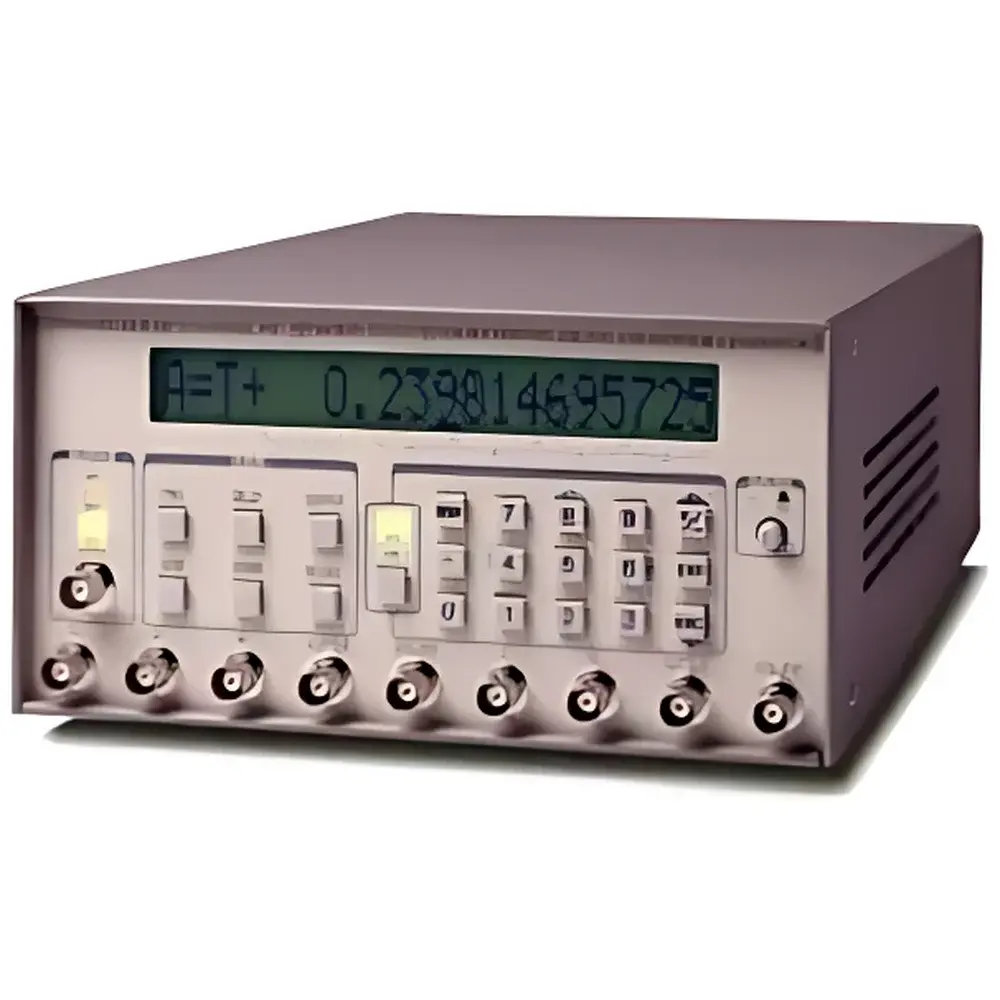
Stanford Research Systems DG535 Digital Delay/Pulse Generator
| Origin | USA |
|---|---|
| Manufacturer Type | Authorized Distributor |
| Origin Category | Imported |
| Model | DG535 |
| Price | Upon Request |
Overview
The Stanford Research Systems DG535 Digital Delay/Pulse Generator is a precision timing instrument engineered for high-fidelity synchronization and temporal control in advanced scientific and industrial measurement systems. Based on digital delay architecture with calibrated timebase stability, the DG535 implements deterministic pulse generation and precise delay synthesis using a low-phase-noise 100 MHz crystal oscillator and high-speed CMOS timing circuitry. Its core functionality centers on generating accurately timed logic-level pulses with sub-nanosecond resolution—enabling critical applications such as pump-probe laser experiments, time-of-flight (TOF) measurements, gated detection, lock-in timing, and multi-instrument triggering across physics, optics, and materials characterization laboratories.
Key Features
- Four independent digital delay channels, each programmable with absolute or relative timing references
- Two fully defined pulse outputs (A and B), supporting variable width, delay, polarity, and logic level configuration
- 5 ps minimum delay resolution—achievable via 32-bit internal counter and interpolation-based timing engine
- 50 ps RMS jitter (typ.) over full delay range, measured at 1 kHz repetition rate into 50 Ω load
- Programmable output amplitude (−3 V to +3 V) and DC offset (±5 V), compatible with TTL, ECL, and CMOS logic families
- Delay range extends from 0 s to 1000 s in single-shot or repetitive modes, with seamless scaling across decades
- Triggering options include internal clock (up to 1 MHz), external TTL/CMOS/NIM inputs, line-triggered (50/60 Hz AC sync), and cascaded (serial) triggering for multi-unit synchronization
- Standard IEEE-488.2 (GPIB) interface with SCPI command set; optional RS-232 and USB-to-GPIB adapters available for modern control environments
- Optional high-voltage output module supports ±35 V amplitude with <100 ps rise/fall times (measured 10%–90%), suitable for driving photomultiplier tube gates and fast optical modulators
Sample Compatibility & Compliance
The DG535 operates as a signal conditioning and timing coordination unit—not a sample analysis device—and therefore imposes no material compatibility constraints. It interfaces reliably with standard 50 Ω coaxial instrumentation (e.g., oscilloscopes, photodetectors, Pockels cells, Q-switches, and RF amplifiers) via SMA connectors. All timing specifications comply with NIST-traceable calibration practices per SRS internal QA protocol. The unit meets CE marking requirements for electromagnetic compatibility (EN 61326-1) and safety (EN 61010-1). While not certified for IEC 62304 or FDA 21 CFR Part 11, its deterministic timing behavior and non-volatile settings storage support GLP/GMP-aligned experimental documentation when integrated into validated test systems.
Software & Data Management
Control is implemented via industry-standard GPIB commands compliant with SCPI 1999 syntax. SRS provides free Windows-compatible configuration software (DG535 Control Panel v3.x) supporting script-based sequence definition, waveform preview, and batch parameter export in CSV format. Third-party integration is supported through LabVIEW VIs (NI-VISA), MATLAB Instrument Control Toolbox, Python (pyvisa), and C/C++ APIs. All settings—including channel configurations, trigger mode, and output states—are retained in non-volatile memory after power cycling. Audit-ready operation is enabled via timestamped GPIB command logging and optional external trigger event stamping (via auxiliary TTL input).
Applications
- Laser system synchronization: precise delay control between pump and probe beams in ultrafast spectroscopy
- Time-resolved fluorescence and phosphorescence lifetime measurements using gated detection
- Pulsed laser ranging and velocity interferometry (e.g., VISAR, PDV)
- Multi-channel data acquisition triggering across oscilloscopes, digitizers, and spectrometers
- Particle image velocimetry (PIV) and laser-induced breakdown spectroscopy (LIBS) timing engines
- Quantum optics experiments requiring synchronized single-photon source and detector gating
- Calibration of time-interval analyzers and time-to-digital converters (TDCs)
FAQ
What is the difference between “delay” and “pulse width” on the DG535?
Delay refers to the time interval between a trigger event and the leading edge of an output pulse; pulse width defines the duration between leading and trailing edges. Both are independently adjustable per channel.
Can the DG535 generate bursts or complex pulse trains?
No—the DG535 is a fixed-sequence digital delay generator, not a pattern generator. It produces up to two precisely timed pulses per trigger. For burst or arbitrary waveform generation, SRS recommends the DG645 or DG800 series.
Is the 5 ps resolution achievable across the entire 0–1000 s delay range?
Yes—the 5 ps resolution is maintained across all delay ranges due to the use of fractional-N interpolation and high-stability timebase referencing.
Does the DG535 support external clock locking (e.g., to a 10 MHz reference)?
No—its internal 100 MHz oscillator is fixed-frequency and non-referencable. For phase-coherent multi-instrument setups, users typically distribute a common master clock externally.
How is calibration maintained over temperature and time?
The DG535 employs oven-controlled crystal oscillator (OCXO) technology with aging compensation algorithms. Factory calibration is valid for 12 months; recommended recalibration interval is annually under typical lab conditions (23 ± 2 °C, stable humidity).



