
Adaptive Scanning Optical Microscope ASOM-001
| Origin | USA |
|---|---|
| Manufacturer Type | Authorized Distributor |
| Origin Category | Imported |
| Model | ASOM-001 |
| Pricing | Available Upon Request |
Overview
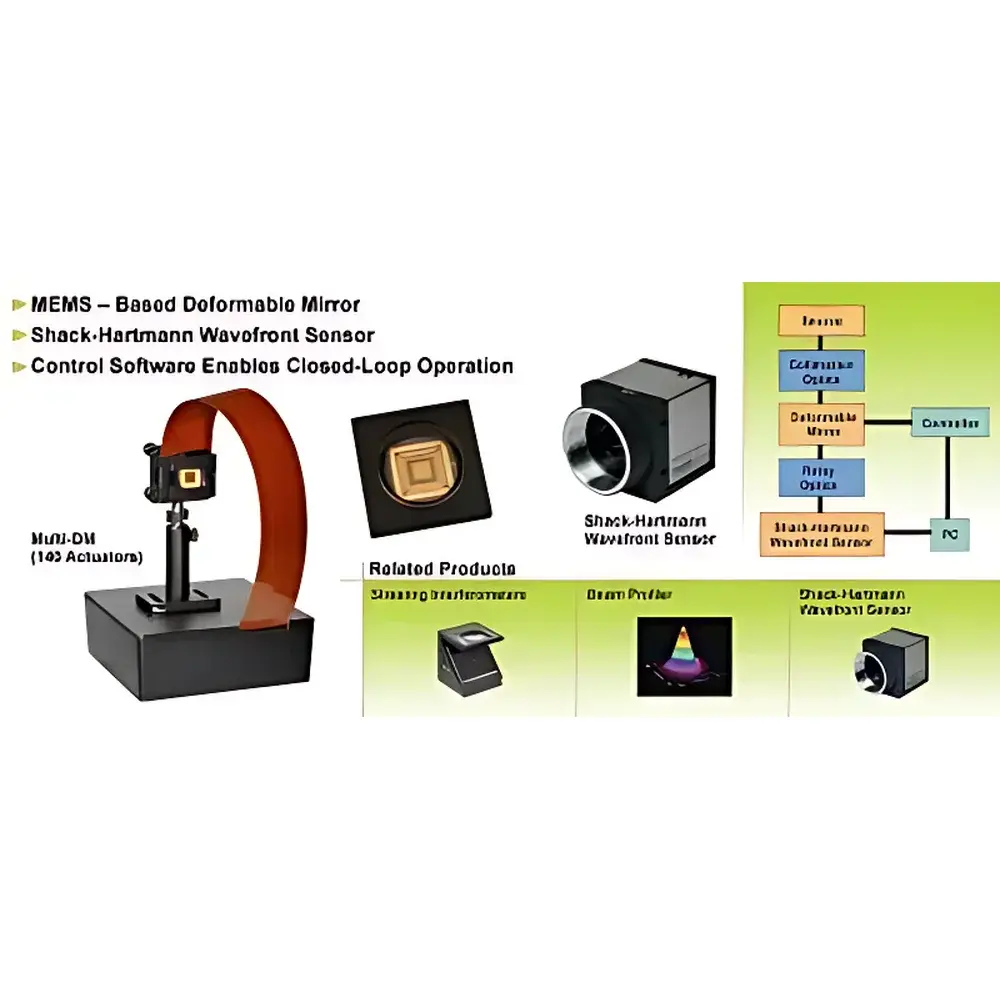
The Adaptive Scanning Optical Microscope (ASOM-001) is a high-speed, wide-field optical imaging platform engineered for live biological specimen observation without mechanical stage translation. Unlike conventional point-scanning or stage-scanning microscopes, the ASOM-001 employs a lightweight, high-bandwidth MEMS-based fast steering mirror (FSM) positioned in the pupil plane of the objective lens to perform inertial-free beam scanning. This optical scanning architecture eliminates sample motion-induced shear stress and hydrodynamic disturbance—critical constraints when imaging fragile, hydrated, or mechanically sensitive specimens in physiological environments. The system operates on principles derived from adaptive optics (AO), originally developed for astronomical wavefront correction, and adapted here to compensate for off-axis aberrations (e.g., coma, astigmatism, field curvature) introduced during large-angle scanning. By integrating real-time wavefront sensing and closed-loop deformation mirror control, the ASOM-001 delivers diffraction-limited resolution across an expanded field of view (FOV), achieving 1.5 µm lateral resolution over a synthesized FOV exceeding 1250 mm²—orders of magnitude larger than standard high-NA microscope objectives permit at equivalent resolution.
Key Features
- MEMS-based fast steering mirror with 140 electrostatic actuators, enabling sub-5 ms inter-frame repositioning and scan rates up to 100 Hz
- Custom-designed telecentric scan lens assembly (7-element, f’ = 19 mm, NA = 0.20) optimized for finite-conjugate imaging and minimal field distortion
- Real-time wavefront correction using a deformable mirror synchronized with Shack-Hartmann wavefront sensor feedback
- Scientific-grade CCD camera (1024 × 768 pixels, 4.7 µm pixel pitch) supporting full-frame readout at ≥100 fps
- Optical architecture compatible with standard inverted or upright microscope frames; no modification to existing objective lenses required
- Modular design supports integration with external actuators, environmental chambers, or microfluidic interfaces without compromising scan stability
Sample Compatibility & Compliance
The ASOM-001 is specifically validated for label-free and fluorescence-based imaging of live, unstained, or minimally perturbed biological specimens—including primary neurons, zebrafish embryos, organoids, and motile microorganisms—under native aqueous or viscous media. Its non-contact scanning paradigm avoids mechanical coupling between stage and sample, making it suitable for long-term time-lapse studies where phototoxicity, thermal drift, and mechanical artifact must be minimized. The system complies with ISO 10934-1 (optical microscopy—nomenclature and terminology) and adheres to engineering best practices aligned with GLP-compliant instrument qualification protocols. While not a medical device, its hardware architecture and data acquisition chain are designed to support audit-ready metadata logging, consistent with FDA 21 CFR Part 11 considerations for research-use-only (RUO) instrumentation in regulated preclinical labs.
Software & Data Management
Control and reconstruction are managed via a deterministic real-time software suite built on LabVIEW Real-Time and MATLAB-based post-processing modules. The software provides synchronized timing control across mirror actuation, camera exposure, and optional peripheral triggers (e.g., electrophysiology amplifiers, piezoelectric stimulators). Raw image streams are saved in TIFF or HDF5 format with embedded calibration metadata—including timestamped mirror voltage maps, wavefront sensor centroid data, and optical path difference (OPD) residuals. Batch processing pipelines support automatic mosaic stitching, aberration-corrected deconvolution, and motion-compensated registration for tracking highly dynamic samples. Export interfaces comply with OME-TIFF standards, ensuring interoperability with Fiji/ImageJ, Imaris, and commercial analysis platforms used in academic and industrial life science workflows.
Applications
- High-throughput live-cell phenotyping and motility assays requiring simultaneous micron-scale resolution and cm-scale field coverage
- Neuroscience applications including calcium imaging of distributed neuronal networks and axonal transport dynamics in explanted tissue
- Developmental biology studies involving multi-hour embryonic development monitoring under perfused culture conditions
- Microfluidic-on-microscope integration for real-time particle tracking, cell sorting validation, and droplet-based assay readout
- Preclinical toxicology screening where rapid, artifact-free imaging of beating cardiomyocytes or ciliated epithelia is essential
- Materials science applications involving in situ thermal or mechanical stress testing of soft polymers and hydrogels
FAQ
Is the ASOM-001 compatible with standard microscope objectives?
Yes—the system is designed as an add-on optical module that interfaces with commercially available infinity-corrected objectives (e.g., Nikon CFI Plan Apo, Olympus UPLSAPO, Zeiss EC Plan-Neofluar) without requiring objective replacement or modification.
Does the system require wavefront sensor recalibration between experiments?
No—once calibrated per objective and magnification, the system retains alignment stability over thermal cycles typical of lab environments (±2°C); automated daily verification routines are included in the software suite.
Can the ASOM-001 be used for fluorescence imaging?
Yes—its optical path preserves excitation/emission efficiency across standard fluorophore bands (DAPI, FITC, TRITC, Cy5); optional dichroic and emission filter turrets are available for multi-channel operation.
What level of technical support is provided for integration into existing lab infrastructure?
Thorlabs-certified application engineers provide remote commissioning, on-site installation support (optional), and documentation packages compliant with ISO/IEC 17025 laboratory accreditation requirements.





