
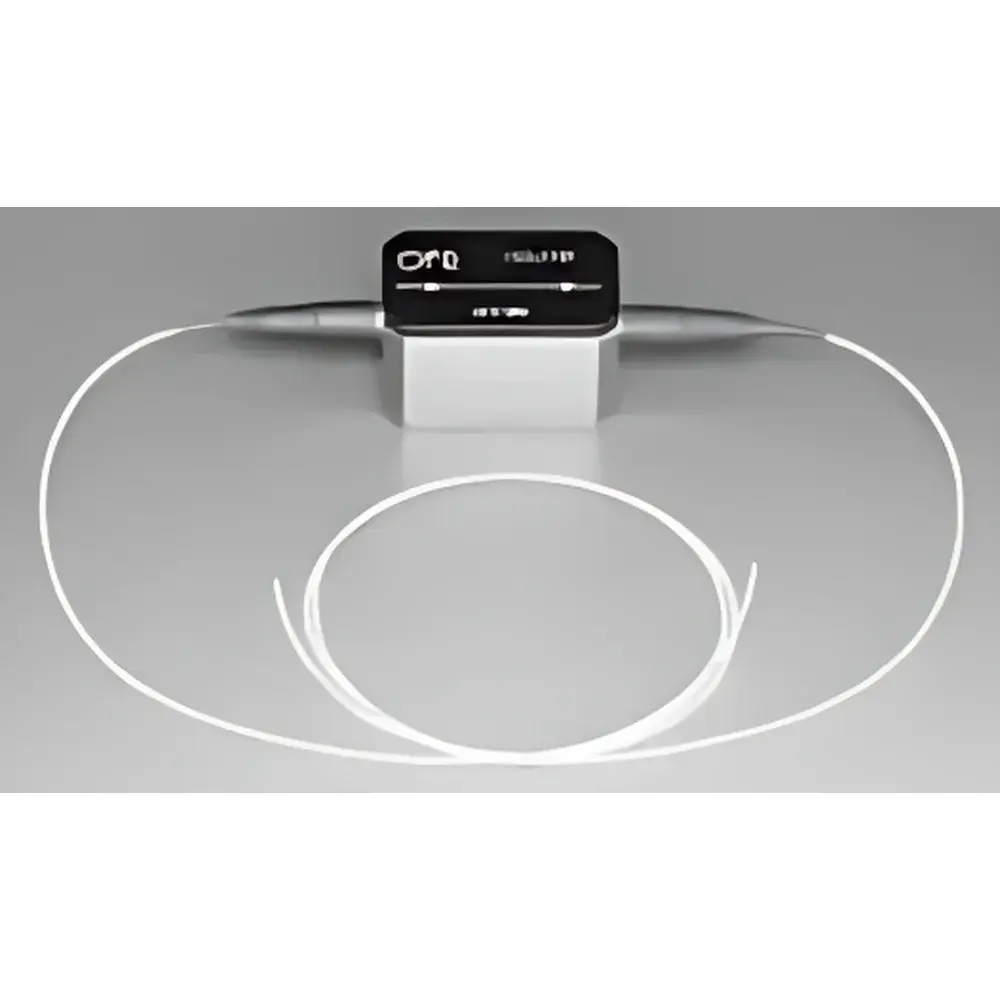
Fiber Optic Isolator IO Series
| Origin | Imported |
|---|---|
| Manufacturer Type | Authorized Distributor |
| Model | IO-H-1064 / IO-G-1310 / IO-F-1550 / IO-K-1064-CO (Multi-Model Platform) |
| Operating Wavelengths | 780–1550 nm |
| Max CW Power Handling | 250 mW to 20 W |
| Isolation | 27–42 dB |
| Insertion Loss | 0.3–2.0 dB |
| PDL | ≤0.25 dB (Polarization-Independent), N/A (Polarization-Dependent) |
| Extinction Ratio | >20 dB (PD), >50 dB (PI) |
| Return Loss | >50 dB |
| Fiber Types | HI1060, SMF-28e, PM980/1064, PM1300, PM1550, 780HP, SM800, SM980/1060 |
Overview
Fiber optic isolators are non-reciprocal passive components essential for protecting laser sources and optical systems from back-reflected light. Based on the Faraday magneto-optic effect, these devices enable unidirectional transmission by rotating the polarization state of forward-propagating light while blocking reverse-traveling light through polarization mismatch at the output port. The IO Series isolators are engineered for high-reliability operation across industrial, scientific, and telecommunications applications—including fiber laser pumping, amplifier staging, interferometric sensing, and quantum optics setups. Each model is optimized for specific wavelength bands (780 nm, 850 nm, 980 nm, 1064 nm, 1310 nm, and 1550 nm), power classes (250 mW to 20 W CW), and polarization requirements—supporting both polarization-independent (PI) and polarization-dependent (PD) configurations. Thermal stability, low polarization-dependent loss (PDL), and consistent isolation performance under varying environmental conditions make this series suitable for integration into OEM modules and rack-mounted instrumentation.
Key Features
- Faraday-based non-reciprocal operation ensuring stable isolation across temperature and input power variations
- Multiple configuration options: polarization-independent (PI) and polarization-dependent (PD) variants
- Wide operating wavelength range: 780 nm to 1550 nm with ±10–±20 nm tolerance depending on model
- High-power handling capability: up to 20 W continuous-wave (CW) in thermally optimized packages (e.g., IO-K-1064-CO)
- Low insertion loss: as low as 0.3 dB (typ.) for SMF-28e-coupled 1310/1550 nm models; <0.6 dB for high-power 1064 nm variants
- Ultra-low PDL: ≤0.1 dB for PI isolators at 1310/1550 nm; specified PDL not applicable for PD types due to inherent polarization selectivity
- High return loss: >50 dB (standard), >55 dB (select 1310/1550 nm high-performance variants)
- Hermetically sealed, industry-standard butterfly or mini-DIL packages compatible with automated fiber alignment processes
Sample Compatibility & Compliance
The IO Series supports a broad spectrum of single-mode and polarization-maintaining fiber types—including SMF-28e, HI1060, PM980/1064, PM1300, PM1550, 780HP, and SM800—enabling seamless integration with common laser diodes, fiber amplifiers, and modulators. All isolators undergo 100% end-face inspection per IEC 61300-3-35 and meet Telcordia GR-1209-CORE reliability standards for vibration, thermal cycling, and humidity exposure. While not certified to ISO 13485 or FDA 21 CFR Part 11 (as inherently non-software-based passive components), documentation packages include full traceability of materials, test reports (including IL, isolation, PDL, and RL measurements), and RoHS/REACH compliance statements. For GLP/GMP-aligned labs, calibration certificates and batch-level performance data are available upon request.
Software & Data Management
As fully passive optical components, IO Series isolators require no firmware, drivers, or software control. Performance characterization data—including spectral response curves, power-dependent isolation roll-off, and thermal drift profiles—is provided in standardized PDF test reports aligned with ISO/IEC 17025-accredited measurement practices. For system integrators, S-parameter files (S2P) and Zemax-compatible .DAT beam propagation models are available for selected high-volume models (e.g., IO-F-1550, IO-K-1064-ELY) to support optical design validation. Traceable metrology records—including wavelength-calibrated spectral scans and polarization extinction mapping—are archived for 10 years and accessible via secure customer portal upon NDA execution.
Applications
- Protection of seed lasers and master oscillators in MOPA and ultrafast amplifier chains
- Stabilization of distributed feedback (DFB) and external cavity diode lasers (ECDLs)
- Isolation between stages in EDFA, YDFA, and Raman amplifier modules
- Back-reflection suppression in fiber-optic gyroscopes and interferometric biosensors
- Polarization management in quantum key distribution (QKD) transmitters and squeezed light sources
- OEM integration into tunable laser assemblies, OCT light engines, and LiDAR transmit modules
FAQ
What is the difference between polarization-independent and polarization-dependent isolators?
Polarization-independent (PI) isolators maintain consistent isolation and insertion loss regardless of input polarization state—ideal for unpolarized or dynamically polarized sources. Polarization-dependent (PD) isolators require aligned linear input polarization but achieve higher extinction ratios (>20 dB) and tighter isolation bandwidths—commonly used with polarization-maintaining fiber systems.
Can IO-K-1064-CO handle pulsed laser operation?
The IO-K-1064-CO is rated for 20 W CW operation. For pulsed applications, peak power density must remain below damage threshold limits (typically ~1 GW/cm² for AR-coated collimators); users should consult pulse width, repetition rate, and beam diameter to assess nonlinear and thermal lensing effects.
Are custom center wavelengths or fiber types supported?
Yes—custom wavelength tuning (±5 nm resolution) and alternative fiber pigtails (e.g., PM1550, LMA-10, or hollow-core photonic bandgap fiber) are available under NRE-supported engineering change orders (ECOs). Lead time: 8–12 weeks.
Do these isolators comply with ITU-T G.694.1 grid specifications?
While not ITU-grid labeled, all 1310 nm and 1550 nm models operate within C-band (1530–1565 nm) and O-band (1260–1360 nm) windows and exhibit spectral flatness <±0.5 dB over ±15 nm—fully compatible with DWDM channel spacing requirements.
Is thermal derating required above 40°C ambient?
For models rated >5 W, isolation degrades by ≤0.3 dB per 10°C rise above 25°C. Derating curves and thermal resistance (Rth) values are provided in the mechanical datasheet for system-level thermal modeling.





