
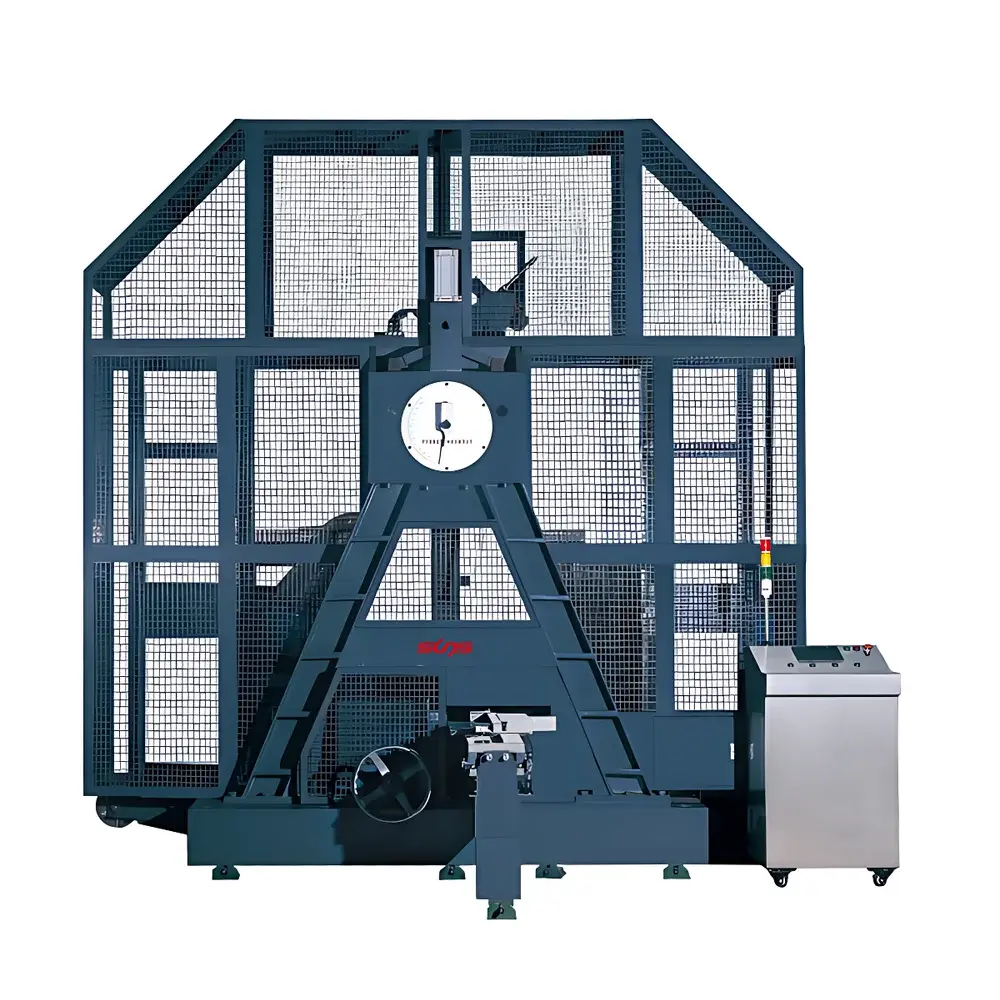
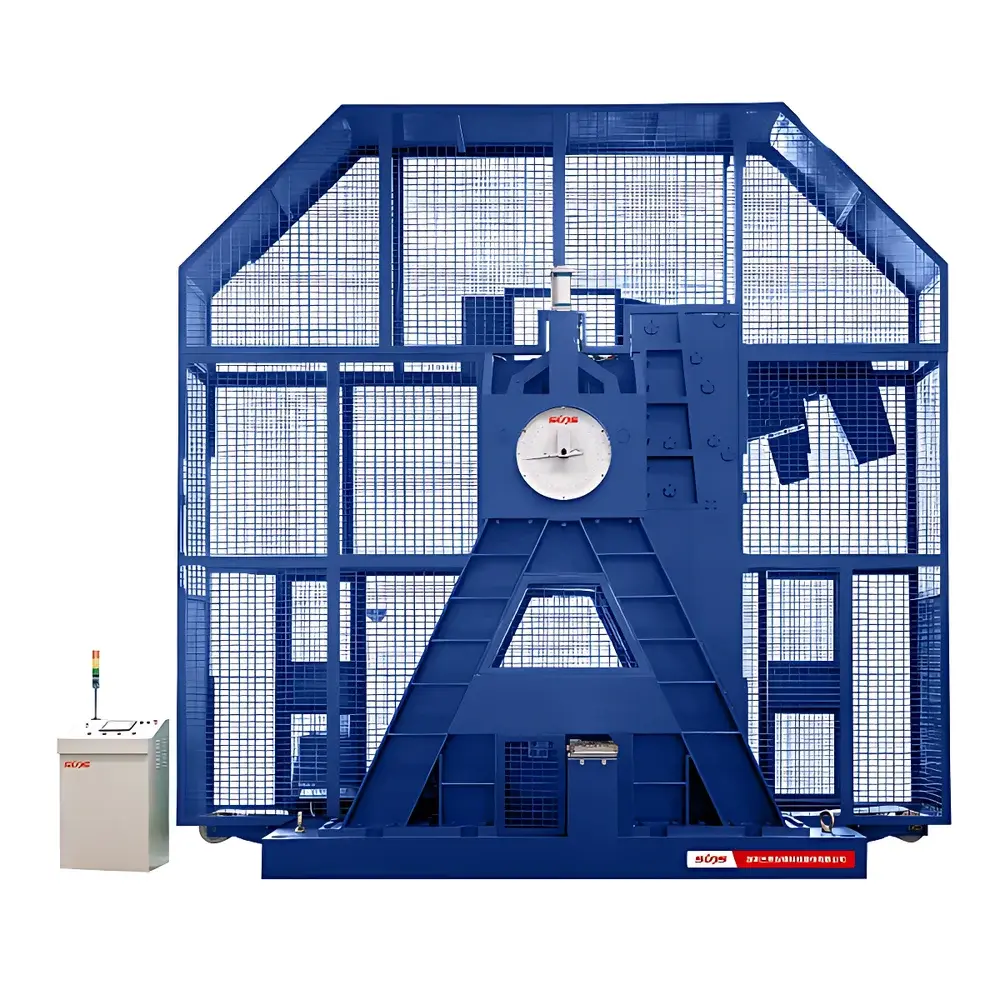
SUNS PTM2000 Series High-Energy Pendulum Impact Testing Machine (20,000 J–100,000 J)
| Brand | SUNS |
|---|---|
| Origin | Shenzhen, China |
| Manufacturer Type | Direct Manufacturer |
| Instrument Type | Pendulum Impact Tester |
| Nominal Impact Energy | 20,000 J, 30,000 J, 40,000 J, 80,000 J, 100,000 J |
| Impact Velocity | 5.788 m/s, 7.088 m/s, 8.183 m/s |
| Pendulum Torque (Impact Constant) | 23,431.46 N·m |
| Load Cell Range | 81.6 kN |
| Maximum Lifting Height | 135 mm |
| Control System | PLC-based Automation with Servo Motor & Hydraulic Buffering |
| Angular Resolution | 0.025° (via High-Precision Rotary Encoder) |
| Safety Enclosure | Fully Interlocked Enclosed Test Chamber |
| Compliance Standards | GB/T 5482–2007, GB/T 8363–2007, GB/T 3808–2002, JJG 145–2007, ASTM E604–83, ASTM E436–03, API RP 5L3–96 |
Overview
The SUNS PTM2000 Series is a high-energy pendulum impact testing machine engineered for precise, repeatable dynamic fracture characterization of heavy-section ferrous materials—particularly ferritic steels, pipeline-grade plates, and thick-walled structural components. Operating on the principle of gravitational potential energy conversion, the system releases a calibrated pendulum from a defined height to deliver a single, controlled impact to a notched or unnotched specimen in a three-point bending configuration. Unlike drop-weight systems, the PTM2000’s tangential impact direction minimizes structural vibration transmission to the laboratory floor, ensuring stable metrological conditions and long-term alignment integrity. Its design conforms to fundamental mechanical impact theory under ISO 148-1 and ASTM E23 frameworks, while its extended energy range (20,000 J to 100,000 J) enables qualification testing of next-generation X80–X120 line pipe, offshore platform steel, and nuclear pressure vessel forgings where conventional 300 J–1,000 J testers are insufficient.
Key Features
- Tangential impact geometry reduces base vibration by >70% compared to axial-drop configurations, preserving foundation stability and adjacent instrumentation accuracy.
- Full automation sequence: servo-driven pendulum lifting with hydraulic buffering, pneumatic specimen positioning, electromechanical release, and post-impact pendulum arrest via air brake—eliminating manual intervention during critical phases.
- Structural rigidity ensured by monolithic cast-iron frame and forged carbon-steel pendulum assembly (quenched & tempered per ASTM A668), minimizing elastic deflection during impact and suppressing torsional oscillation.
- High-fidelity data acquisition: dual-channel measurement of absorbed energy (via load cell, 81.6 kN full scale) and angular displacement (0.025° resolution rotary encoder), synchronized at ≥10 kHz sampling rate.
- Interlocked safety enclosure with light-curtain monitoring and emergency stop circuitry compliant with ISO 13857 and IEC 61508 SIL2 requirements.
- PLC-based control architecture with deterministic real-time response (<5 ms cycle time), supporting audit-ready event logging and fault diagnostics traceable to individual test cycles.
Sample Compatibility & Compliance
The PTM2000 accommodates specimens up to 150 mm × 150 mm × 100 mm (W × D × H), including standard DT (Dynamic Tear) and DWTT (Drop-Weight Tear Test) coupons per GB/T 5482–2007 and GB/T 8363–2007. It supports both unnotched and machined-notch configurations (V- or U-type) with automated alignment verification. The system meets calibration traceability requirements per JJG 145–2007 and GB/T 3808–2002, with verification protocols aligned to ISO/IEC 17025:2017 for accredited laboratories. Software-generated reports include uncertainty budgets per GUM (JCGM 100:2008) and support GLP-compliant electronic signatures per FDA 21 CFR Part 11 when deployed with validated Windows OS configurations.
Software & Data Management
The Windows-based control software provides real-time visualization of force–displacement curves, energy partitioning (plastic deformation vs. crack propagation), and fiber-brittleness ratio calculation per ASTM E604 Annex A1. All raw sensor data (time-stamped, 32-bit resolution) is stored in vendor-neutral HDF5 format with embedded metadata (operator ID, environmental conditions, calibration certificate IDs). Built-in report templates comply with ISO/IEC 17025 clause 7.8.2 for result presentation, including automatic flagging of outliers based on Grubbs’ test (α = 0.05). Audit trails record every user action—including parameter modification, calibration updates, and report export—with immutable timestamps and hash-verified integrity logs.
Applications
- Qualification of girth weld toughness in API 5L X100/X120 pipeline systems under low-temperature service conditions (−40°C to −60°C).
- Development testing of thermomechanically rolled (TMCP) ferritic steels for Arctic offshore platforms requiring DWTT pass criteria at −60°C.
- Fracture mechanics validation of heavy-section reactor pressure vessel (RPV) steels per ASME Section III, Appendix G.
- Dynamic tear energy mapping across thickness direction (through-thickness anisotropy analysis) per ASTM E23 Practice B.
- Reference material certification for national metrology institutes performing inter-laboratory comparison studies under CCQM guidelines.
FAQ
What standards does the PTM2000 Series formally validate against?
It is verified per GB/T 3808–2002 and JJG 145–2007 for mechanical performance, and supports test execution per GB/T 5482–2007, GB/T 8363–2007, ASTM E604–83, ASTM E436–03, and API RP 5L3–96.
Is the system suitable for ISO/IEC 17025-accredited laboratories?
Yes—its calibration traceability, uncertainty quantification tools, and audit-trail functionality meet Clause 7.7 (Equipment) and Clause 7.8 (Reporting) requirements when implemented with documented SOPs.
Can the machine be integrated into a factory MES or LIMS environment?
It supports OPC UA 1.04 and Modbus TCP protocols for bidirectional data exchange, enabling seamless integration with LabWare LIMS, Siemens SIMATIC IT, or custom MES platforms.
What maintenance intervals are recommended for the hydraulic buffering and pneumatic systems?
Hydraulic buffer fluid replacement every 24 months; pneumatic filter-regulator-lubricator (FRL) unit servicing every 6 months; annual verification of encoder linearity and load cell hysteresis per manufacturer’s calibration schedule.
Does the software provide raw data export for third-party statistical analysis?
Yes—HDF5, CSV, and XML exports include all analog sensor channels, timestamps, and metadata required for Weibull analysis, master curve construction (ASTM E1921), or finite-element model correlation.



