
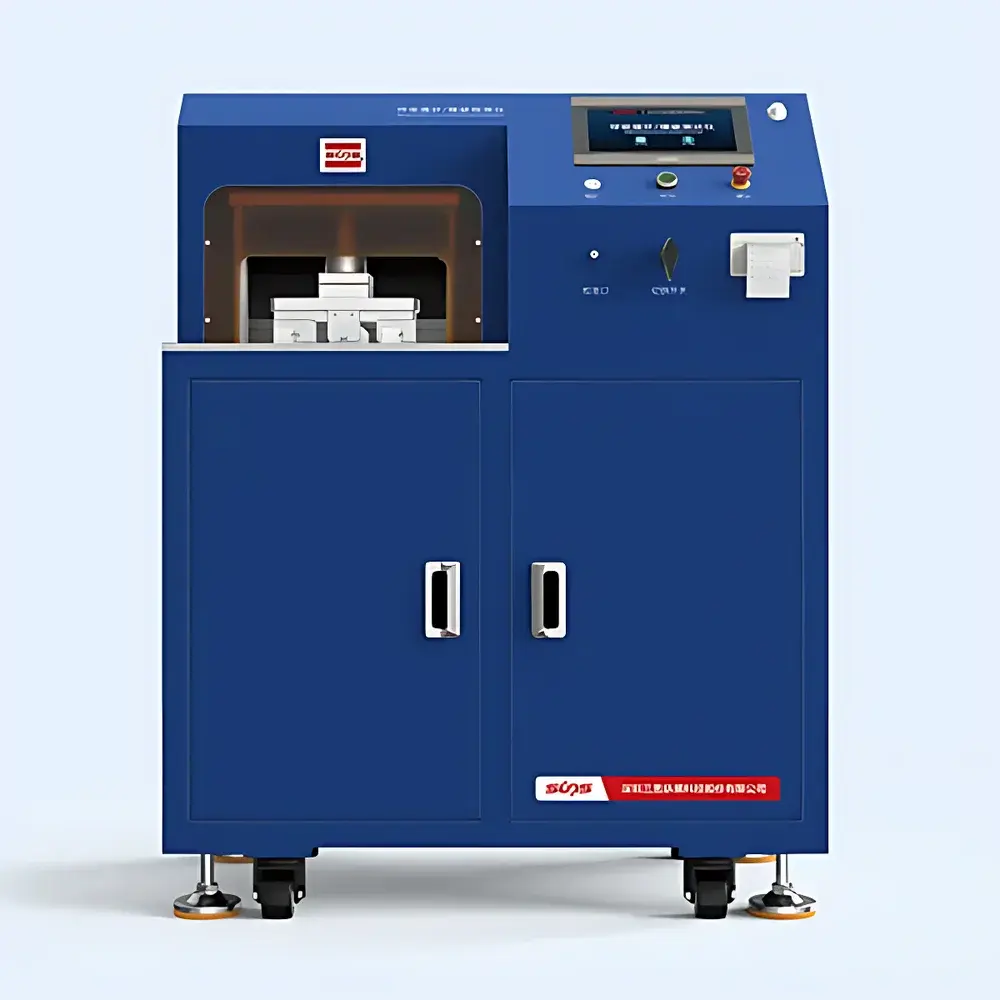
SUNS SHDC3000 Breathing and Burst Pressure Tester
| Brand | SUNS |
|---|---|
| Origin | Shenzhen, China |
| Manufacturer Type | Direct Manufacturer |
| Model | SHDC3000 |
| Test Pressure Range | 0.035–3 MPa (customizable to higher pressures) |
| Timing Range | 0–999.9 s |
| Air Supply Requirement | 0.4–3 MPa (clean, dry compressed air) |
| Resolution | 0.1 kPa / 1 kPa / 0.0001 MPa |
| Accuracy | ±0.2 % FS |
| Pressure Units | kPa, bar, psi, MPa |
| Pressure Regulation | Mechanical or Electrically Controlled (optional) |
| Data Export | USB interface |
| Channel Count | 1 (multi-channel expansion supported) |
| Communication Interfaces | RS485, RJ45 Ethernet (RS232 optional) |
| I/O Ports | 6 digital inputs, 6 digital outputs |
| Display | 10-inch LCD touchscreen |
| Power Supply | AC 110–240 V, 50/60 Hz |
| Test Modes | Leak Integrity, Respiratory Cycling, Burst Pressure |
| Operating Environment | 5–45 °C, ≤80 % RH (non-condensing) |
| Booster Pump Ratio | 3×–5× |
| Dimensions | 980 × 540 × 1252 mm |
Overview
The SUNS SHDC3000 Breathing and Burst Pressure Tester is an integrated pneumatic test platform engineered for precise, repeatable evaluation of pressure integrity and dynamic mechanical performance in medical respiratory devices, packaging systems, and flexible fluid containment components. It operates on a controlled gas pressurization principle—utilizing clean, dry compressed air as the actuation medium—and implements real-time closed-loop pressure regulation to execute three standardized test protocols: static leak integrity (air-tightness), cyclic breathing simulation (repetitive inflation/deflation mimicking physiological respiration), and ultimate burst pressure determination. The system’s architecture complies with fundamental design principles outlined in ISO 11607-2 (packaging for terminally sterilized medical devices), ASTM F2096 (bubble emission test for porous medical packaging), and ISO 8536-4 (infusion equipment standards), making it suitable for R&D validation, quality control release testing, and regulatory submission support under GLP and ISO 13485 frameworks.
Key Features
- Triple-mode operational capability: programmable leak testing, programmable breathing cycle simulation (frequency, dwell time, pressure amplitude independently adjustable), and ramp-to-failure burst testing with automatic pressure hold and rupture detection.
- High-fidelity pressure measurement system featuring dual-range transducers with selectable resolution (0.1 kPa at low range; 0.0001 MPa at high range) and calibrated accuracy of ±0.2 % full scale—traceable to national metrology institutes.
- Modular pneumatic architecture with integrated 3×–5× air-driven booster pump, enabling stable output up to 3 MPa from standard shop air supply (0.4–3 MPa input), eliminating dependency on external high-pressure gas cylinders.
- Industrial-grade 10-inch capacitive touchscreen HMI with intuitive test sequence builder, real-time pressure/time curve visualization, and configurable pass/fail logic based on user-defined thresholds and slope criteria.
- Robust I/O subsystem supporting six digital inputs (e.g., for external trigger signals or sensor feedback) and six digital outputs (e.g., for solenoid valve control, alarm activation, or PLC handshake), facilitating integration into automated production lines.
- Dual communication redundancy: native RS485 Modbus RTU for legacy SCADA compatibility and RJ45 Ethernet with TCP/IP stack for modern MES/SCADA connectivity; RS232 available as optional interface.
Sample Compatibility & Compliance
The SHDC3000 accommodates a broad spectrum of sample geometries and materials—including but not limited to endotracheal tubes, ventilator circuits, anesthesia masks, IV bags, blister packs, pouches, and silicone respiratory bellows—via customizable fixture interfaces and adaptable sealing manifolds. All pressure pathways are constructed from stainless steel and fluoropolymer-lined components to ensure chemical inertness and prevent moisture retention. The system supports audit-ready documentation per FDA 21 CFR Part 11 requirements when paired with validated software (optional add-on), including electronic signatures, change tracking, and immutable test record generation. Calibration certificates, uncertainty budgets, and IQ/OQ documentation packages are available upon request to meet ISO/IEC 17025 laboratory accreditation needs.
Software & Data Management
Embedded firmware enables local test configuration, real-time monitoring, and onboard data logging (up to 10,000 test records with timestamps, operator ID, and environmental metadata). Raw pressure vs. time datasets export directly via USB mass storage in CSV format for post-processing in MATLAB, Python, or statistical analysis tools. Optional PC-based software provides advanced features: multi-test report templating (PDF/Excel), SPC charting (X-bar/R, Cp/Cpk), comparative batch trending, and automated compliance reporting aligned with ISO 13485 clause 8.2.5 and MDR Annex XIV. All exported files include embedded digital signatures and hash verification to satisfy data integrity requirements under GMP Annex 11.
Applications
- Verification of seal integrity in sterile barrier systems per ISO 11607-1 and ASTM F1886.
- Respiratory device fatigue assessment under simulated clinical breathing profiles (e.g., 12–30 cycles/min, 5–40 cmH₂O pressure swing).
- Burst strength qualification of elastomeric components used in CPAP masks and nebulizer chambers.
- Validation of pressure relief mechanisms in infusion sets and dialysis tubing.
- Accelerated life testing of flexible pharmaceutical packaging subjected to vacuum and positive pressure stress.
- Supporting Design Verification (DV) and Process Validation (PV) activities for Class II and III medical devices under FDA QSR 820 and EU MDR.
FAQ
Does the SHDC3000 support automated calibration verification?
Yes—the system includes built-in self-diagnostic routines and supports periodic verification using NIST-traceable reference standards. Optional calibration management software logs all verification events with electronic signatures.
Can test sequences be password-protected and version-controlled?
Yes—user roles (Operator, Supervisor, Administrator) enforce hierarchical access control; all test method revisions are timestamped and archived with change justification fields.
Is the system compatible with LIMS or ERP integration?
Yes—via standard Modbus TCP or HTTP REST API (available with optional software license), enabling bidirectional data exchange with LabVantage, Thermo Fisher SampleManager, or SAP QM modules.
What maintenance intervals are recommended for the booster pump and pressure sensors?
Booster pump oil replacement every 2,000 operating hours; pressure transducer recalibration annually or per internal SOP—certified calibration services available through SUNS global service network.
How is burst detection triggered during ramp testing?
Burst is identified by a sustained pressure drop exceeding 10 % of peak value within 100 ms, confirmed by dual-sensor cross-checking to eliminate false positives from transient leaks or thermal drift.





