
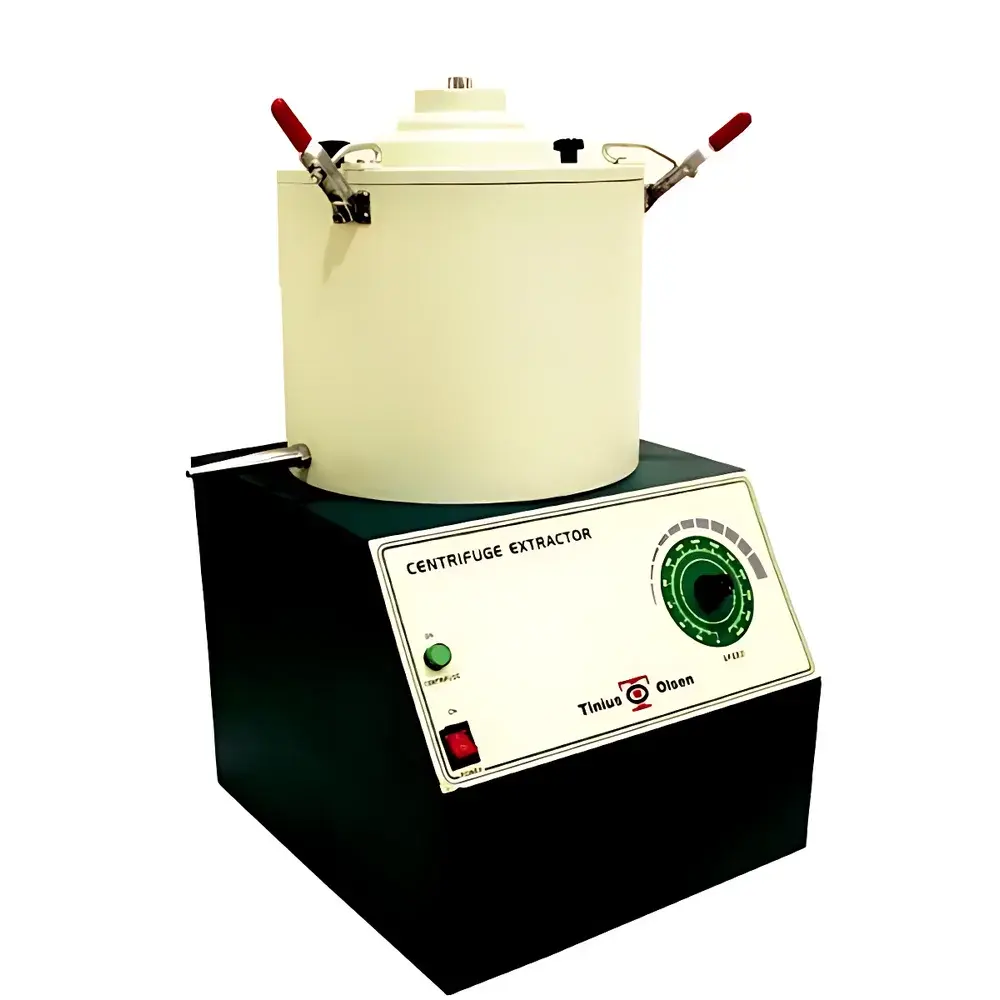
Tinius Olsen TP-563 Asphalt Centrifugal Extractor
| Brand | Tinius Olsen |
|---|---|
| Origin | USA |
| Model | TP-563 |
| Compliance | ASTM D2172, AASHTO T58/T164, EN 12697-1 |
| Adjustable Speed Range | 0–3600 rpm |
| Sample Capacity Options | 1500 kg or 3000 kg |
| Power Supply | 220 V, 50 Hz |
| Includes | 25 precision filter paper discs |
| Construction | Machined aluminum rotating bowl, cast iron housing, vertical shaft drive |
| Operation Mode | Electrical motor-coupled centrifugation |
Overview
The Tinius Olsen TP-563 Asphalt Centrifugal Extractor is an engineered laboratory instrument designed for the quantitative determination of asphalt binder content in hot-mix asphalt (HMA) and cold-mix asphalt specimens. It operates on the principle of centrifugal separation—applying controlled rotational force to displace asphalt binder from aggregate matrix using a compatible solvent (e.g., trichloroethylene or alternative EPA-compliant solvents). The system utilizes a precisely balanced, vertically oriented aluminum rotating bowl mounted on a rigid shaft, enclosed within a robust cast-iron housing. During operation, solvent is introduced via a dedicated feed cup mounted on the housing, allowing uniform wetting and subsequent extraction under high-G conditions. The variable-speed drive enables precise control over centrifugal force (up to ~4,800 × g at 3600 rpm), ensuring reproducible phase separation between dissolved binder and inert aggregate residue. This method delivers gravimetric accuracy aligned with internationally recognized test protocols for quality assurance in pavement materials production and road construction laboratories.
Key Features
- Machined aluminum rotating bowl with precision surface finish for consistent solvent contact and minimal binder retention
- Vertically aligned shaft-and-bowl architecture optimized for mechanical stability and load symmetry at high rotational speeds
- Adjustable speed control (0–3600 rpm) with digital tachometric feedback for repeatable G-force application
- Integrated cast-iron housing providing structural rigidity, vibration damping, and solvent containment compliance
- Quick-clamp mechanism with knurled nut for secure compression of standardized filter paper discs between bowl and cover plate
- Dual capacity configurations available: TP-563-1-03 (1500 kg nominal batch mass) and TP-563-2-03 (3000 kg nominal batch mass)
- CE-compliant electrical drive system rated for continuous-duty operation at 220 V / 50 Hz
Sample Compatibility & Compliance
The TP-563 accommodates standard-sized asphalt specimens prepared per ASTM D2172 Section 7 or AASHTO T58 Section 5—including both plant-produced HMA and field-collected cores (after appropriate size reduction and drying). Filter paper discs (included, 25 units per shipment) conform to ASTM D2172 Annex A1 specifications for porosity, ash content, and dimensional tolerance. The instrument’s mechanical design and operational envelope satisfy all mechanical and procedural requirements outlined in ASTM D2172 (Standard Test Method for Quantitative Extraction of Bitumen from Bituminous Paving Mixtures), AASHTO T58 (Asphalt Content of Hot-Mix Asphalt by Centrifuge Method), AASHTO T164 (Bitumen Content by Ignition Method—used for cross-validation), and EN 12697-1 (Bituminous Mixtures – Test Methods for Hot Mix Asphalt – Part 1: Sampling). Its construction and safety interlocks meet IEC 61000-6-2/6-3 EMC standards and are suitable for GLP-compliant environments requiring documented equipment qualification.
Software & Data Management
While the TP-563 operates as a standalone electromechanical extractor without embedded microprocessor control, it is fully compatible with external laboratory data management systems. Users may integrate rotational speed logs, run duration timestamps, and specimen identification metadata into LIMS platforms via optional analog output modules (0–10 V or 4–20 mA signal interface, available upon request). All calibration records, preventive maintenance logs, and performance verification reports (e.g., speed accuracy verification per ISO 17025 Clause 6.5.2) are maintained in accordance with ISO/IEC 17025:2017 and FDA 21 CFR Part 11–aligned documentation practices when deployed in regulated QA/QC settings. Tinius Olsen provides a comprehensive Equipment Qualification Package (EQP) including IQ/OQ templates and traceable speed calibration certificates.
Applications
- Quality control testing of asphalt binder content in production batches at asphalt plants
- Independent verification of mix designs during pavement engineering studies
- Forensic analysis of pavement distress linked to binder deficiency or overdosing
- Research-grade extraction for rheological characterization of recovered asphalt binders (per AASHTO R30)
- Compliance auditing for DOT-mandated acceptance testing per state-specific construction specifications
- Training and proficiency testing in asphalt technology education programs accredited by NCAT or Eurobitume
FAQ
What solvents are compatible with the TP-563?
Trichloroethylene (TCE) remains the reference solvent per ASTM D2172; however, alternatives such as n-propyl bromide (nPB) or bio-based terpene solvents may be used if validated for equivalent extraction efficiency and residue volatility.
Is operator training provided with purchase?
Yes—Tinius Olsen offers on-site or virtual commissioning support, including hands-on operation, safety protocol review, and routine maintenance demonstration.
Can the TP-563 be used for reclaimed asphalt pavement (RAP) analysis?
Yes, provided RAP samples are pre-screened to ≤19 mm and dried to constant mass prior to extraction; method adjustments may be required for highly oxidized or polymer-modified binders.
Does the system include solvent recovery capability?
No—the TP-563 is a dedicated extraction unit; solvent recovery must be performed externally using distillation or adsorption systems compliant with local environmental regulations.
How often does the rotating bowl require recalibration?
Speed calibration is recommended annually or after any major mechanical service; traceable verification against a NIST-traceable tachometer is advised per ISO/IEC 17025 internal audit requirements.







