
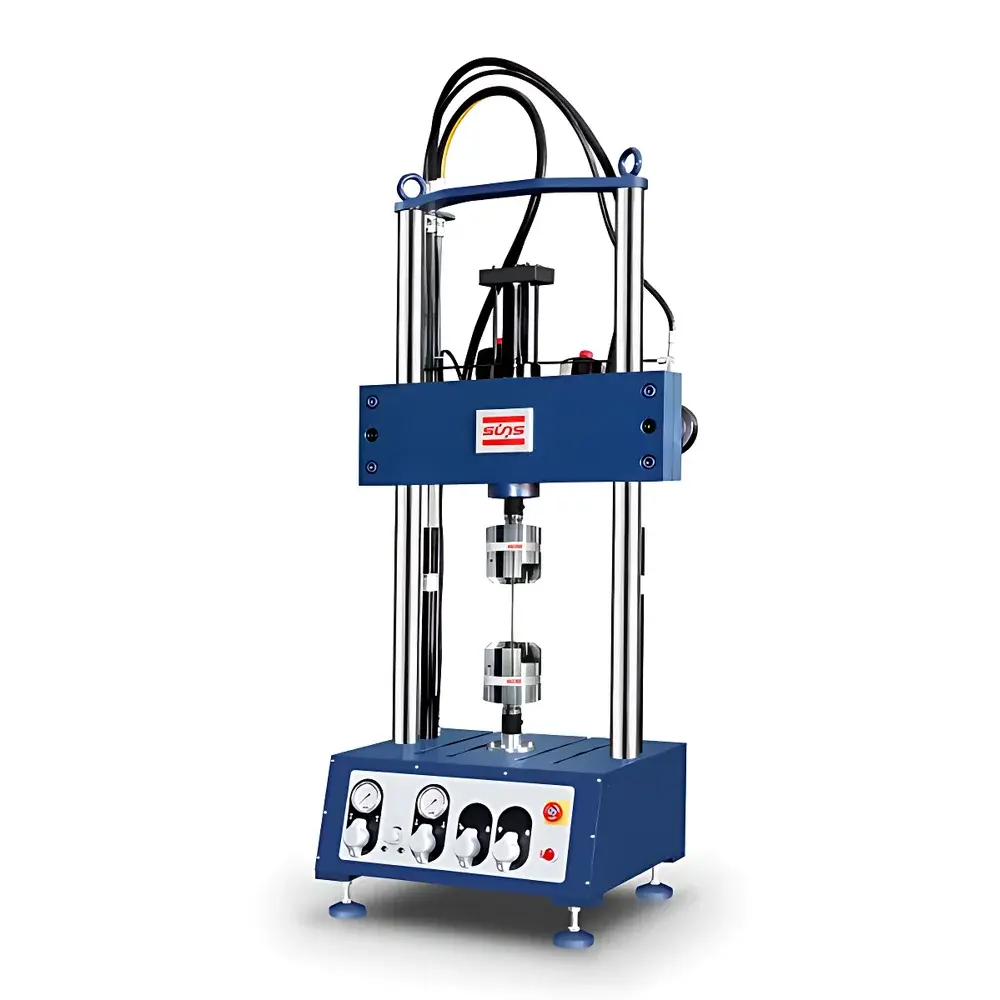
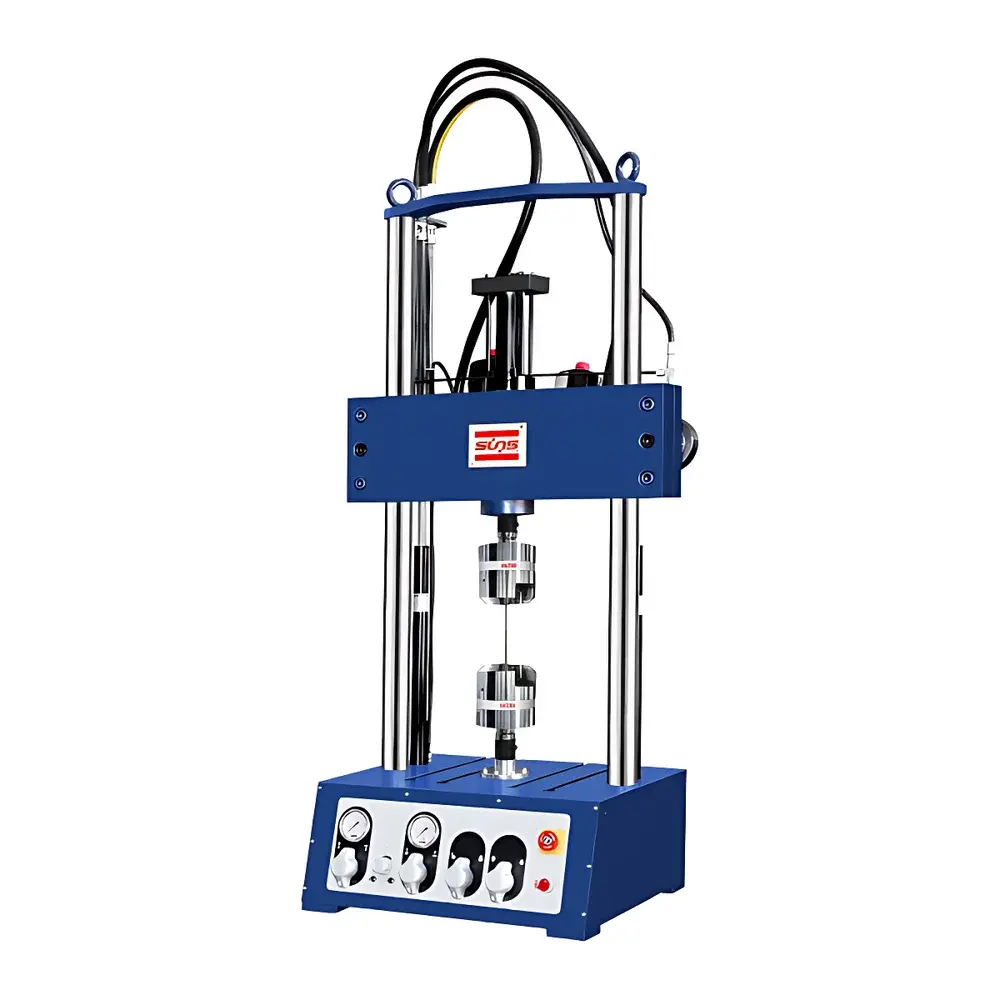
SUNS SUNS890 Series Desktop Electro-Hydraulic Servo Fatigue Testing Machine
| Brand | SUNS |
|---|---|
| Origin | Guangdong, China |
| Manufacturer Type | Direct Manufacturer |
| Regional Classification | Domestic (China) |
| Model | SUNS890 |
| Instrument Type | Electro-Hydraulic Servo Fatigue Testing Machine |
| Maximum Test Load | 25 kN |
| Frequency Range | 0.01–50 Hz |
| Host Weight | 435 kg |
Overview
The SUNS SUNS890 Series Desktop Electro-Hydraulic Servo Fatigue Testing Machine is an engineered solution for high-precision static and dynamic mechanical characterization of structural materials and components. Based on closed-loop electro-hydraulic servo control architecture, it delivers precise force and displacement actuation through a high-bandwidth hydraulic actuator system coupled with real-time digital signal processing. The system operates on the principle of servo-controlled cyclic loading—applying programmable waveforms (sinusoidal, triangular, square, trapezoidal, and user-defined random spectra) to induce fatigue damage under controlled stress/strain/position regimes. Designed for laboratory-scale deployment, the SUNS890 accommodates standard test specimens and full-scale subcomponents across aerospace, nuclear, biomedical, and advanced composite applications. Its compact T-frame structural design ensures high rigidity (≥1.2 × 10⁶ N/mm vertical stiffness), minimizing parasitic deflection during high-cycle testing and enabling reliable data acquisition in both low-cycle (LCF) and high-cycle (HCF) fatigue regimes.
Key Features
- T-frame monolithic base structure with integrated T-slot worktable—optimized for torsional and bending rigidity, supporting rapid fixture interchangeability and modular environmental chamber integration (e.g., high-temperature furnaces up to 1200°C, thermal chambers from –70°C to +350°C, and corrosion-resistant enclosures).
- Top-mounted servo actuator with ±75 mm stroke and oil-immersed motor-driven hydraulic pump—ensuring low acoustic emission (<65 dB(A)), stable thermal equilibrium, and extended operational duty cycles without performance drift.
- Closed-loop hydraulic power unit with pressure-compensated flow control—eliminates external oil reservoirs and reduces footprint while maintaining consistent pressure response across 0.01–50 Hz frequency bandwidth.
- Three-mode closed-loop control: force control, strain control, and displacement control—with seamless transition between modes and automatic gain scheduling for optimal stability at resonance frequencies.
- Adjustable crosshead height via hydraulic lift mechanism—enabling continuous vertical travel adjustment (≥800 mm usable test space) without mechanical reassembly or alignment recalibration.
Sample Compatibility & Compliance
The SUNS890 supports standardized specimen geometries per ASTM E466, ISO 1099, and GB/T 2611–2007, including dog-bone tensile bars, notched bend beams, compact tension (CT) specimens, and adhesive lap-shear coupons. Optional fixtures include hydraulically actuated wedge grips, four-point bending assemblies, and compression platens compliant with ASTM E9 and ISO 3187. System validation adheres to JJG 556–2011 (axial fatigue calibration protocol) and HB 7705–2001 (small-crack growth rate measurement). Full traceability is maintained via NIST-traceable load cell calibration certificates (±0.5% FS accuracy over 2–100% full scale) and encoder-based displacement verification per ISO 23718. The platform meets GLP-compliant data integrity requirements, with audit-trail-enabled software logging all parameter changes, calibration events, and test interruptions.
Software & Data Management
The proprietary SUNS FatigueTest Pro software provides ISO/IEC 17025-aligned test sequencing, real-time S–N curve generation, crack growth rate (da/dN) calculation per ASTM E647, and hysteresis loop analysis. All raw sensor data—including load, displacement, extensometer strain, and environmental chamber feedback—is timestamped at ≥1 kHz sampling rate and stored in HDF5 format for long-term archival and third-party post-processing (MATLAB, Python Pandas, or MTS TestSuite compatibility). Software architecture complies with FDA 21 CFR Part 11 requirements for electronic records and signatures, featuring role-based access control, encrypted database storage, and immutable audit logs. Export options include CSV, PDF reports with embedded metadata, and XML-based test definitions for automated batch execution.
Applications
The SUNS890 is routinely deployed in academic fracture mechanics labs for R-curve determination and threshold stress intensity factor (ΔKth) mapping; in aerospace OEM quality assurance for turbine blade vibration fatigue screening per SAE AIR 4502B; in nuclear regulatory compliance testing for pressure vessel weld integrity per ASME Section III Appendix II; and in biomaterial development for cyclic loading of orthopedic implants (ASTM F2129, ISO 14801). Its versatility extends to viscoelastic polymer fatigue life prediction, adhesive joint durability assessment (GB/T 27595–2011), and seismic damper qualification per EN 15129.
FAQ
What load capacities are available in the SUNS890 series?
The SUNS890 platform offers three standard configurations: 10 kN, 20 kN, and 25 kN maximum rated force—each calibrated to ±0.5% FS accuracy across 2–100% of full scale.
Can the system perform crack propagation tests?
Yes—the machine supports linear elastic fracture mechanics (LEFM) testing per ASTM E399 and E647, including ΔK-controlled crack growth rate measurements using clip-gauge or DC potential drop methods.
Is environmental chamber integration supported?
Fully compatible with commercially available high-temperature furnaces, thermal shock chambers, and salt-fog corrosion enclosures—mechanically and electrically interfaced via standardized I/O modules and PID synchronization protocols.
Does the system meet international metrological standards?
Calibration and verification procedures conform to JJG 556–2011, ISO 1099, and ASTM E466; load cells and displacement transducers carry valid NIST-traceable certification reports.
What waveform types can be generated?
Standard waveforms include sine, triangle, square, trapezoidal, and user-defined arbitrary waveforms—programmable with variable amplitude, frequency sweep, hold segments, and phase offset for multi-axis coordination studies.



