
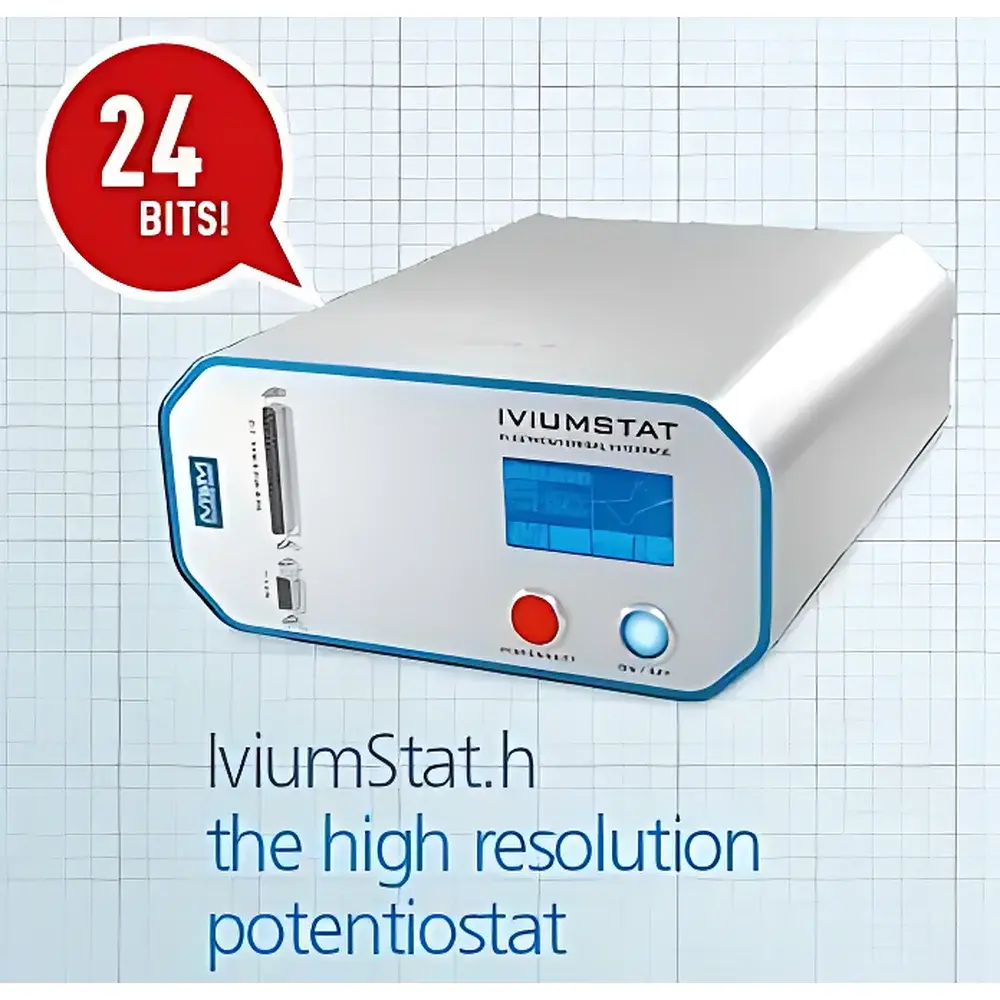
Iviumstat.h Electrochemical Workstation
| Brand | Ivium |
|---|---|
| Origin | Netherlands |
| Model | iviumstat.h |
| Channel Count | Single-Channel |
| Current Range | ±5 A |
| Current Accuracy | ±0.2% |
| Potential Accuracy | ±1 mV |
| Potentiostatic Range | ±10 V |
| EIS Frequency Range | 10 µHz – 8 MHz |
| Current Resolution | 0.6 aA (at 1 pA range) |
| Potential Resolution | 0.15 nV |
| Sampling Rate (Standard) | 100 kHz (10 µs interval) |
| EIS High-Frequency Capability | Up to 8 MHz for solid-state impedance characterization |
| Input Impedance (HiZ module) | >10¹⁵ Ω |
| Bias Current (HiZ) | 3 fA |
| Wireless Connectivity | Integrated Wi-Fi module with SD card data logging |
| Cloud Integration | Ivium Cloud remote access and instrument control via web browser |
| Temperature Monitoring | K-type thermocouple support (TCM-K module) |
| Photoelectrochemical Options | ModuLight LED source (365–940 nm), iviSun solar simulator (1075 W/m², AM1.5G compliant) |
| Expandability | BiStat (dual potentiostat), MultiWE32 (32-electrode multiplexer), QCM/E-QCM, SPR/E-SPR, RDE/RRDE control |
Overview
The Iviumstat.h is a high-performance, single-channel electrochemical workstation engineered for precision electrochemical research and industrial quality control. Built on Ivium’s proprietary digital potentiostat architecture, it employs real-time digital signal processing (DSP) and low-noise analog front-end design to deliver exceptional resolution and stability across a wide dynamic range. Its core measurement principle is based on controlled-potential (potentiostatic) and controlled-current (galvanostatic) techniques, supporting fundamental methods including cyclic voltammetry (CV), linear sweep voltammetry (LSV), chronoamperometry (CA), chronopotentiometry (CP), and electrochemical impedance spectroscopy (EIS). With an EIS frequency bandwidth extending from 10 µHz to 8 MHz, the Iviumstat.h is uniquely suited for characterizing fast interfacial processes in battery materials, corrosion layers, conductive polymers, and solid electrolytes—where high-frequency response is critical for resolving charge-transfer resistance and double-layer capacitance.
Key Features
- Ultra-low noise performance: 0.6 aA current resolution (at 1 pA full scale) and 0.15 nV potential resolution enable detection of sub-femtoampere Faradaic currents and microvolt-level potential shifts.
- High-speed transient capability: Standard sampling rate of 100 kHz (10 µs interval); expandable to 20 MHz (50 ns interval) with FastScan module for ultrafast kinetic studies.
- Extended dynamic range: ±5 A maximum output current and ±10 V compliance voltage; compatible with HiZ module (>10¹⁵ Ω input impedance, 3 fA bias current) for insulating or high-impedance samples.
- Integrated wireless operation: Wi-Fi module enables cable-free communication—essential for glovebox-integrated experiments—and supports local SD-card data storage to ensure continuity during host PC power loss.
- Cloud-enabled remote operation: Ivium Cloud allows secure, browser-based access to powered instruments from any internet-connected device (laptop, tablet, smartphone), facilitating collaborative labs and off-site monitoring.
- Dedicated photoelectrochemical modules: ModuLight (tunable monochromatic LEDs, 365–940 nm) and iviSun (1075 W/m², AM1.5G-compliant solar simulator) support IPCE, IMPS, IMVS, and full J–V curve analysis with automated parameter extraction (Isc, Eoc, Pmax, FF).
Sample Compatibility & Compliance
The Iviumstat.h is compatible with standard three-electrode electrochemical cells (working, reference, counter), rotating disk electrodes (RDE), rotating ring-disk electrodes (RRDE), quartz crystal microbalances (QCM), and surface plasmon resonance (SPR) systems when equipped with optional interface modules. Its hardware and software architecture comply with GLP/GMP data integrity requirements: all measurements include timestamped metadata, user authentication logs, and audit-trail-enabled method files. EIS data acquisition adheres to ASTM G106 and ISO 16773 standards for impedance measurement reproducibility. The system supports 21 CFR Part 11-compliant electronic signatures and data archiving when deployed with IviumSoft’s validated configuration package.
Software & Data Management
IviumSoft, the native Windows-based control and analysis suite, provides modular, intuitive workflows for experiment design, real-time visualization, and post-processing. Its EIS fitting engine implements non-linear least-squares regression with drag-and-drop circuit element assembly and auto-initialization of parameters. The “Mixed Mode” function enables synchronized application of up to 255 sequential or combinatorial stimuli—including potential/current steps, ramps, and open-circuit holds—while simultaneously recording EIS spectra at each step. For battery research, built-in PITT and GITT protocols extract diffusion coefficients and phase transition kinetics. Electrochemical noise (ECN) analysis includes time-domain statistics, FFT spectral decomposition, and trend removal algorithms—all operating directly on raw aA/nV-resolution data streams. All datasets are stored in open-format .txt or .csv files, ensuring long-term archival compatibility and third-party interoperability.
Applications
- Battery and fuel cell R&D: SEI formation kinetics, Li-ion diffusion coefficient mapping (via GITT/PITT), cathode/anode impedance evolution under cycling.
- Corrosion science: Polarization resistance (Rp), Tafel analysis, electrochemical noise monitoring of localized pitting, and cyclic polarization for passivation behavior.
- Photoelectrochemistry: Quantum efficiency mapping of perovskite and dye-sensitized solar cells, transient photocurrent analysis under modulated illumination.
- Electrocatalysis: Reaction mechanism elucidation via scan-rate-dependent CV, reaction order determination, and EIS-based identification of rate-limiting steps.
- Conductive polymer and biosensor development: In-situ doping/dedoping studies, redox switching kinetics, and impedance-based label-free biomolecular detection.
FAQ
What is the maximum EIS frequency supported by the Iviumstat.h?
The Iviumstat.h achieves an upper EIS limit of 8 MHz, optimized for high-frequency dielectric and interfacial characterization of solid-state electrolytes and thin-film coatings.
Can the Iviumstat.h operate inside an inert-atmosphere glovebox?
Yes—its integrated Wi-Fi module eliminates the need for feedthrough cables, enabling fully wireless operation and real-time data streaming from within argon- or nitrogen-filled gloveboxes.
Is multi-electrode screening possible with this workstation?
While the base Iviumstat.h is single-channel, the optional MultiWE32 module enables sequential or parallel interrogation of up to 32 working electrodes using shared reference and counter electrodes—ideal for high-throughput catalyst or sensor array testing.
Does the system support regulatory-compliant data handling for pharmaceutical or medical device applications?
When configured with IviumSoft’s validation package, the system meets 21 CFR Part 11 requirements for electronic records and signatures, including role-based access control, immutable audit trails, and secure data export.
How is temperature integration achieved during electrochemical experiments?
The TCM-K thermocouple module connects via 15-pin or 37-pin D-sub interface, delivering real-time K-type thermocouple readings synchronized with electrochemical data acquisition at user-defined sampling intervals.






