
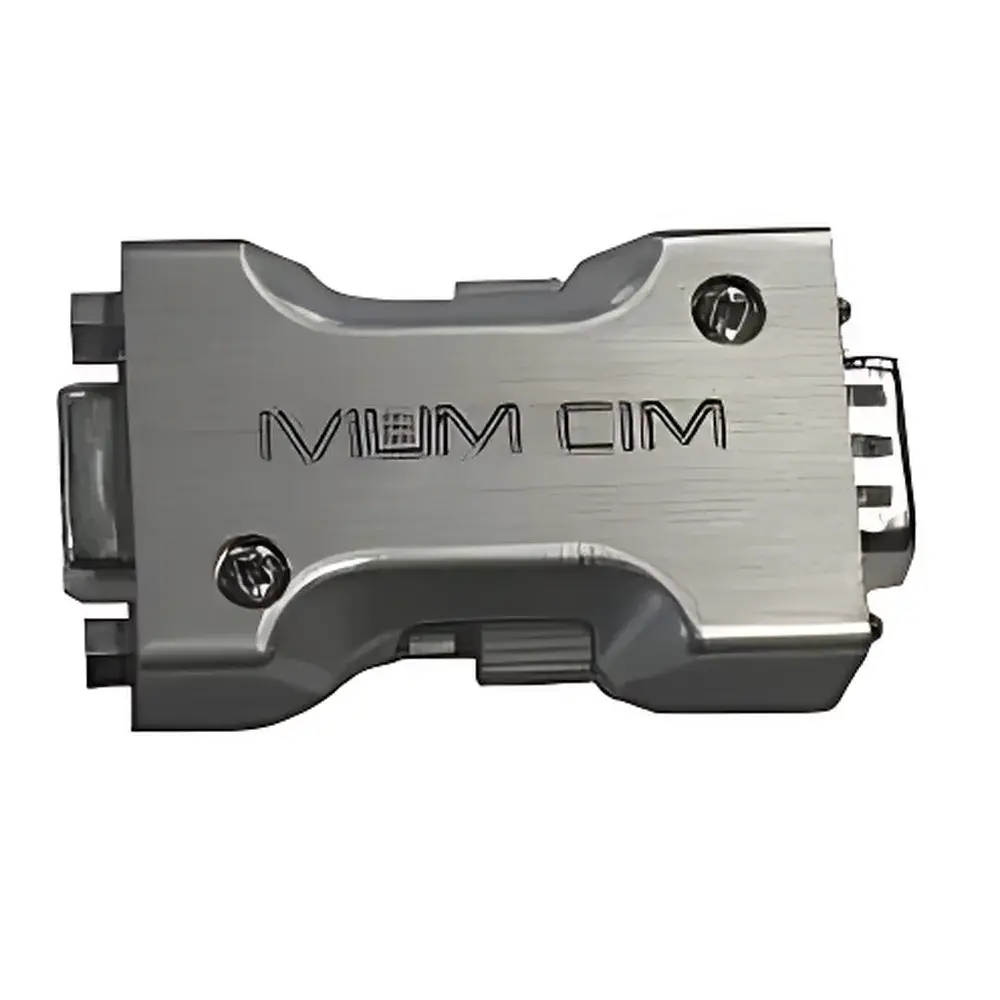
Ivium Current Interrupt Module (CIM) for iR Compensation
| Brand | Ivium |
|---|---|
| Origin | Netherlands |
| Model | Current Interrupt Module |
| Instrument Type | Electrochemical Instrument Accessory |
| Application | iR Compensation via Current Interruption Method |
| Connectivity | Direct integration with Ivium potentiostat electrode cable assemblies |
| Compliance Context | Designed for use in ASTM G102-compliant corrosion testing and ISO 17475 electrochemical impedance validation workflows |
Overview
The Ivium Current Interrupt Module (CIM) is a precision-engineered hardware accessory designed exclusively for real-time iR compensation in electrochemical measurements using the current interruption method. Unlike software-based compensation techniques, the CIM implements a hardware-synchronized, zero-latency interruption of the applied current during galvanostatic or potentiostatic experiments—enabling direct measurement of the uncompensated solution resistance (Ru) without perturbing the electrochemical interface. This module operates by inserting a high-speed electronic switch between the working electrode lead and the potentiostat’s current source, triggering microsecond-scale current breaks synchronized to the control signal. The resulting instantaneous potential decay is captured by the Ivium potentiostat’s high-bandwidth analog front end, allowing accurate Ru extraction and subsequent automatic correction of ohmic drop across the electrolyte. The CIM is not a standalone instrument but a system-level extension that enhances measurement fidelity in low-impedance cells, high-conductivity media, and fast kinetic studies where uncompensated resistance introduces significant error in Tafel analysis, polarization resistance (Rp) determination, and EIS modeling.
Key Features
- Hardware-integrated current interruption with sub-10 µs switching latency, minimizing transient artifacts during potential recovery
- Seamless plug-and-play compatibility with all IviumStat, IviumCompact, and Ivium-n-Stat series potentiostats via standardized electrode cable interface
- No firmware update or configuration required—automatically recognized and enabled through IviumSoft’s advanced experiment scripting engine
- Galvanostatic and potentiostatic mode support, including pulsed and stepped current protocols
- Robust opto-isolated triggering circuitry ensures electrical noise immunity and prevents ground-loop interference in multi-cell setups
- Calibration-free operation: leverages the potentiostat’s internal reference voltage and ADC timing synchronization for traceable Ru quantification
Sample Compatibility & Compliance
The CIM is optimized for aqueous and non-aqueous electrochemical systems where solution resistance ranges from 0.1 Ω to 5 kΩ—covering applications such as battery electrode characterization, corrosion rate assessment per ASTM G102, coated metal evaluation per ISO 16773, and fuel cell catalyst layer impedance profiling. It supports standard three-electrode configurations (working, counter, reference) and is compatible with microelectrodes, rotating disk electrodes (RDE), and electrochemical quartz crystal microbalance (EQCM) cells when used with appropriate Ivium cable adapters. From a regulatory standpoint, the CIM contributes to GLP-compliant data acquisition when deployed within IviumSoft’s audit-trail-enabled environments (21 CFR Part 11 compliant with electronic signature modules). Its design adheres to IEC 61010-1 safety standards for laboratory electrical equipment and meets CE marking requirements for EMC and low-voltage directives.
Software & Data Management
The CIM is fully controlled through IviumSoft v6.x or later, where it appears as an active hardware option in the “Compensation” tab of any technique setup dialog. Users select “Current Interrupt” from the iR compensation dropdown, define interruption duration (typically 10–100 µs) and post-interruption sampling window (1–50 µs), and specify whether compensation is applied online (during acquisition) or offline (during post-processing). All raw interruption transients are stored alongside primary data in the native .mpt binary format, preserving full temporal resolution for retrospective Ru re-evaluation. Data export supports CSV, ASCII, and MATLAB-compatible formats, with metadata fields explicitly tagging CIM activation status, interruption timing parameters, and calculated Ru values. For automated QA/QC workflows, IviumSoft’s script engine (via Python or IviumScript) enables conditional activation of CIM-based compensation based on measured current thresholds or impedance magnitude.
Applications
- Accurate determination of charge transfer resistance (Rct) in lithium-ion battery half-cells with low-ohmic separators
- Quantitative corrosion rate calculation in aggressive chloride media using linear polarization resistance (LPR) with validated iR correction
- High-fidelity Tafel extrapolation for hydrogen evolution reaction (HER) kinetics on Pt-group catalysts
- Stability assessment of conductive polymer coatings under accelerated aging conditions
- Real-time monitoring of electrolyte conductivity changes during in situ electrochemical impedance spectroscopy (EIS)
- Validation of reference electrode placement in flow-through electrochemical reactors
FAQ
Is the CIM compatible with third-party potentiostats?
No—the CIM is electrically and protocol-specific to Ivium’s proprietary electrode interface architecture and cannot be retrofitted to non-Ivium instruments.
Does the CIM require recalibration after installation?
No—its operation relies on intrinsic timing and voltage references embedded in the host potentiostat; no user calibration is necessary.
Can the CIM be used during electrochemical impedance spectroscopy (EIS)?
Yes, but only in hybrid modes such as current-interrupt assisted DC-biased EIS or as a pre-measurement step to determine Ru prior to frequency sweep acquisition.
What is the minimum measurable solution resistance using the CIM?
With proper cabling and shielding, reliable Ru resolution down to 0.05 Ω is achievable in well-designed low-impedance cells.
How does the CIM differ from positive feedback iR compensation?
Unlike positive feedback methods—which inject compensating current and risk instability—the CIM measures Ru passively during controlled current breaks, eliminating loop gain uncertainty and ensuring unconditional stability.





