
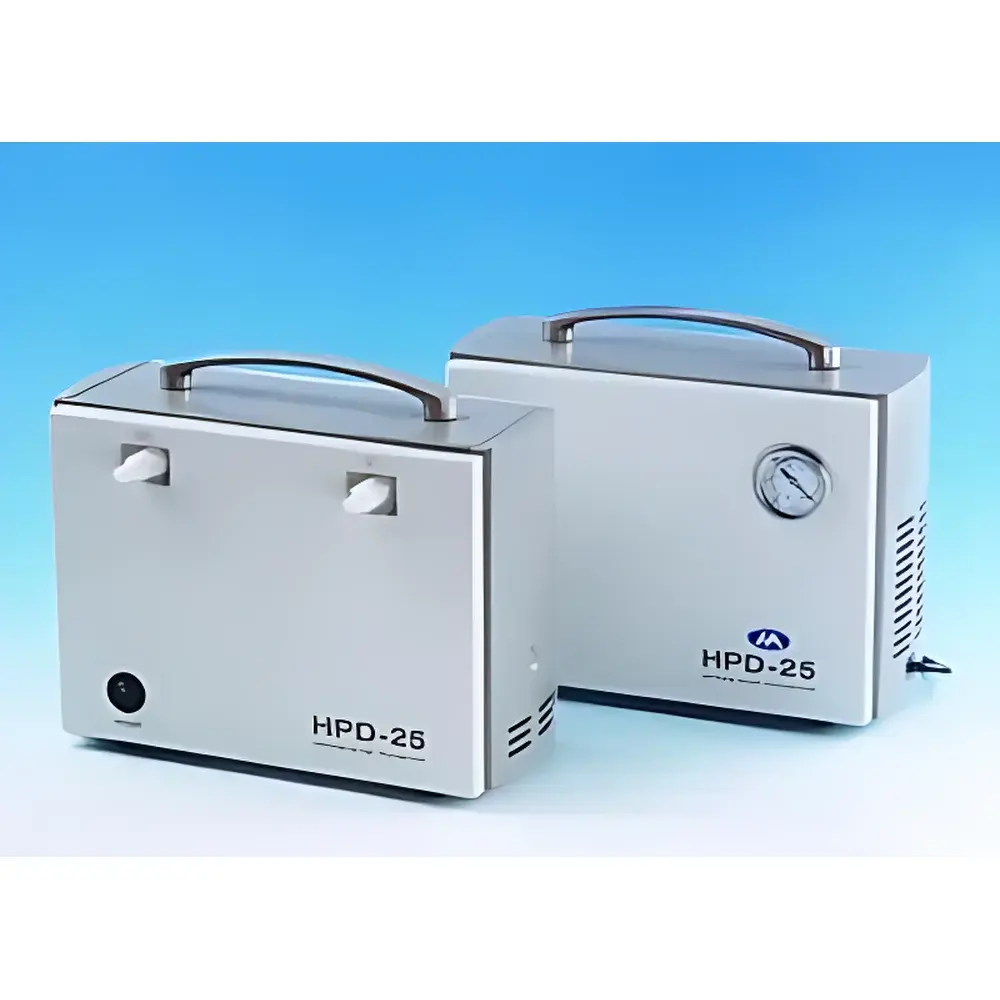
Chu Ding Technology HPD-25A Oil-Free Diaphragm Vacuum Pump
| Brand | Chu Ding Technology |
|---|---|
| Origin | Tianjin, China |
| Model | HPD-25A |
| Pump Type | Diaphragm Vacuum Pump |
| Lubrication | Oil-Free |
| Ultimate Vacuum | 0.1 MPa (abs) |
| Flow Rate | 25 L/min |
| Motor Power | 60 W |
| Application | Vacuum Filtration, Vacuum Drying, Rotary Evaporation Support, Solid-Phase Extraction (SPE), Positive-Pressure Filtration |
Overview
The Chu Ding Technology HPD-25A is an oil-free diaphragm vacuum pump engineered for reliable, contamination-free vacuum generation in analytical and preparative laboratory workflows. Unlike oil-lubricated rotary vane pumps, this unit employs a sealed, elastomeric diaphragm actuated by an eccentric cam mechanism—eliminating hydrocarbon vapor backstreaming, oil mist carryover, or solvent degradation of internal components. Its operating principle relies on cyclic volume displacement within a chemically resistant chamber, generating vacuum through mechanical expansion and contraction without lubricant involvement. Designed specifically for intermittent-to-moderate-duty applications—including vacuum-assisted filtration, desiccation, concentration under reduced pressure, and SPE manifold support—the HPD-25A delivers a stable ultimate vacuum of 0.1 MPa (absolute), with a nominal free-air flow rate of 25 L/min at atmospheric inlet conditions. Its compact footprint (220 × 120 × 180 mm), low acoustic emission (<52 dB(A)), and thermally managed 60 W induction motor enable quiet, energy-efficient operation on standard 230 V / 50 Hz laboratory circuits.
Key Features
- Oil-free diaphragm architecture ensures zero risk of sample or system contamination—critical for HPLC mobile phase degassing, lyophilization pre-chamber evacuation, and pharmaceutical QC sample preparation.
- Reinforced 3 mm composite diaphragm: constructed from solvent-resistant nitrile rubber with embedded woven polyester reinforcement layer, providing high fatigue resistance over >10,000 operational cycles under typical lab duty cycles.
- Thermally optimized motor design minimizes heat buildup during extended operation; integrated thermal cutoff protection prevents coil damage during accidental overloading or restricted exhaust conditions.
- Modular exhaust configuration: standard vented outlet accepts optional silencer or activated carbon filter kit for VOC abatement; optional pressure-regulating valve enables precise control of suction force for delicate membrane filtration or gel drying.
- Ergonomic housing with non-slip rubber feet, recessed power switch, and IP20-rated enclosure suitable for ISO Class 7 clean bench integration when used with external exhaust ducting.
Sample Compatibility & Compliance
The HPD-25A is compatible with aqueous, mildly acidic/basic, and low-polarity organic solvents (e.g., methanol, acetonitrile, ethyl acetate) commonly encountered in sample prep workflows. It is not rated for halogenated solvents (e.g., chloroform, DCM), strong oxidizers (e.g., concentrated HNO₃), or corrosive vapors (e.g., HF, HCl gas). While not certified to IEC 61000-6-3 (EMC) or UL 61010-1 as a standalone device, its electrical design complies with GB 4793.1–2007 (Chinese equivalent of IEC 61010-1) for laboratory equipment safety. The pump meets general requirements for GLP-compliant environments when operated per manufacturer’s maintenance schedule (diaphragm replacement every 12–18 months under average use); audit-ready usage logs can be maintained via optional RS-232 interface (firmware v2.1+).
Software & Data Management
The HPD-25A operates as a stand-alone analog device with no embedded microcontroller or digital display. However, it supports external process monitoring via its optional analog voltage output (0–5 V DC proportional to motor current draw) or TTL-level run-status signal. When integrated into automated platforms—such as vacuum-controlled parallel evaporators or SPE workstations—it interfaces seamlessly with LabVIEW, Python (PySerial), or PLC-based control systems for duty-cycle logging, fault detection (e.g., current surge indicating diaphragm failure), and scheduled shutdown protocols. All firmware updates, calibration certificates, and maintenance checklists are provided in English and comply with ISO/IEC 17025 documentation traceability standards.
Applications
- Vacuum filtration of biological suspensions, colloidal dispersions, and particulate-laden environmental extracts using glass fiber, PTFE, or PVDF membranes.
- Supporting benchtop rotary evaporators requiring stable sub-atmospheric pressure (≤100 mbar) for low-boiling-point solvent removal.
- Drying heat-sensitive compounds (e.g., peptides, oligonucleotides) in vacuum ovens where hydrocarbon residue must be excluded per USP compounding guidelines.
- Positive-pressure filtration in syringe-driven microfiltration setups where backpressure regulation improves reproducibility across replicate samples.
- Pre-evacuation of sample vials prior to headspace GC analysis to minimize atmospheric interference and improve analyte transfer efficiency.
FAQ
What is the maximum continuous duty cycle recommended for the HPD-25A?
For optimal diaphragm longevity, continuous operation should not exceed 45 minutes followed by a 15-minute cooldown period. Intermittent use (e.g., 10 min on / 5 min off) extends service life beyond 2 years under typical lab conditions.
Can the HPD-25A be used with aggressive solvents like acetone or THF?
Acetone is acceptable with short-term exposure; THF requires caution due to potential swelling of nitrile diaphragms—consult the chemical compatibility chart in Section 4.2 of the English user manual before deployment.
Is the pump compliant with FDA 21 CFR Part 11 for electronic records?
As a non-digital, non-networked device, the HPD-25A does not generate electronic records. However, its analog output signals may feed into Part 11–compliant data acquisition systems when validated per site-specific SOPs.
Does the HPD-25A include an exhaust filter by default?
No. A replaceable activated carbon exhaust filter (Cat. No. HPD-FIL-C) is available as an optional accessory to mitigate volatile organic emissions during solvent-intensive applications.
What maintenance intervals are specified for regulatory audits?
Diaphragm replacement every 12 months (or after 1,500 operating hours), motor bearing inspection every 24 months, and visual housing integrity check before each shift—documented in accordance with ISO/IEC 17025 clause 6.4.4.
Related Products



