
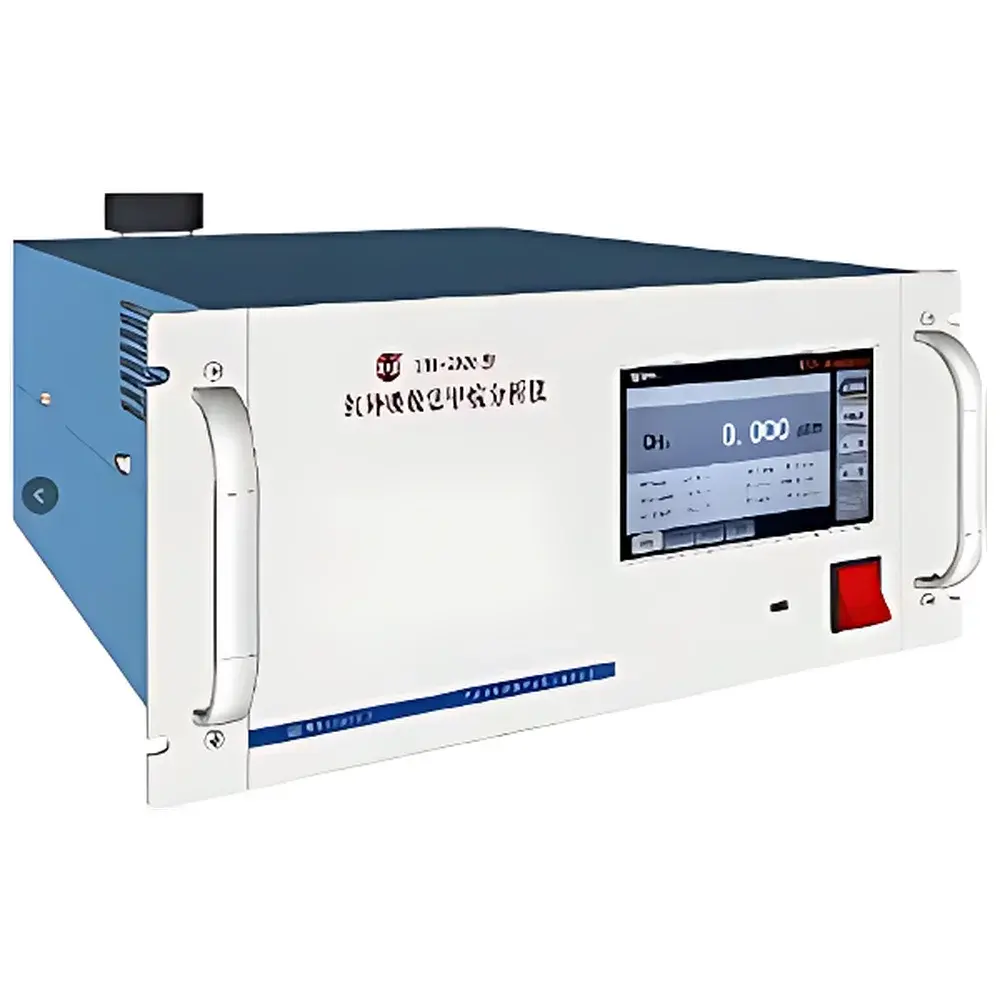
Tianhong TH-2026 Infrared Absorption Methane Analyzer
| Brand | Tianhong |
|---|---|
| Origin | Hubei, China |
| Model | TH-2026 |
| Detection Principle | Gas Correlation Infrared Absorption |
| Measurement Range | Low-concentration CH₄ in ambient air and flue gas |
| Output Units | mg/m³, µg/m³, nmol/mol, µmol/mol, ppm, ppb |
| Display | 7-inch full-touch color LCD |
| Data Logging | One year of stored records (5-minute intervals) |
| Environmental Compensation | Automatic temperature & pressure compensation |
| Remote Capability | Remote calibration & diagnostic parameter access |
| Filter Wheel | Engineered gas-correlation wheel with CH₄/N₂ spectral filters |
| Compliance Context | Designed for continuous emission monitoring (CEM) in accordance with China’s HJ 1012–2018 and compatible with international ambient air quality reference methodologies (e.g., ISO 13964, ASTM D6522) |
Overview
The Tianhong TH-2026 Infrared Absorption Methane Analyzer is a fixed-installation, continuous gas monitoring instrument engineered for high-stability quantification of methane (CH₄) in ambient air and low-concentration industrial exhaust streams. It operates on the principle of gas correlation infrared absorption—a selective, interference-resistant variant of non-dispersive infrared (NDIR) spectroscopy. Unlike conventional broadband NDIR systems, the TH-2026 employs a rotating dual-filter wheel containing precisely tuned CH₄-specific and inert N₂ reference filters. This design eliminates cross-sensitivity to water vapor, CO₂, and other common IR-absorbing interferents by ensuring that only spectrally matched radiation interacts with the sample gas. The analyzer measures the differential attenuation between measurement and reference optical paths, applying the Lambert–Beer law to derive CH₄ concentration with robust baseline stability and minimal drift over extended operation cycles.
Key Features
- Gas correlation infrared detection architecture with mechanically rotated CH₄/N₂ filter wheel—optimized for long-term reliability and reduced spectral interference.
- 7-inch capacitive touch-screen interface supporting real-time unit conversion among mg/m³, µg/m³, nmol/mol, µmol/mol, ppm, and ppb—enabling direct alignment with regulatory reporting formats (e.g., EU Directive 2008/50/EC or US EPA Method 25A).
- Auto-ranging optical path gain control ensures linear response across dynamic concentration spans typical of landfill biogas vents, coal-fired power plant stack emissions, and municipal waste incinerator off-gases.
- Onboard temperature and barometric pressure sensors feed real-time compensation algorithms—critical for maintaining stoichiometric accuracy under variable site conditions.
- Adaptive signal processing firmware dynamically adjusts integration time and baseline correction to maximize signal-to-noise ratio (SNR) while minimizing response lag—typical T₉₀ < 30 seconds for step changes within 0–10 ppmv range.
- Remote maintenance capability via secure Ethernet or RS-485 interface: supports remote zero/span calibration verification, internal diagnostics (lamp intensity, detector bias, wheel position), and firmware updates without physical site access.
Sample Compatibility & Compliance
The TH-2026 is validated for continuous sampling of unfiltered ambient air and conditioned flue gas (post-particulate filtration, dew point < 5 °C). It meets the functional requirements of China’s HJ 1012–2018 standard for “Environmental Air Quality—Determination of Methane and Non-Methane Hydrocarbons by Gas Chromatography” as a complementary continuous monitoring solution. While not a chromatographic system, its gas correlation methodology provides traceable, field-deployable CH₄ data suitable for trend analysis, fugitive emission screening, and compliance pre-monitoring. The analyzer’s hardware architecture adheres to IP54 ingress protection and EMC Class B emission limits per GB/T 17626 series, ensuring operational integrity in industrial perimeter monitoring stations and stack-mounted CEMS cabinets.
Software & Data Management
Embedded firmware logs measurement values, diagnostic flags, and environmental parameters at user-configurable intervals (default: 5 minutes), storing ≥1 year of timestamped records internally (≥105,000 entries). Data export is supported via USB mass storage or Modbus TCP protocol to SCADA or LIMS platforms. All logged entries include audit-trail metadata: acquisition time (UTC), sensor status codes, calibration event markers, and compensation coefficients applied. While the TH-2026 does not implement FDA 21 CFR Part 11 electronic signature controls, its deterministic logging structure and immutable record timestamps support GLP-aligned data integrity practices when integrated into validated environmental monitoring networks.
Applications
- Continuous methane monitoring at municipal solid waste landfills—tracking fugitive emissions against national GHG inventory protocols.
- Stack-side verification of combustion efficiency in biomass and coal-fired power plants, where CH₄ slip indicates incomplete oxidation.
- Real-time process monitoring in steelmaking facilities using coke oven gas, where methane concentration correlates with coke quality and furnace thermal efficiency.
- Ambient air quality networks requiring sub-ppm CH₄ resolution near natural gas infrastructure, agricultural zones, and wastewater treatment plants.
- Pre-compliance screening for ISO 14064-1 greenhouse gas inventories and CDP Climate Change Reporting frameworks.
FAQ
What is the minimum detectable concentration (MDL) for CH₄ under standard conditions?
The TH-2026 achieves an MDL of ≤50 ppb (measured as 3σ of zero-gas baseline noise over 1-hour period at 25 °C and 101.3 kPa), per internal verification per HJ 1012–2018 Annex B.
Does the analyzer require periodic consumables or replacement optical components?
No consumables are required. The CH₄/N₂ correlation wheel is fabricated from fused silica with hardened anti-reflective coatings; lifetime exceeds 5 years under continuous 24/7 operation.
Can the TH-2026 be integrated into an existing CEMS platform using Modbus RTU?
Yes—Modbus RTU (RS-485) and Modbus TCP (Ethernet) protocols are natively supported with configurable register mapping for CH₄ concentration, temperature, pressure, and alarm status bits.
Is factory calibration traceable to NIST or national metrology institutes?
Calibration certificates reference traceability to China National Institute of Metrology (NIM) certified CH₄ standards; NIST-traceable equivalents are available upon request for international deployment.
Related Products







