
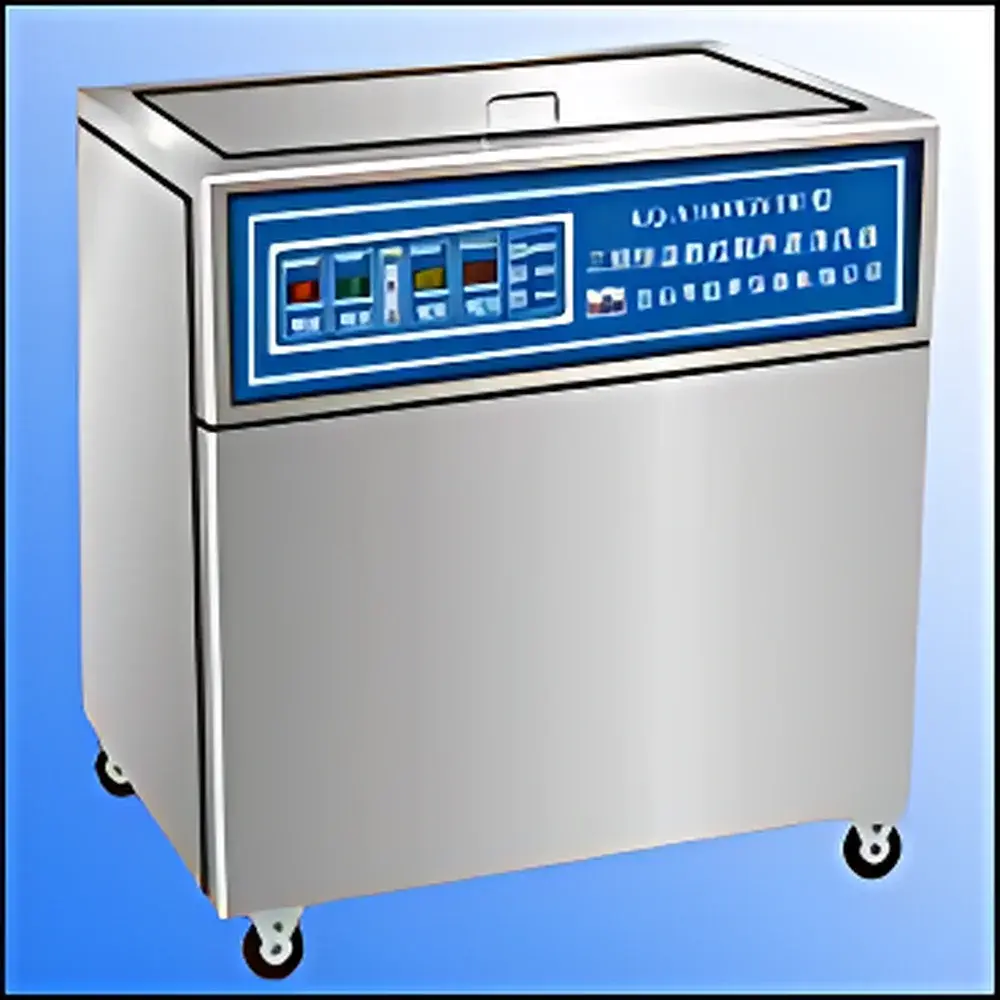
KQ-800KDE Desktop High-Power Digital Ultrasonic Cleaner
| Origin | Shanghai, China |
|---|---|
| Manufacturer Type | Authorized Distributor |
| Origin Category | Domestic (PRC) |
| Model | KQ-800KDE |
| Price | USD 2,050 (FOB Shanghai) |
| Dimensions (W×D×H) | 530×320×380 mm |
| Tank Internal Dimensions (L×W×H) | 500×300×150 mm |
| Tank Capacity | 22.5 L |
| Ultrasonic Frequency | 40 kHz |
| Ultrasonic Power Output | 800 W |
| Heating Power | 1000 W |
| Temperature Range | 20–80 °C |
| Timer Range | 1–480 min |
| Built-in Sound-Dampening Lid | Yes |
| Drain Valve | Yes |
| Tank Material | 304 Stainless Steel |
| Basket Material | 304 Stainless Steel (Argon-Welded Mesh) |
Overview
The KQ-800KDE Desktop High-Power Digital Ultrasonic Cleaner is an integrated benchtop system engineered for precision cleaning, degassing, dispersion, emulsification, homogenization, solvent extraction, and cell lysis in research laboratories, quality control environments, and academic institutions. It operates on the principle of high-frequency acoustic cavitation—where 40 kHz ultrasonic energy induces controlled microbubble formation and collapse within the cleaning medium, generating localized shear forces exceeding 10,000 psi and transient temperatures above 5,000 K at bubble implosion sites. This physical mechanism enables effective removal of particulate contaminants, organic residues, oxides, and biofilms from complex geometries—including microfluidic channels, optical components, surgical instruments, printed circuit boards, and analytical sample vials—without mechanical abrasion or chemical aggression beyond the selected solvent.
Key Features
- Integrated digital control panel with real-time display of elapsed time, set time, bath temperature, and actual temperature—retaining user-defined parameters across power cycles.
- Dual-stage safety architecture: independent over-temperature, over-voltage, and over-current protection circuits with LED fault indication and automatic shutdown.
- 800 W total ultrasonic output delivered via eight high-efficiency piezoelectric transducers (100 W per transducer), uniformly bonded to the bottom of a 304 stainless steel tank for consistent energy distribution and minimal node interference.
- Robust 304 stainless steel construction: seamless tank body formed by deep-drawing and argon-welded mesh basket ensures corrosion resistance, structural integrity, and compliance with ISO 15190:2020 laboratory equipment material requirements.
- Adjustable heating system (1000 W) maintains stable thermal conditions between 20 °C and 80 °C with ±1 °C accuracy, supporting temperature-dependent applications such as lipid extraction or enzyme deactivation studies.
- Acoustically insulated hinged lid reduces ambient noise to ≤65 dB(A) at 1 m distance and minimizes solvent evaporation during extended operation.
- Integrated drain valve with PTFE-sealed brass fitting enables safe, residue-free tank emptying—critical for solvent recovery protocols and cross-contamination prevention in regulated workflows.
Sample Compatibility & Compliance
The KQ-800KDE accommodates a broad range of sample types and carriers, including glassware (vials, cuvettes, pipette tips), metal parts (stainless steel, titanium, aluminum), silicon wafers, ceramic substrates, and polymer-based microdevices. Its 22.5 L tank volume supports immersion of large-format items up to 500 × 300 × 150 mm while maintaining uniform cavitation intensity across the active zone. The system meets general electrical safety requirements per IEC 61010-1:2010 and electromagnetic compatibility standards IEC 61326-1:2020. While not certified for sterile processing under ISO 13485, its design facilitates integration into GLP-compliant cleaning validation protocols—including cycle mapping, thermocouple placement studies, and residue challenge testing per ASTM D4387-22.
Software & Data Management
The KQ-800KDE operates via embedded firmware without external PC dependency. All operational parameters—including timer settings, temperature setpoints, and fault logs—are stored in non-volatile memory and accessible through the front-panel interface. Though it does not support USB or Ethernet connectivity, its repeatable digital controls ensure procedural consistency required for SOP-driven environments. For laboratories requiring audit trails, the unit can be operated within a documented workflow incorporating external data loggers (e.g., calibrated thermistors and timer stamps) to satisfy FDA 21 CFR Part 11 data integrity expectations when used in pharmaceutical QC or medical device reprocessing validation.
Applications
- Life Sciences: Cell disruption for protein isolation, DNA shearing prior to NGS library prep, cleaning of electrophoresis tanks and gel trays.
- Materials Science: Removal of sputtering residues from SEM stubs, debubbling of resin composites prior to curing, cleaning of AFM probes and TEM grids.
- Electronics Manufacturing: Flux residue removal from PCB assemblies, pre-soldering cleaning of SMT stencils and nozzles.
- Analytical Chemistry: Solvent extraction of PAHs from soil matrices, preparation of calibration standards in volumetric flasks, cleaning of HPLC injection valves and autosampler vials.
- Quality Assurance: Validation of cleaning efficacy per USP particulate matter testing, routine maintenance of reference standards and metrology tools.
FAQ
What is the recommended cleaning solution for use with the KQ-800KDE?
Aqueous alkaline detergents (e.g., Alconox® or Liquinox®) are preferred for general labware; low-volatility solvents (e.g., isopropanol or terpene-based formulations) may be used with strict ventilation and thermal monitoring.
Can the unit operate continuously for extended durations?
Yes—the system supports uninterrupted operation up to 480 minutes per cycle and includes thermal cutoffs to prevent coil overheating during prolonged heating or ultrasonication.
Is the stainless steel tank compatible with acidic or chlorinated solutions?
304 stainless steel resists mild acids and neutral salts but is not recommended for prolonged exposure to hydrochloric acid, hypochlorite, or ferric chloride solutions; alternative tank materials (e.g., 316 SS or titanium) require custom configuration.
How often should the ultrasonic transducers be serviced?
Under normal usage (≤4 hrs/day), transducer performance remains stable for ≥5 years; annual visual inspection of bonding integrity and impedance verification using a multimeter is advised.
Does the KQ-800KDE support multi-step programmable cycles?
No—it features single-parameter digital control per cycle; sequential operations (e.g., heat → sonicate → cool) must be manually initiated or coordinated via external PLC integration.



