
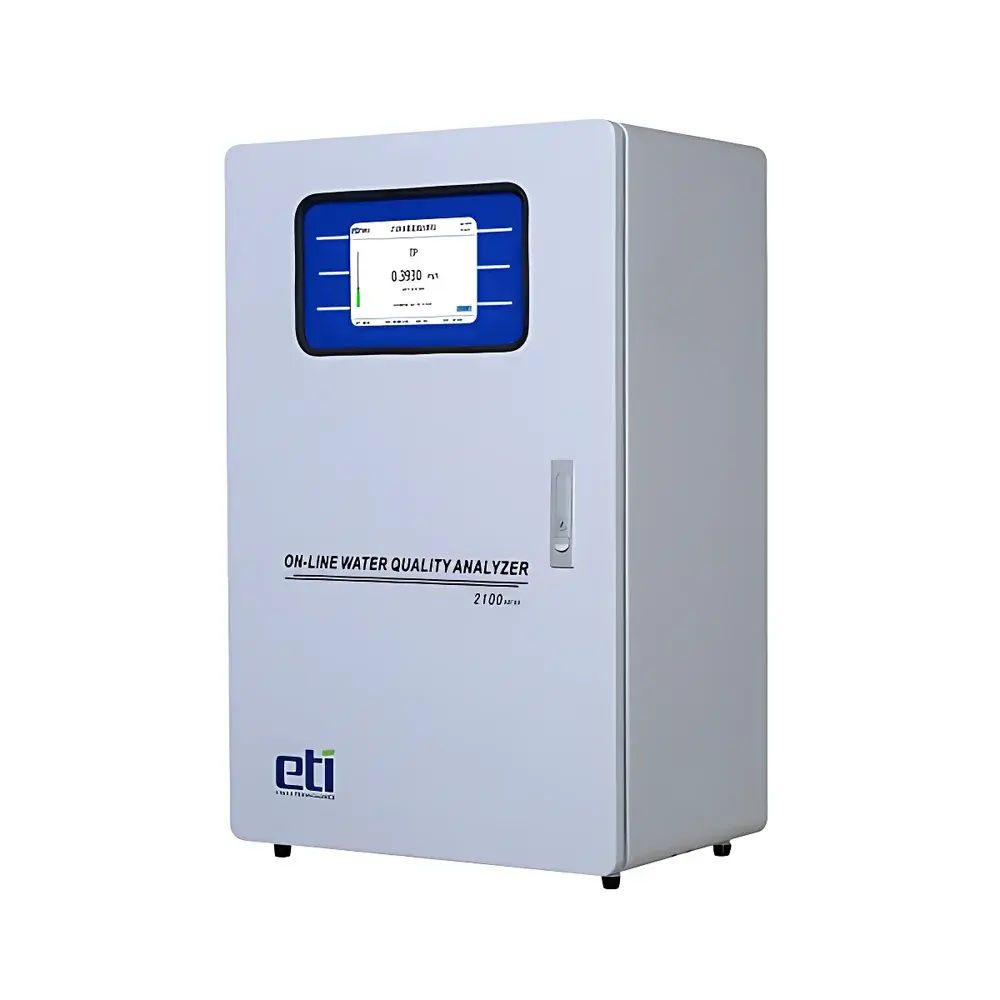
ETI 2100Plus Nickel Online Water Quality Analyzer
| Brand | ETI |
|---|---|
| Origin | Guangdong, China |
| Manufacturer Type | Authorized Distributor |
| Country of Manufacture | China |
| Model | 2100Plus Nickel |
| Instrument Type | Online Analyzer |
| Detection Principle | Photometric Method (Colorimetric) |
| Target Analyte | Nickel (Ni²⁺) |
| Analysis Time | 10 min per cycle |
| Accuracy/Precision | ±5% of reading |
| Resolution | 0.001 mg/L |
| Measurement Range | 0–2 mg/L (extendable to multiple optional ranges) |
| Measurement Modes | Cyclic, Triggered, Fixed-point, Continuous, Manual |
| Verification Modes | Remote, Manual, Automatic (time-based or limit-exceeded) |
| Output Signals | 4–20 mA analog output |
| Power Supply | 220 ± 22 VAC, 50 ± 0.5 Hz |
| Enclosure Dimensions | 520 mm (W) × 380 mm (D) × 800 mm (H) |
| Net Weight | ~45 kg (excluding reagents) |
Overview
The ETI 2100Plus Nickel Online Water Quality Analyzer is an industrial-grade, fully automated photometric system engineered for continuous, unattended monitoring of dissolved nickel (Ni²⁺) in aqueous matrices. It operates on the principle of colorimetric photometry—where nickel ions in pretreated water samples react with a selective chromogenic reagent under controlled pH and temperature conditions to form a stable colored complex. The absorbance of this complex is measured at a defined wavelength (typically within the visible range, e.g., 530–560 nm), and quantified via Beer–Lambert law calibration. Designed for long-term deployment in demanding environmental and industrial settings, the 2100Plus delivers high reproducibility and low maintenance burden while meeting routine compliance requirements for regulatory reporting and process control.
Key Features
- Patented intelligent dilution module enabling automatic range switching—eliminates manual intervention during low- and high-concentration events.
- High-precision syringe pump architecture ensuring accurate, repeatable metering of sample, reagents, and standards (±0.5% volumetric accuracy).
- Integrated power-fail protection with non-volatile memory retention and auto-resume functionality upon power restoration.
- Modular hardware design facilitating rapid component replacement, field-level diagnostics, and simplified service logistics.
- Flexible method programming: users can define custom analysis sequences—including calibration frequency, QC insertion points, blank subtraction logic, and multi-point standard curves.
- Comprehensive remote management capability via embedded web server and Modbus RTU/TCP protocol support for SCADA integration.
Sample Compatibility & Compliance
The 2100Plus is validated for direct analysis of raw and pretreated water streams including surface water, drinking water sources, municipal wastewater effluents, and industrial discharge (e.g., electroplating, battery manufacturing, and metal finishing facilities). Sample turbidity up to 100 NTU and suspended solids ≤ 50 mg/L are accommodated via integrated filtration and air-bubble removal. The analyzer complies with core performance expectations outlined in ISO 7027 (turbidity interference mitigation), ASTM D1688 (nickel in water by spectrophotometry), and supports audit-ready documentation aligned with GLP and GMP principles. Optional 21 CFR Part 11-compliant software modules are available for regulated environments requiring electronic signature, user access control, and immutable audit trails.
Software & Data Management
The embedded firmware includes a real-time operating system supporting dual-mode operation: local HMI (touchscreen interface) and remote web-based configuration. All measurement data—including raw absorbance values, calculated concentrations, QC results, instrument status logs, and error codes—are timestamped and stored internally for ≥90 days. Data export is supported via CSV over USB or Ethernet, and seamless integration with third-party LIMS or cloud platforms (e.g., AWS IoT Core, Microsoft Azure IoT Hub) is enabled through configurable RESTful API endpoints. Built-in QC protocols include standard addition recovery tests, duplicate analysis, and scheduled standard verifications—with pass/fail thresholds programmable per site-specific QA/QC plans.
Applications
- Regulatory compliance monitoring at national and provincial discharge permit sites where Ni limits are enforced (e.g., China’s GB 3838–2002 Class III/IV, EU WFD priority substance monitoring).
- Early-warning detection in source water intakes serving municipal treatment plants to prevent nickel breakthrough into distribution systems.
- Process optimization and leak detection in industrial facilities handling nickel-containing electrolytes, catalysts, or alloys.
- Long-term trend analysis for environmental impact assessments and watershed health studies requiring sub-ppb sensitivity and inter-laboratory comparability.
- Support for ISO/IEC 17025-accredited laboratories performing method validation and instrument qualification (IQ/OQ/PQ).
FAQ
What sample pretreatment is required prior to analysis?
Minimal pretreatment is needed: samples must be free of particulates > 80 µm (achieved via built-in 80 µm filter); no acid digestion or chelation is required for soluble Ni²⁺ detection.
Can the instrument operate without on-site technician support?
Yes—the 2100Plus supports fully autonomous operation for ≥30 days with standard reagent packs, and includes self-diagnostic routines for pump wear, optical path fouling, and reagent depletion alerts.
Is multi-analyte expansion possible on the same platform?
The hardware architecture is designed for modular reagent manifold upgrades; however, nickel-specific optics and chemistry modules are not interchangeable with other metals (e.g., Cu, Cr, Cd) without factory recalibration and hardware modification.
How does the system handle high-chloride or high-hardness water matrices?
The method incorporates masking agents to suppress interference from Fe³⁺, Co²⁺, and Cu²⁺; chloride tolerance is up to 2,000 mg/L Cl⁻, and calcium/magnesium hardness up to 500 mg/L CaCO₃ equivalent has been verified in field trials.
What cybersecurity measures are implemented for remote access?
HTTPS encryption, role-based authentication (admin/operator/viewer), TLS 1.2+ communication, and configurable firewall rules via Ethernet port are standard; optional hardware security module (HSM) integration is available for critical infrastructure deployments.
Related Products







