
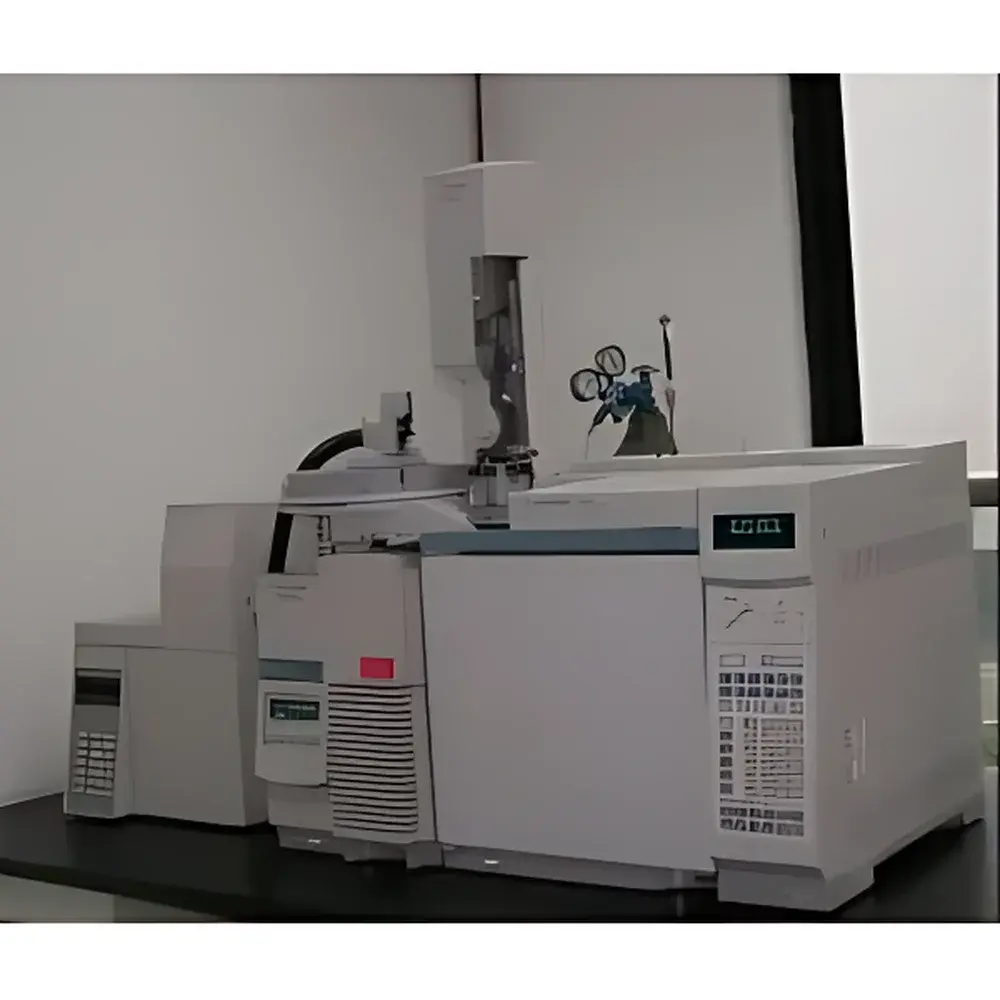
Agilent 6890N-5973N Gas Chromatography Mass Spectrometry System (Used)
| Brand | Agilent Technologies |
|---|---|
| Origin | USA |
| Model | 6890N (GC) / 5973N (MSD) |
| Instrument Type | Single Quadrupole GC-MS |
| GC Configuration | Capillary Column Inlet with Electronic Pressure Control (EPC) |
| MS Ionization Modes | Electron Ionization (EI), Chemical Ionization (CI), Negative Chemical Ionization (NCI) |
| Mass Range | 1.6–800 u |
| Mass Accuracy | ±0.1 u |
| EI Sensitivity | 1 pg OFN (m/z 272), S/N ≥ 20:1 (full scan) |
| 20 fg OFN (m/z 272), S/N ≥ 10 | 1 (SIM) |
| PCI Sensitivity | 100 pg di-tert-butyl methylamine (m/z 183.1), S/N ≥ 75:1 |
| NCI Sensitivity | 1 pg OFN (m/z 272), S/N ≥ 500:1 |
| Quadrupole | Gold-coated quartz, temperature-controlled, hyperbolic geometry |
| Ion Source | Molybdenum alloy, independently heated, inert surface finish |
Overview
The Agilent 6890N-5973N Gas Chromatography Mass Spectrometry (GC-MS) system is a robust, field-proven benchtop platform engineered for high-fidelity qualitative and quantitative analysis of volatile and semi-volatile organic compounds. This used instrument integrates Agilent’s industry-standard 6890N gas chromatograph—featuring fully electronic pressure control (EPC), precise oven temperature programming, and retention time locking (RTL)—with the 5973N mass selective detector (MSD), a single quadrupole mass spectrometer optimized for sensitivity, stability, and long-term operational reliability. The system operates on electron ionization (EI), chemical ionization (CI), and negative chemical ionization (NCI) principles, enabling comprehensive spectral library matching (e.g., NIST), method transfer across instruments, and trace-level detection in complex matrices. Designed for compliance-critical environments, it supports audit-ready data acquisition and meets foundational requirements for GLP and GMP-aligned workflows when paired with appropriate software configuration and system validation documentation.
Key Features
- Retention Time Locking (RTL): Enables precise retention time reproducibility across instruments, columns, and maintenance cycles—critical for regulatory method transfer and routine QC verification.
- Electronically Controlled Pneumatics (EPC): Delivers sub-psi pressure resolution and <0.02 min retention time repeatability over extended runs, ensuring method robustness and inter-laboratory comparability.
- Temperature-Regulated Quadrupole: Gold-coated quartz hyperbolic rods with active heating eliminate thermal gradients, minimizing mass drift and improving ion transmission stability over multi-hour analyses.
- Inert Ion Source: Molybdenum alloy construction and controlled source temperature reduce active surface adsorption, extending cleaning intervals and preserving spectral fidelity for reactive analytes.
- Multi-Mode Ionization: Switchable EI/CI/NCI sources support both library-searchable fragmentation patterns and soft ionization for molecular weight confirmation—particularly valuable for pharmaceutical impurity profiling and environmental metabolite identification.
- Integrated Automation Support: Compatible with Agilent 7683B autosampler (100-position tray), enabling unattended batch processing with programmable vial wash, injection volume precision, and syringe temperature control.
Sample Compatibility & Compliance
This GC-MS system accommodates a broad range of sample types—including organic extracts from biological fluids (serum, urine), environmental water/soil extracts, headspace volatiles, essential oils, and synthetic reaction mixtures—provided they are amenable to capillary GC separation (typically <400 °C boiling point and moderate polarity). The 6890N’s split/splitless inlet and optional PTV or cold-on-column configurations allow direct injection of dirty or thermally labile samples with minimal derivatization. From a regulatory standpoint, the hardware architecture supports 21 CFR Part 11-compliant operation when deployed with Agilent ChemStation or OpenLab CDS configured with electronic signatures, audit trails, and user-access controls. While the 5973N predates modern digital security frameworks, its analog signal path and deterministic firmware ensure stable, non-alterable raw data acquisition—facilitating retrospective validation under ISO/IEC 17025 or ASTM E2681 guidelines.
Software & Data Management
Data acquisition and processing are performed using Agilent ChemStation (G1701DA or later versions), a validated Windows-based platform supporting full-scan, SIM, and TIC/SIM hybrid acquisition modes. The software provides automated peak detection, spectral deconvolution (via AMDIS), library search (NIST/EPA/WHO libraries), calibration curve generation (linear, quadratic, weighted), and report templates compliant with ISO 17025 reporting clauses. Raw data (.D files) are stored in proprietary but openly documented binary format; third-party tools (e.g., MS-DIAL, Compound Discoverer) support import via vendor-neutral formats (mzXML/mzML) generated through ChemStation export utilities. Audit trail functionality records all parameter changes, integration edits, and report generation events—with timestamps and operator IDs—meeting baseline GLP record-keeping expectations.
Applications
- Residue analysis of pesticides, PCBs, PAHs, and dioxins in food and environmental samples per EPA Methods 8270, 8082, and ISO 17890.
- Pharmaceutical impurity profiling and degradation product identification in accordance with ICH Q3A/B and USP <1225>.
- Volatile organic compound (VOC) screening in drinking water (EPA 524.2), indoor air (ISO 16000-6), and packaging headspace.
- Metabolite identification in pharmacokinetic studies using plasma/urine extracts—leveraging NCI for enhanced sensitivity toward halogenated compounds.
- Quality control of essential oils and natural product extracts via terpene and sesquiterpene fingerprinting against reference standards.
FAQ
Is this system compatible with modern LIMS or ELN platforms?
Yes—via OLE/COM automation interfaces or ASCII export protocols, ChemStation can integrate with major LIMS vendors (e.g., LabWare, Thermo SampleManager) for sample registration and result push. Custom API wrappers may be required for native RESTful ELN ingestion.
What vacuum pump options are supported?
The original Agilent 5973N requires a two-stage rotary vane pump (e.g., Agilent 600-1121 or equivalent). Oil-free scroll pumps are not recommended due to insufficient ultimate vacuum (<1×10⁻⁵ Torr) and potential hydrocarbon backstreaming.
Can the 5973N perform tandem MS experiments?
No—the 5973N is a single quadrupole instrument and does not support MS/MS. For structural elucidation requiring fragmentation pathway confirmation, a triple quadrupole (e.g., 7000-series) or Q-TOF system is required.
What is the typical service life expectancy of a refurbished 6890N-5973N?
With proper preventive maintenance—including quarterly ion source cleaning, annual quadrupole bake-out, and EPC valve calibration—operational lifespan routinely exceeds 12 years post-refurbishment in academic and contract lab settings.
Does the system include calibration standards and performance verification protocols?
Standard delivery includes a factory-verified tuning compound (perfluorotributylamine, PFTBA) and Agilent’s GC-MS Performance Check procedure. Full qualification (IQ/OQ/PQ) documentation must be commissioned separately per client SOP requirements.





