
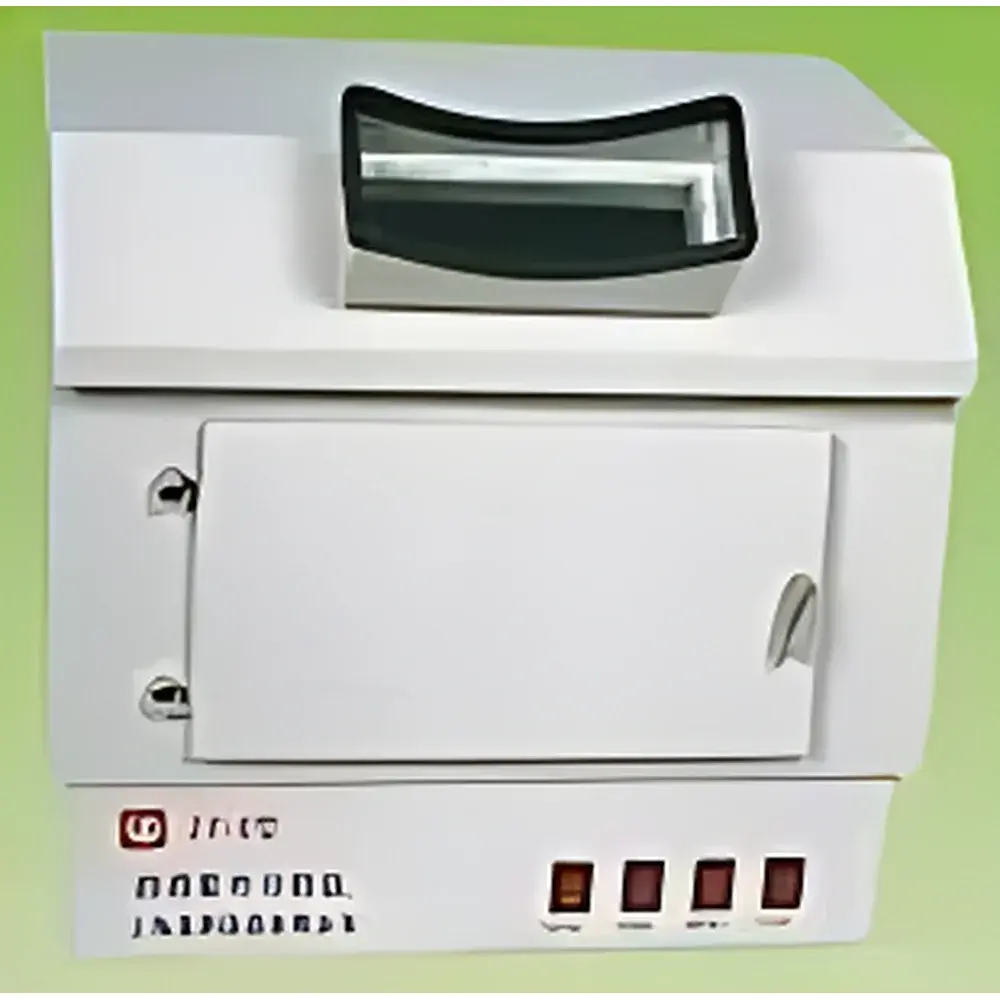
Chu Ding ZF-8 Dark-Box Quad-Wavelength UV Transilluminator and Visualizer
| Brand | Chu Ding |
|---|---|
| Origin | Shanghai, China |
| Model | ZF-8 |
| UV Wavelengths | 254 nm (short-wave), 302 nm (medium-wave), 365 nm (long-wave) |
| Visible Light Output | Yes |
| UV Filter Glass Dimensions | 200 × 80 mm |
| Instrument Dimensions (L×W×H) | 320 × 220 × 310 mm |
| Power Supply | AC 220 V ±10%, 50 Hz |
| UV Lamp Power | 6 W per wavelength (254/302/365 nm), 4 W visible light |
| UV Blocking Efficiency of Viewing Window | >95% attenuation of incident UV radiation |
| Compliance | Designed for routine laboratory use under standard biosafety and electrical safety guidelines (IEC 61010-1) |
Overview
The Chu Ding ZF-8 Dark-Box Quad-Wavelength UV Transilluminator and Visualizer is a benchtop analytical instrument engineered for safe, efficient visualization and qualitative assessment of fluorescently labeled biomolecules under controlled ultraviolet and visible illumination. It operates on the principle of fluorescence excitation—where nucleic acids (e.g., ethidium bromide–stained DNA/RNA), proteins, or other fluorophore-tagged analytes absorb UV photons at specific wavelengths and re-emit visible light, enabling detection without radioactive labeling. The ZF-8 integrates four discrete illumination modes—254 nm (optimal for nucleic acid damage and high-sensitivity detection), 302 nm (balanced sensitivity and reduced photodamage), 365 nm (low-energy excitation ideal for intact sample handling and preparative gel documentation), and white visible light (for non-fluorescent reference imaging or Coomassie-stained gels)—within a fully enclosed dark-box architecture. This design eliminates the need for external darkrooms while maintaining operator safety through a certified UV-blocking viewing window that attenuates >95% of incident UV radiation, conforming to occupational exposure limits defined in ACGIH TLVs® and IEC 62471 for lamp safety.
Key Features
- Integrated quad-wavelength illumination system with independently switchable 254 nm, 302 nm, and 365 nm UV lamps plus white LED visible light source
- Optically sealed dark-box enclosure (320 × 220 × 310 mm) with hinged lid and UV-absorbing acrylic viewing window meeting EN 170:2002 spectral transmittance requirements
- Standard 200 × 80 mm UV-transmissive filter glass plate optimized for uniform irradiance distribution across common mini-gel formats (e.g., 8 × 10 cm)
- Stable, low-heat cold-cathode UV lamps with rated service life ≥2,000 hours and consistent output intensity (±5% variation over 30 min warm-up period)
- Front-panel toggle switches with LED status indicators for each wavelength mode; no software or external controller required
- Compliant with IEC 61010-1:2010 for laboratory electrical equipment safety, including reinforced insulation and thermal cutoff protection
Sample Compatibility & Compliance
The ZF-8 supports standard electrophoretic formats including agarose gels (0.5–3.0% w/v), polyacrylamide gels (8–20% T), TLC plates (silica gel 60 F254, aluminum-backed), and paper chromatography sheets. It accommodates common fluorescent dyes such as ethidium bromide (EtBr), SYBR Safe, GelRed, GelGreen, and fluorescein derivatives. While not intended for quantitative densitometry, its stable output enables reproducible qualitative band comparison across runs. The instrument is suitable for use in GLP-aligned laboratories performing routine QC checks in pharmaceutical, food safety (e.g., aflatoxin screening per AOAC 992.02), forensic (STR fragment analysis), and academic research settings. It does not comply with FDA 21 CFR Part 11 for electronic records due to lack of audit trail or user authentication; however, it may be integrated into validated workflows when paired with compliant imaging systems.
Software & Data Management
The ZF-8 is a hardware-only transilluminator with no embedded firmware, touchscreen interface, or digital connectivity (USB/Ethernet). Image capture requires an external DSLR, scientific CCD camera, or smartphone mounted on a fixed stand. No proprietary drivers or acquisition software are supplied. Users are responsible for implementing metadata logging (e.g., exposure time, wavelength, sample ID) via laboratory notebooks or LIMS-integrated templates. For regulatory environments requiring traceability, documentation must follow institutional SOPs for manual instrument operation—including daily verification of lamp functionality and viewing window integrity.
Applications
- Molecular biology: Visualization and excision of DNA/RNA bands from stained gels; rapid confirmation of PCR product size and purity prior to cloning or sequencing
- Pharmaceutical quality control: Fluorescence-based identity testing of steroidal hormones, alkaloids, and vitamin preparations per USP and EP 2.2.41
- Food safety: Screening for aflatoxin B1 in cereals and nuts using immunoaffinity column–coupled TLC with UV-induced fluorescence
- Forensic science: Detection of latent biological evidence (e.g., semen stains with acridine orange) and fiber identification via differential UV response
- Materials science: Assessment of fluorescent additives in polymers, rubber compounds, and textile dyes per ASTM D4329 for UV exposure testing
- Environmental analysis: Qualitative detection of polycyclic aromatic hydrocarbons (PAHs) in soil extracts via thin-layer chromatography
FAQ
Is the ZF-8 suitable for quantitative gel densitometry?
No. It provides uniform illumination for visual inspection and manual band excision but lacks calibrated intensity sensors or integrated image analysis capabilities.
Can the 254 nm lamp be used for UV crosslinking of nucleic acids to membranes?
Not recommended. The ZF-8 delivers non-uniform irradiance and lacks dose calibration; dedicated UV crosslinkers (e.g., Stratalinker®) with radiometric feedback are required for reproducible covalent immobilization.
Does the instrument include a timer or exposure control?
No. Exposure duration is manually managed by the user; prolonged UV exposure may cause photobleaching or DNA strand breakage.
What safety certifications does the ZF-8 carry?
It conforms to IEC 61010-1:2010 for electrical safety and incorporates a UV-filtering window tested per EN 170:2002. It is not CE-marked for medical device use or RoHS-certified.
Is replacement filter glass available from the manufacturer?
Yes—Chu Ding supplies OEM 200 × 80 mm UV-transmissive glass (part number ZF-8-FG) with documented transmission spectra for 254/302/365 nm bands.




