
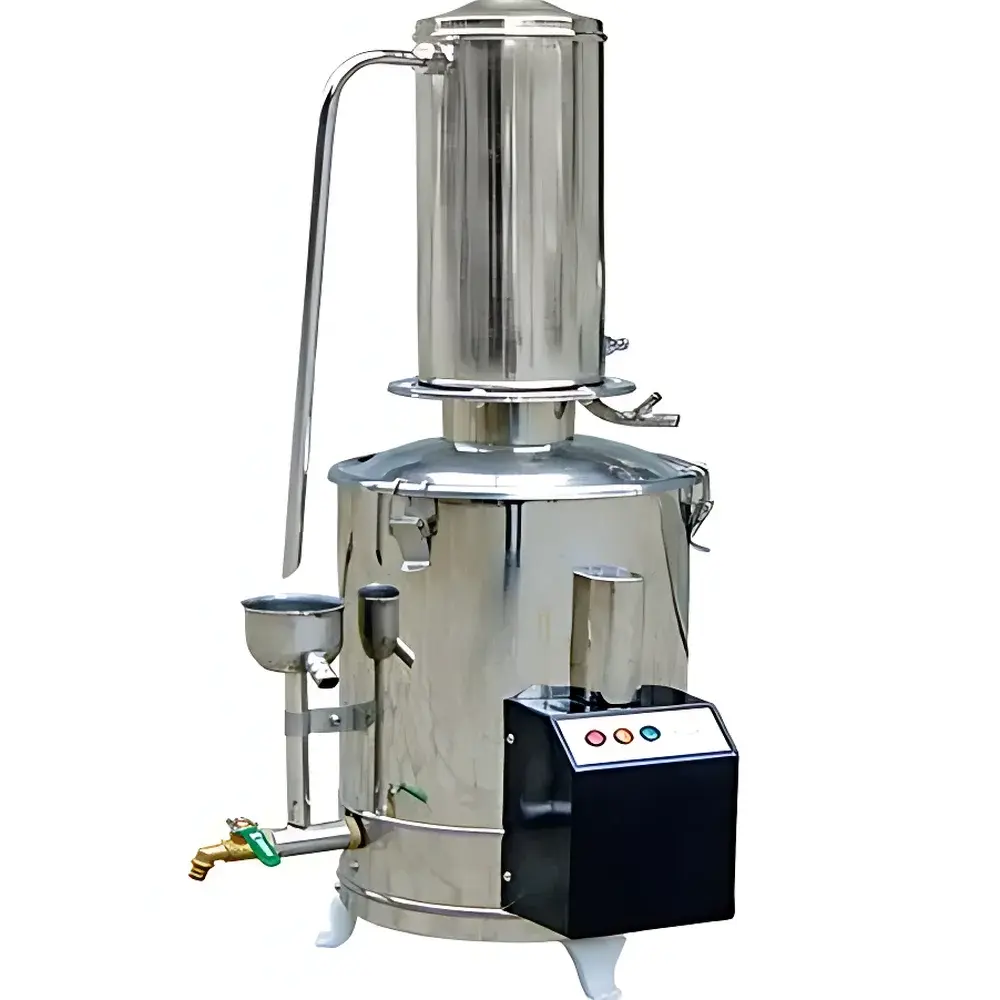
DZ-5 / DZ-10 / DZ-20 Stainless Steel Electric Distillation Apparatus with Auto-Water-Shortage Protection
| Origin | Shanghai, China |
|---|---|
| Manufacturer Type | Authorized Distributor |
| Regional Origin | Domestic (PRC) |
| Models | DZ-5 / DZ-10 / DZ-20 |
| Power Input | 5 kW (220 V), 7.5 kW (380 V), 15 kW (380 V) |
| Output Capacity | 5 L/h, 10 L/h, 20 L/h |
| Construction Material | AISI 304 Stainless Steel |
| Compliance | GB/T 6682–2008 Grade III Water Specification |
| Safety Features | Automatic dry-run cutoff, audible/visual low-water alarm, auto-refill & restart logic |
Overview
The DZ-5, DZ-10, and DZ-20 Stainless Steel Electric Distillation Apparatus are bench- to floor-standing laboratory-scale water purification systems engineered for continuous production of reagent-grade distilled water via thermal phase separation. These units operate on the principle of single-stage vaporization-condensation: feed water is heated in a stainless steel boiling chamber; steam rises through a vapor path into a vertically oriented, air-cooled condenser tube; and condensed distillate is collected in a sealed, corrosion-resistant reservoir. Designed for sustained operation in regulated environments—including pharmaceutical QC labs, chemical synthesis facilities, and academic research centers—the apparatus meets the physical and chemical purity requirements of GB/T 6682–2008 Level III water (equivalent to ASTM D1193 Type IV and ISO 3696 Grade 3), with typical conductivity ≤ 5.0 µS/cm at 25 °C and total oxidizable carbon (TOC) < 500 ppb under standard operating conditions.
Key Features
- Full AISI 304 stainless steel construction—including boiler chamber, condenser housing, collection vessel, and external casing—ensures long-term resistance to chloride-induced pitting, scaling, and thermal fatigue.
- Integrated dry-run protection circuitry automatically de-energizes heating elements upon detection of low water level in the boiler, followed by an audible alarm and dual-color LED status indication (red for fault, green for operational).
- Auto-refill functionality engages when water level recovers above the safety threshold, enabling seamless resumption of distillation without manual reset or operator intervention.
- Dedicated front-panel indicators provide real-time status feedback: power-on, heating active, and low-water warning—each mapped to discrete LED outputs for unambiguous visual monitoring.
- Modular thermal design supports stable output across ambient temperatures ranging from 10 °C to 35 °C, with minimal sensitivity to inlet water temperature fluctuations (15–30 °C recommended).
Sample Compatibility & Compliance
The DZ series accepts municipal tap water, softened water, or pre-filtered feed sources with total dissolved solids (TDS) ≤ 500 mg/L and free chlorine ≤ 1.0 mg/L. It is not intended for direct use with seawater, high-hardness well water (>300 ppm CaCO₃), or chemically pretreated industrial effluents. All models comply with GB/T 6682–2008 for analytical laboratory water quality (Grade III), supporting applications requiring non-critical rinsing, buffer preparation, media dissolution, and general instrument feed. While not certified to ISO/IEC 17025 or FDA 21 CFR Part 11 out-of-the-box, the system’s deterministic control logic and event-driven status logging enable integration into GLP/GMP workflows when paired with validated procedural documentation and periodic performance verification per ASTM D1193 Annex A1.
Software & Data Management
This apparatus operates as a standalone analog-electronic system with no embedded microcontroller, touchscreen interface, or digital data export capability. Operational parameters—including runtime, heating cycles, and alarm events—are recorded manually or via external loggers. For laboratories requiring electronic audit trails, integration with building management systems (BMS) or PLC-based supervisory control is achievable using the unit’s dry-contact alarm relay output (NO/NC) and 24 V DC auxiliary power terminal. No proprietary software, firmware updates, or cloud connectivity are provided; all maintenance and calibration procedures follow mechanical and electrical standards defined in IEC 61000-6-2 (EMC immunity) and IEC 61000-6-4 (EMC emission).
Applications
- Preparation of rinse water for glassware cleaning in clinical pathology labs.
- Feed water for autoclaves, ultrapure water (UPW) pretreatment trains, and steam generators in GMP manufacturing suites.
- Solvent-free dilution of standards and reagents in environmental testing (e.g., EPA Method 200.7, ISO 17294-2).
- Continuous supply of low-conductivity water for electrochemical cell conditioning and electrode calibration.
- Backup distillation capacity during primary UPW system maintenance or validation downtime.
FAQ
What feed water quality is required to ensure optimal lifespan and distillate consistency?
Tap water with residual chlorine < 1.0 mg/L and TDS < 300 mg/L is recommended. Pre-filtration through activated carbon and softening is strongly advised where hardness exceeds 150 ppm CaCO₃.
Can the DZ-20 be operated continuously for 24 hours?
Yes—when supplied with uninterrupted feed water, stable voltage (±5% of rated 380 V), and ambient ventilation ≥ 0.5 m³/min, the DZ-20 supports uninterrupted operation up to 168 h per maintenance cycle.
Is third-party calibration or certification available for this model?
Calibration services are offered by accredited metrology labs using NIST-traceable conductivity and temperature standards; however, the unit itself carries no factory-issued calibration certificate.
How often should the condenser tube be descaled?
Under typical municipal feed conditions, inspection and citric acid descaling are recommended every 200–300 operating hours—or quarterly if usage is intermittent.
Does the system meet international pharmacopoeia requirements for purified water?
No—it produces water meeting GB/T 6682 Grade III, which aligns with general lab use but does not satisfy USP , EP 2.2.44, or JP XVII Purified Water monographs requiring additional microbial control and TOC limits.



