
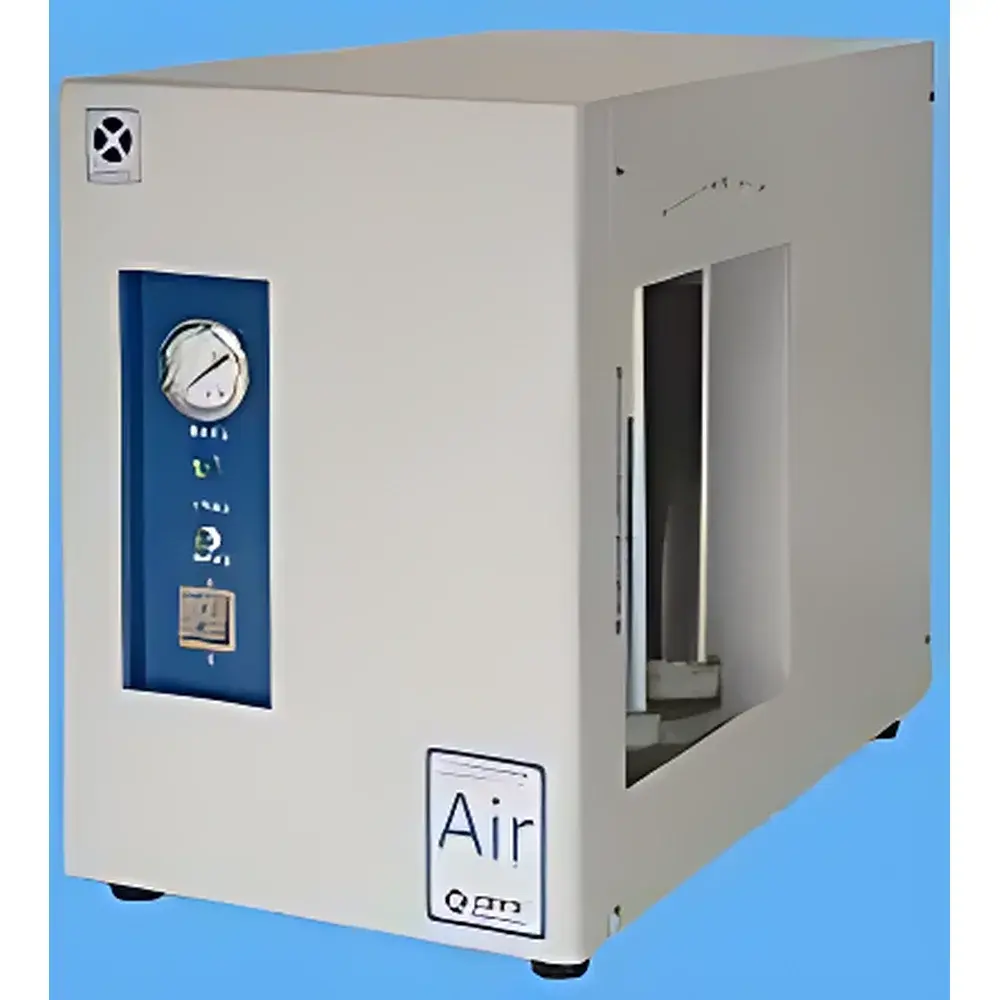
Chu Ding Technology XYA-5000 Air Generator (Lab-Scale Zero-Air Supply System)
| Brand | Chu Ding Technology |
|---|---|
| Origin | Shanghai, China |
| Model | XYA-5000 |
| Output Flow Rate | 0–5000 mL/min |
| Hydrocarbon Content | <0.1 ppm (v/v) |
| Max Input Pressure | 0–0.6 MPa |
| Operating Temperature | 0–40 °C |
| Relative Humidity | <85% RH |
| Power Supply | 220 V ±10%, 50 Hz ±5% |
| Noise Level | <52 dB(A) |
| Construction | Electropolished Stainless Steel Tubing, Integrated Auto-Drain Stainless Steel Storage Tank |
| Filtration | Dual-Stage Coalescing + Catalytic Hydrocarbon Scrubber (XY-A Purification Module) |
| Safety | Low-Pressure Start, Thermal Overload Protection, Pressure Relief Valve, Automatic Shutdown on Filter Saturation |
Overview
The Chu Ding Technology XYA-5000 Air Generator is an engineered zero-air supply system designed specifically for gas chromatography (GC) laboratories requiring consistent, high-purity compressed air as a carrier, detector (e.g., FID, NPD), or auxiliary gas source. Unlike conventional oil-lubricated compressors or bottled air, the XYA-5000 employs a low-noise, maintenance-free diaphragm or scroll-type air pump—configured with a proprietary XY-A catalytic purification module—to remove hydrocarbons, esters, oils, and particulates to sub-ppm levels. Its operation is grounded in pressure swing adsorption (PSA) principles combined with catalytic oxidation, ensuring continuous delivery of air meeting ASTM D6299 and ISO 8573-1 Class 1.2.1 (solid particles ≤0.1 µm, water dew point ≤−40 °C, oil content <0.01 mg/m³) specifications for GC-grade air. The unit is intended for indoor laboratory use only and complies with IEC 61010-1 safety requirements for electrical equipment used in measurement, control, and laboratory applications.
Key Features
- Integrated XY-A dual-stage purification: First-stage coalescing filter removes bulk moisture and aerosols; second-stage catalytic scrubber oxidizes residual hydrocarbons (<0.1 ppm total non-methane hydrocarbons), eliminating need for periodic carbon replacement.
- Electropolished 316L stainless steel gas path: All wetted components—including tubing, valves, and the 3 L internal storage tank—are passivated and ultrasonically cleaned to prevent metal ion leaching and ensure long-term inertness.
- Auto-drain stainless steel tank: Condensate is automatically expelled via timed solenoid valve actuation, preventing rust formation and avoiding yellow iron oxide contamination common in mild-steel tanks.
- Low-pressure start circuitry: Reduces inrush current and mechanical stress during compressor activation, extending service life beyond 10,000 operating hours under typical lab duty cycles (≤8 h/day).
- Two-stage precision pressure regulation: Delivers stable output pressure (0–0.4 MPa adjustable) with ≤±0.005 MPa fluctuation, critical for reproducible GC detector response and pneumatic control systems.
- Acoustically optimized enclosure: Sound-dampening foam and vibration-isolated mounting reduce operational noise to <52 dB(A) at 1 m distance—suitable for shared analytical labs and open-plan facilities.
Sample Compatibility & Compliance
The XYA-5000 is validated for seamless integration with all major GC platforms—including Agilent 8890/8860, Thermo Scientific TRACE 1300/1600, Shimadzu GC-2030, and PerkinElmer Clarus series—as both FID support gas and make-up gas. It meets the air purity prerequisites defined in USP , EP 2.2.46, and ASTM D3612 for hydrocarbon-free combustion gases. While not certified to ISO/IEC 17025, its design incorporates traceability-ready features: built-in pressure and flow monitoring ports allow external calibration against NIST-traceable standards. The unit supports GLP-compliant workflows through optional analog 0–5 V or 4–20 mA output signals for integration into LIMS or building management systems.
Software & Data Management
The XYA-5000 operates as a standalone hardware system without embedded firmware or network connectivity. However, it includes dual analog output interfaces (pressure and flow) compatible with third-party data acquisition modules (e.g., National Instruments USB-6009, LabJack T7). Optional RS-485 Modbus RTU communication enables remote status monitoring—including filter saturation alerts, thermal shutdown events, and runtime hour logging—within SCADA or ELN environments. Audit trails are maintained externally via connected DAQ software adhering to FDA 21 CFR Part 11 requirements when paired with appropriate electronic signature and access control layers.
Applications
- FID (Flame Ionization Detector) air supply in routine and regulated GC analysis of petrochemicals, environmental samples, and pharmaceutical residuals.
- Make-up gas for ECD (Electron Capture Detector) and NPD (Nitrogen Phosphorus Detector) to stabilize baseline and improve sensitivity.
- Auxiliary air source for GC-MS interface heaters, pneumatic autosampler actuators, and column oven purge circuits.
- Support gas for portable GC systems deployed in field laboratories where cylinder logistics are impractical.
- Primary air source in QC/QA labs conducting method validation per ICH Q2(R2), particularly where air purity variability must be excluded as an analytical uncertainty contributor.
FAQ
What is the expected service life of the XY-A purification module?
Under standard lab conditions (22 °C, 50% RH, 4000 mL/min average flow), the XY-A module maintains <0.1 ppm hydrocarbon removal efficiency for ≥12 months. No user-replacement is required; performance decay triggers automatic system alert via front-panel LED indicator.
Can the XYA-5000 be used with nitrogen or hydrogen generators in a multi-gas cabinet setup?
Yes—the XYA-5000 is mechanically and electrically isolated. When installed alongside Chu Ding’s XYN-500 nitrogen or XYH-500 hydrogen generators, shared exhaust ducting and centralized power distribution must comply with local hazardous location codes (e.g., NEC Article 500) due to potential hydrogen accumulation risks.
Is the output air suitable for GC-MS applications requiring ultra-low hydrocarbon background?
The <0.1 ppm total hydrocarbon specification satisfies most routine GC-MS applications. For high-sensitivity trace analysis (e.g., dioxins, PAHs), supplemental inline hydrocarbon traps (e.g., Restek Hydrocarbon Trap, 22600) are recommended prior to the MS inlet.
Does the unit include documentation compliant with ISO 9001 quality system requirements?
Each shipment includes a Factory Acceptance Test (FAT) report listing serial-numbered component certifications (e.g., CE, RoHS), pressure test records, and hydrocarbon verification data obtained using a calibrated photoionization detector (PID) per ISO 10156 Annex B.
Related Products




