
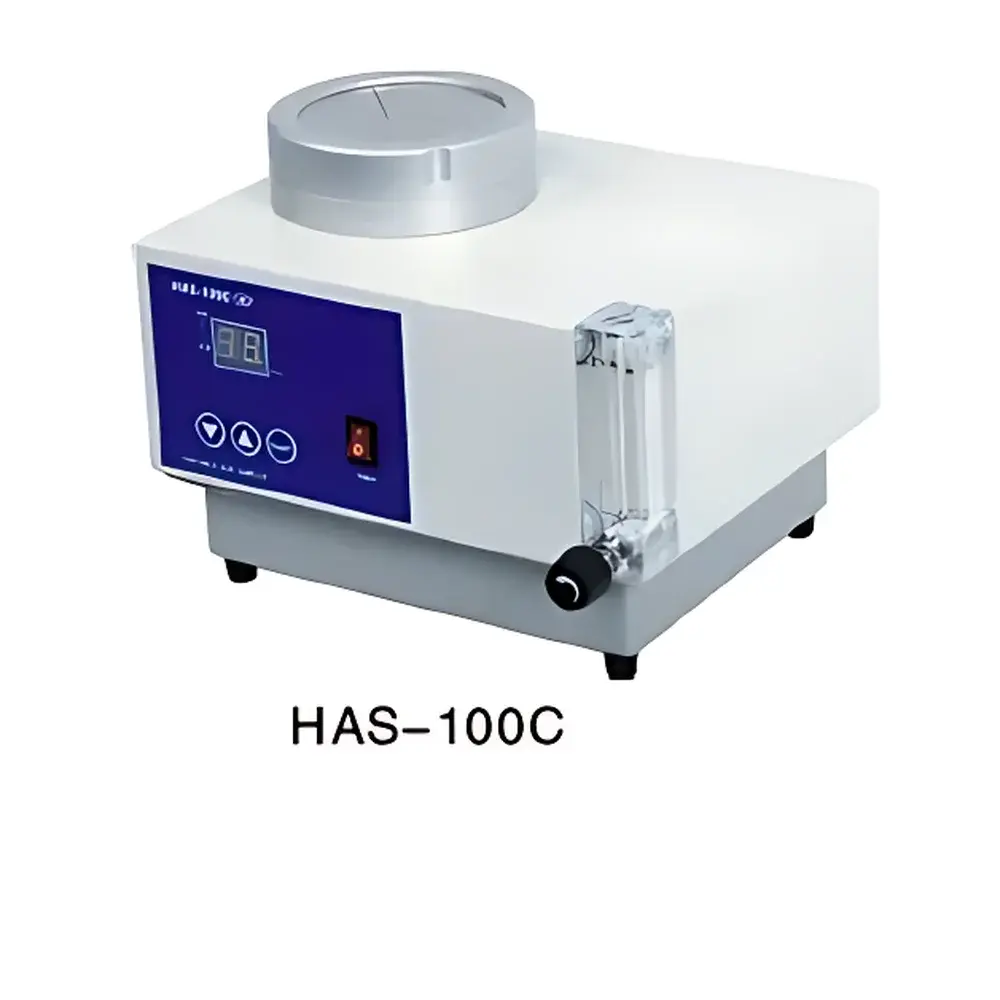
Chu Ding Technology HAS-100C Slit-Type Air Sampler for Viable Microbial Monitoring
| Brand | Chu Ding Technology |
|---|---|
| Origin | Shanghai, China |
| Manufacturer Type | Authorized Distributor |
| Country of Origin | China |
| Model | HAS-100C |
| Instrument Type | Manual Slit-Impact Air Sampler |
| Sampling Flow Rate | 100 L/min (typical) |
| Collection Efficiency | ≥95% for particles ≥0.6 µm (per Anderson principle calibration) |
| Display | Dot-matrix LCD with real-time battery indicator |
| Power | Rechargeable Ni-MH battery (≥8 h continuous operation) |
| Sample Rotation Speed | Adjustable (0–3 rpm) |
| Auto-Power Management | Backlight off after 30 s inactivity |
| Sterilization Compatibility | Removable sampling head withstands autoclaving at 121°C for 20 min |
| Dimensions | 240 × 180 × 220 mm |
| Weight | 3.2 kg |
| Compliance | Designed per GB/T 18883–2002 and aligned with ISO 14698-1:2003 principles for biocontamination control |
Overview
The Chu Ding Technology HAS-100C Slit-Type Air Sampler for Viable Microbial Monitoring is a compact, benchtop active air sampler engineered for quantitative assessment of airborne viable microorganisms in controlled environments. It operates on the slit-impact principle—a variant of the Anderson cascade impactor methodology—where sampled air is drawn at a calibrated flow rate across a rotating Petri dish containing solid growth medium. The narrow slit geometry ensures laminar airflow and high-velocity impaction, enabling efficient inertial deposition of viable particles onto agar surfaces without thermal or mechanical damage to microorganisms. This physical collection mechanism preserves colony-forming unit (CFU) viability, making the HAS-100C suitable for subsequent isolation, enumeration, and identification of bacteria, yeasts, and molds. Its design adheres to the technical rationale outlined in GB/T 18883–2002 and reflects foundational principles referenced in ISO 14698-1:2003 (Biocontamination control — Part 1: General principles and methods), supporting routine environmental monitoring in Grade A–D cleanrooms per EU GMP Annex 1 and USP .
Key Features
- Slit-impact sampling architecture optimized for high collection efficiency (>95% for ≥0.6 µm particles) while maintaining microbial viability
- Adjustable Petri dish rotation speed (0–3 rpm) ensures uniform spatial distribution of deposited colonies, minimizing edge effects and improving count reproducibility
- Dot-matrix LCD interface with real-time battery level indication and intuitive menu navigation—no external PC required for basic operation
- Integrated rechargeable Ni-MH battery supports ≥8 hours of continuous sampling at 100 L/min, enabling unattended operation in remote or mobile settings
- Detachable stainless-steel sampling head rated for autoclaving at 121°C for 20 minutes—fully compliant with sterile processing requirements in pharmaceutical QC labs
- Intelligent power management: backlight deactivation after 30 seconds of inactivity; automatic shutdown after 5 minutes in standby mode
- Ergonomic, portable form factor (240 × 180 × 220 mm; 3.2 kg) with rotatable sampling head for flexible positioning in laminar flow hoods, isolators, or production suites
Sample Compatibility & Compliance
The HAS-100C accepts standard 90 mm Petri dishes filled with TSA, SDA, or other microbiologically appropriate media. Its slit geometry and flow dynamics are validated for use with both conventional and chromogenic agars. While the instrument itself does not carry CE or FDA 510(k) certification, its operational methodology aligns with internationally recognized standards for environmental monitoring—including ISO 14698-1:2003, ISO 14644-1:2015 (cleanroom classification), and EU GMP Annex 1 (2022 revision). Data generated using the HAS-100C may be incorporated into formal environmental monitoring programs subject to documented validation per ICH Q5A(R2) and internal SOPs governing biocontamination risk assessment.
Software & Data Management
The HAS-100C is a standalone hardware platform with no embedded data logging or USB/Bluetooth connectivity. All operational parameters—including elapsed time, total volume sampled (calculated from flow rate × duration), and battery status—are displayed in real time but not stored internally. Users are expected to record sampling metadata manually or integrate results into laboratory information management systems (LIMS) during post-sampling colony enumeration. For regulated environments, manual entry must be supported by contemporaneous documentation practices consistent with ALCOA+ principles and 21 CFR Part 11 compliance when paired with electronic record systems.
Applications
- Routine environmental monitoring in pharmaceutical manufacturing cleanrooms (Grade A–D) and aseptic processing areas
- Microbial surveillance in hospital operating theaters, isolation rooms, and pharmacy compounding units
- Process validation support for sterilization cycles, HVAC performance qualification, and filter integrity testing
- Research applications in food safety labs assessing airborne spoilage organisms in fermentation facilities
- Field-based bioaerosol studies in agricultural biotechnology and veterinary diagnostics centers
- Teaching laboratories requiring robust, low-maintenance instrumentation for microbiology coursework
FAQ
Does the HAS-100C meet ISO 14698-1 requirements for viable particle sampling?
It implements the core physical sampling principles described in ISO 14698-1:2003, though formal conformity assessment requires user-performed installation and operational qualification.
Can the sampling head be sterilized in an autoclave?
Yes—the removable stainless-steel head is rated for repeated autoclaving at 121°C for 20 minutes without degradation.
What is the recommended maintenance schedule?
Daily visual inspection of the slit aperture and gasket integrity; monthly cleaning with 70% isopropyl alcohol; annual flow calibration verification using a traceable rotameter or mass flow meter.
Is external power required for operation?
No—it operates independently on its internal Ni-MH battery, though an AC adapter is provided for charging and extended benchtop use.
How is sampling volume calculated?
Volume = Flow rate (100 L/min, factory-calibrated) × Sampling duration (user-set); users must log time manually as the device does not timestamp or store run data.




