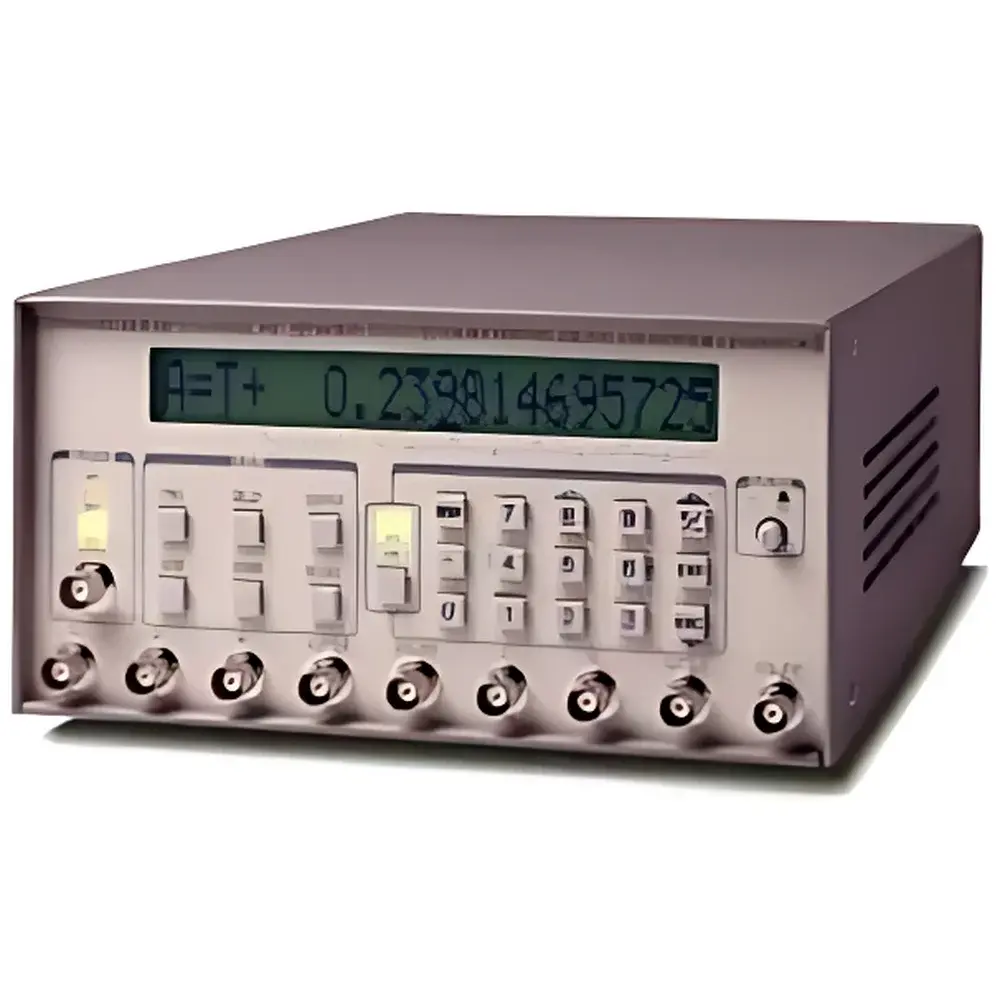
SRS DG535 Digital Delay/Pulse Generator
| Origin | USA |
|---|---|
| Manufacturer Type | Distributor |
| Origin Category | Imported |
| Model | DG535 |
| Price | Upon Request |
| Channels | 4 independent delay channels |
| Pulse Outputs | 2 fully defined pulse outputs |
| Delay Resolution | 5 ps |
| RMS Jitter | 50 ps |
| Max Delay Range | 1000 s |
| Max Trigger Frequency | 1 MHz (internal/external/serial/line) |
| Interface | Standard GPIB (IEEE-488.2) |
| Output Voltage Range | Adjustable amplitude and offset voltage |
| Output Voltage | Up to 35 V |
| Rise/Fall Time | 100 ps (with optional module) |
Overview
The SRS DG535 Digital Delay/Pulse Generator is a precision timing instrument engineered for laboratory-grade synchronization, time-resolved measurement, and deterministic event control in physics, optics, and engineering applications. Based on high-stability quartz timing architecture and digital delay synthesis, the DG535 implements four independent delay channels with sub-picosecond resolution to generate precisely timed logic transitions, TTL/CMOS-compatible pulses, or programmable gate windows. Its core functionality centers on deterministic temporal alignment—enabling precise triggering of lasers, detectors, data acquisition systems, lock-in amplifiers, and motion controllers with nanosecond-to-kilosecond latency control. Unlike analog delay generators, the DG535 employs digitally synthesized delays with zero drift over temperature and time, ensuring long-term repeatability required for automated test benches and regulated environments.
Key Features
- Four fully independent delay channels, each configurable with user-defined trigger source, delay time, width, and polarity
- Two fully programmable pulse outputs supporting arbitrary pulse shape definition via delay/width pairing
- 5 ps delay resolution across the full 1000-second range—achievable through 64-bit internal counter architecture and phase-locked interpolation
- Low-jitter timing performance: 50 ps RMS jitter (typical) referenced to stable external or internal 10 MHz clock
- Flexible triggering: supports internal clock, external TTL/CMOS/NIM inputs, serial command-triggered events, and line-synchronized (50/60 Hz) operation
- Adjustable output amplitude (–5 V to +35 V) and DC offset (–5 V to +35 V), compatible with both standard logic levels and high-voltage instrumentation interfaces
- 100 ps rise/fall time achievable with optional high-speed output module (DG535-HV), optimized for low-inductance cabling and fast photodiode or Pockels cell drivers
- GPIB (IEEE-488.2) interface standard; SCPI-compliant command set enables seamless integration into LabVIEW, Python (PyVISA), MATLAB, and custom automation frameworks
Sample Compatibility & Compliance
The DG535 operates as a timing backbone—not a sample-contacting instrument—and thus imposes no material compatibility constraints. It interfaces electrically with standard laboratory equipment via 50 Ω BNC connectors and supports TTL, CMOS, ECL, and NIM logic families. For regulatory compliance, the unit conforms to FCC Part 15 Class A emissions limits and meets CE marking requirements for electromagnetic compatibility (EMC Directive 2014/30/EU) and low-voltage safety (LVD Directive 2014/35/EU). While not inherently GLP/GMP-certified, its deterministic timing behavior, non-volatile delay storage, and GPIB audit trail capability support traceable operation in ISO/IEC 17025-accredited labs when paired with appropriate calibration documentation (NIST-traceable calibration available upon request).
Software & Data Management
The DG535 includes built-in non-volatile memory for storing up to 16 complete instrument configurations—including delay values, trigger settings, and output states—which persist across power cycles. Remote control is implemented via industry-standard GPIB commands (e.g., DLAY1 1.234567890123E-6) with full SCPI syntax support. Standalone operation requires no host PC; front-panel keypad and LCD provide intuitive manual setup. For automated workflows, Stanford Research Systems provides comprehensive driver libraries for LabVIEW (NI-VISA), MATLAB Instrument Control Toolbox, and Python (via PyVISA). All timing parameters are stored as IEEE 754 double-precision floating-point values, ensuring numerical fidelity across multi-hour experiments. Audit-ready logging is achievable through GPIB command echo and timestamped external data acquisition synchronized to DG535’s trigger output.
Applications
- Laser cavity dumping, Q-switching, and pump-probe experiment synchronization
- Time-of-flight (TOF) measurements in LIDAR, particle velocity mapping, and ultrasonic transit-time flow meters
- Phase-locked triggering of streak cameras, gated CCDs, and time-correlated single-photon counting (TCSPC) systems
- Multi-stage pulsed power sequencing for plasma diagnostics and pulsed magnet applications
- Calibration reference for oscilloscope timebase verification and jitter analysis setups
- Stimulus-response latency testing in neurophysiology rigs and real-time control loops
FAQ
What is the minimum resolvable delay increment?
The DG535 achieves 5 ps resolution across its entire 1000 s delay range using interpolated digital synthesis—not fixed-step lookup tables.
Can the DG535 generate bursts or repetitive pulse trains?
Yes—via internal repetition mode with user-defined period (1 µs to 1000 s) and burst count (1 to 65,535), synchronized to any channel’s output or external trigger.
Is the 100 ps rise/fall time specification guaranteed with standard cabling?
No—the 100 ps specification applies only when using the optional DG535-HV output module and matched 50 Ω coaxial cabling under controlled impedance conditions; standard outputs specify ≤1 ns.
Does the DG535 support USB or Ethernet connectivity?
No—GPIB is the only standard interface; however, GPIB-to-USB or GPIB-to-Ethernet bridges (e.g., National Instruments GPIB-ENET/1000) are widely supported and validated in production environments.
How is calibration maintained over time and temperature?
The internal 10 MHz oven-controlled crystal oscillator (OCXO) provides ±50 ppb stability over 0–50 °C and aging <±500 ppb/year; factory calibration is traceable to NIST standards and includes full delay linearity verification.