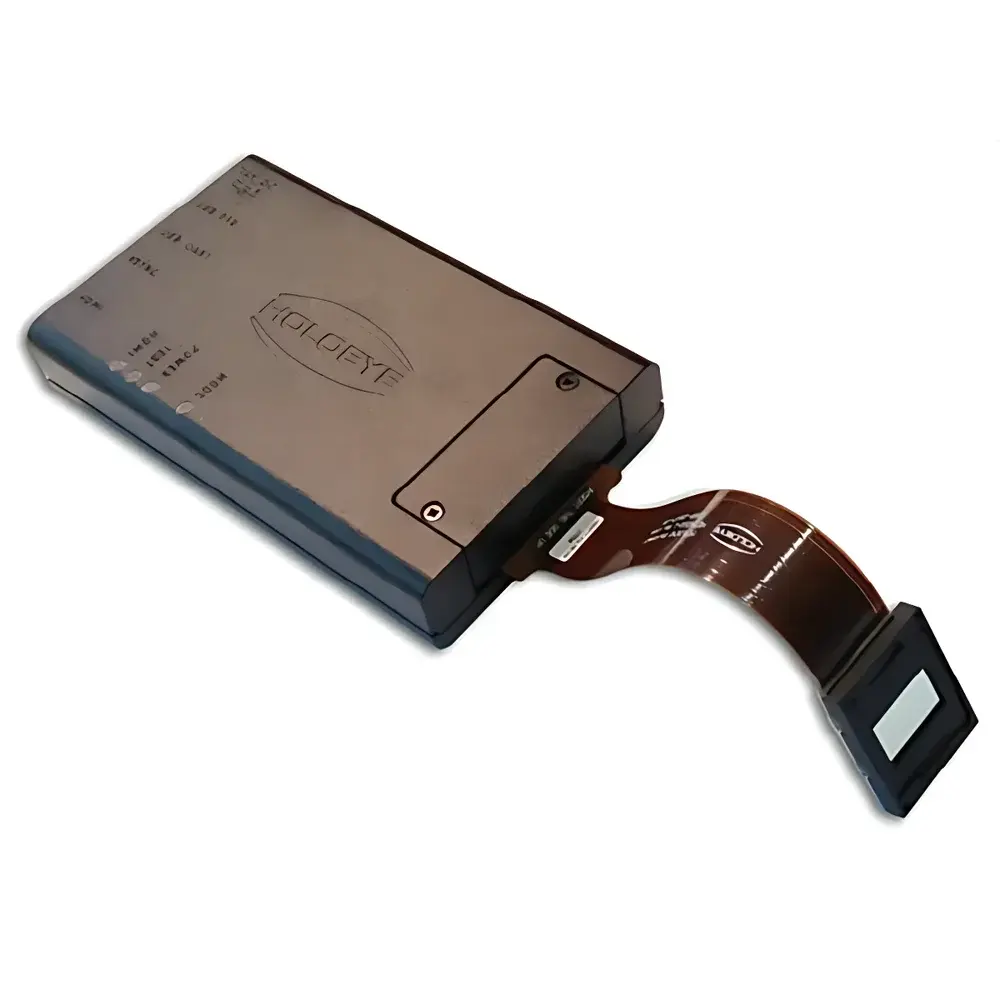
Holoeye PLUTO-2.1-VIS-130 Pure-Phase Spatial Light Modulator
| Brand | Holoeye |
|---|---|
| Origin | Germany |
| Model | PLUTO-2.1-VIS-130 |
| Resolution | 1920 × 1080 pixels |
| Pixel Pitch | 8 µm |
| Operating Wavelength Range | Visible spectrum (400–700 nm) |
| Modulation Type | Pure-phase, reflective LCOS-based |
| Interface | HDMI/DisplayPort input with external frame buffer or direct GPU streaming |
| Active Area | 15.36 mm × 8.64 mm |
| Refresh Rate | Up to 60 Hz (full resolution), higher at reduced ROI |
| Bit Depth | 8-bit phase control (256-level quantization) |
Overview
The Holoeye PLUTO-2.1-VIS-130 is a high-resolution, pure-phase spatial light modulator (SLM) engineered for precision wavefront shaping in visible-light optical systems. Based on liquid crystal on silicon (LCOS) technology, it operates in reflective mode and delivers deterministic phase-only modulation across its full active aperture. Unlike intensity-modulating devices, the PLUTO-2.1-VIS-130 suppresses amplitude variation to maintain high diffraction efficiency—critical for applications demanding minimal zero-order leakage and precise holographic reconstruction. Its native 1920 × 1080 pixel array, with an 8 µm pixel pitch, yields an active area of 15.36 mm × 8.64 mm, enabling fine spatial sampling of optical wavefronts while maintaining compatibility with standard F/2–F/4 imaging optics. Designed for laboratory integration, the device supports real-time phase pattern loading via HDMI or DisplayPort, with optional GPU-accelerated streaming for dynamic holography, adaptive optics, and structured illumination microscopy.
Key Features
- Pure-phase modulation architecture optimized for high-diffraction-efficiency holographic applications
- 1920 × 1080 pixel resolution with uniform 8 µm pixel pitch and >90% fill factor
- Visible spectral range coverage (400–700 nm), calibrated for peak performance at 532 nm and 633 nm
- Reflective LCOS design with anti-reflection coated window and integrated thermal stabilization
- Hardware-triggered synchronization support (TTL input) for time-critical interferometric setups
- Low RMS phase error (<λ/50 @ 633 nm) and high inter-frame repeatability under stable thermal conditions
- Driver software SDK compatible with Windows and Linux, supporting Python, MATLAB, and C/C++ APIs
Sample Compatibility & Compliance
The PLUTO-2.1-VIS-130 is designed for integration into research-grade optical benches and OEM instrumentation platforms. It requires collimated, linearly polarized input illumination aligned to its specified polarization axis (typically TE-polarized). The device complies with CE marking requirements for electromagnetic compatibility (EMC Directive 2014/30/EU) and low-voltage safety (LVD Directive 2014/35/EU). While not certified for medical or industrial process control use, its performance characteristics align with common metrology benchmarks referenced in ISO 10110-5 (optical component surface figure) and ISO/IEC 17025–accredited calibration workflows when used with traceable interferometric verification tools. No FDA or IEC 61000-4-x certification is claimed; users are responsible for system-level validation per application-specific regulatory frameworks (e.g., GLP-compliant holographic trapping setups).
Software & Data Management
Holoeye provides the SLM Display software suite, which includes pre-compiled phase mask generators (e.g., vortex, lens, grating, kinoform), real-time phase calibration utilities, and GPU-accelerated pattern rendering. All phase maps are loaded as 8-bit grayscale bitmaps conforming to standard image formats (BMP, PNG), ensuring interoperability with third-party simulation tools such as COMSOL Multiphysics, Lumerical MODE, or custom CUDA-based wave propagation kernels. Audit-trail functionality is available through optional logging modules that record timestamped pattern uploads, exposure duration, and hardware status flags—supporting documentation requirements for ISO/IEC 17025 or internal lab SOPs. Data export is supported in CSV, HDF5, and FITS formats for post-processing in Python (NumPy, SciPy) or MATLAB environments.
Applications
- Holographic optical tweezers and multi-point particle manipulation in biophotonics
- Adaptive optics correction in microscopy (e.g., two-photon, STED, and light-sheet systems)
- Dynamic diffractive optical element (DOE) emulation for beam shaping and laser material processing
- Quantum optics experiments requiring programmable mode sorting (e.g., OAM state generation)
- Fourier-plane filtering and computational imaging architectures
- Education and prototyping of diffractive neural networks and optical computing elements
FAQ
What is the maximum frame rate achievable at full resolution?
The PLUTO-2.1-VIS-130 supports up to 60 Hz at native 1920 × 1080 resolution when driven via HDMI 1.4 or DisplayPort 1.2 with appropriate graphics hardware. Higher rates (up to 120 Hz) are attainable using region-of-interest (ROI) addressing or compressed pattern streaming modes.
Is phase calibration included with the device?
Yes—each unit ships with a factory-measured phase response curve (phase vs. gray level) for the target wavelength. Users may perform additional in-situ calibration using interferometric methods or commercial wavefront sensors.
Can the SLM be used in vacuum or high-humidity environments?
No—the device is rated for operation only in ambient laboratory conditions (15–30 °C, <70% RH, non-condensing). Enclosure within sealed optical mounts is permissible; direct vacuum exposure or immersion is prohibited.
Does the driver software support automated batch loading of phase sequences?
Yes—via the provided DLL and Python bindings, users can script sequential pattern loading with microsecond-level timing control, including TTL-triggered execution and frame-accurate synchronization with cameras or lasers.
What maintenance is required during normal operation?
No routine maintenance is required. Avoid mechanical shock, direct UV exposure, or prolonged operation above 35 °C ambient. Clean optical surfaces only with spectroscopic-grade solvents and lint-free wipes following ISO 10110-7 protocols.