
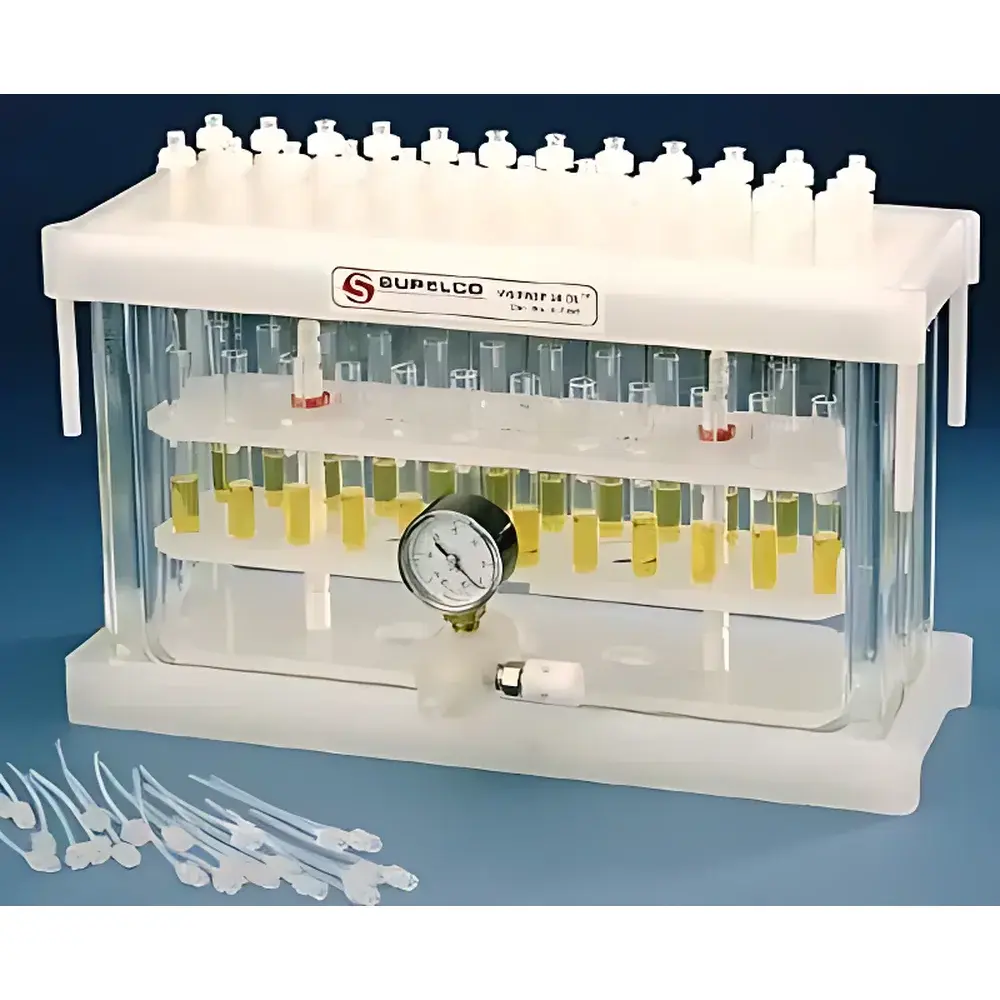
Supelco 57265 24-Position Solid Phase Extraction Manifold
| Brand | Supelco |
|---|---|
| Origin | USA |
| Manufacturer Type | Authorized Distributor |
| Product Category | Imported |
| Model | 57265 |
| Automation Level | Semi-Automatic |
| Channel Count | Single-Channel |
| Extraction Format | Column-Based SPE |
| Flow Rate Control Range | 0.1–30 mL/min |
| Solvent Reservoir Positions | 24 |
| Sample Capacity | 24 Samples |
| Sample Loading Volume | 1–30 mL |
| Wetted Materials | Borosilicate Glass |
Overview
The Supelco 57265 24-Position Solid Phase Extraction (SPE) Manifold is a precision-engineered, semi-automatic vacuum manifold designed for high-throughput, reproducible sample preparation in analytical laboratories. Built on the foundational principles of solid-phase extraction—selective adsorption, washing, and elution—the system enables efficient isolation and concentration of analytes from complex liquid matrices prior to chromatographic or mass spectrometric analysis. Its robust borosilicate glass construction ensures chemical inertness across a broad range of organic solvents (e.g., methanol, acetonitrile, ethyl acetate, dichloromethane) and aqueous buffers, minimizing leaching and background interference. Unlike modular plastic manifolds, the all-glass architecture supports rigorous cleaning protocols, repeated sterilization, and long-term stability under vacuum—critical for regulated environments requiring method validation and trace-level quantitation.
Key Features
- 24-position column format with individually sealed, anti-cross-contamination vacuum ports—each port features independent O-ring sealing and tapered glass frits to prevent channel-to-channel carryover during parallel processing.
- Vacuum-tight borosilicate glass body and solvent reservoirs certified to withstand continuous operation at ≤−80 kPa (≤600 mmHg), compatible with standard laboratory vacuum sources including oil-free diaphragm pumps (e.g., Gast DOA-P504-BN, 25 L/min).
- Precision-machined flow control valves (0.1–30 mL/min range) integrated into each column port, enabling consistent, operator-independent flow rates across all 24 positions—essential for method transfer and inter-laboratory reproducibility.
- Modular compatibility with Supelco-certified SPE cartridges (1 mL, 3 mL, 6 mL, 12 mL, 20 mL, and 60 mL formats) via optional adapters (e.g., part #57020-U), ensuring retention of manufacturer-specified bed mass, particle size, and surface chemistry integrity.
- Designed for seamless integration with downstream SPE accessories: 24-position drying manifolds (part #57124), large-volume samplers (part #57272 / #57275), PTFE-coated transfer lines (part #57059), and 1000 mL glass buffer flasks (part #M81217) for stable vacuum maintenance during extended batch runs.
Sample Compatibility & Compliance
The 57265 manifold supports diverse sample types per ICH Q5A, USP , and EPA Method 500/600 series guidelines—including biological fluids (serum, plasma, urine, cerebrospinal fluid), food and beverage extracts (milk, beer, fruit juice, spirits), environmental water (drinking water, groundwater, wastewater), pharmaceutical formulations (liquid dosage forms, dissolution media), and solid tissue digests (soil, sediment, homogenized animal tissue). All wetted components comply with USP Class VI biocompatibility standards and are free of detectable heavy metals (Pb, Cd, As, Hg) per ISO 10993-12. The system is routinely deployed in GLP-compliant labs conducting residue analysis (e.g., veterinary drug screening per EU Regulation 37/2010) and validated under FDA 21 CFR Part 11 when paired with audit-trail-capable vacuum controllers and electronic logbooks.
Software & Data Management
As a hardware-only manifold, the 57265 does not include embedded firmware or proprietary software. However, its mechanical design facilitates full documentation within LIMS and ELN platforms: column lot numbers, solvent lot IDs, operator initials, vacuum pressure logs (via external digital manometer), and processing timestamps can be recorded manually or imported via CSV from connected vacuum controllers. When used in conjunction with Supelco’s certified SPE cartridge kits (e.g., ENVI-Carb, C18, SCX), batch-specific certificate of analysis (CoA) data—including breakthrough volume, recovery %, and retention time shift—can be archived per ISO/IEC 17025 clause 7.7 requirements.
Applications
- Quantitative bioanalysis of small-molecule therapeutics and metabolites in human plasma per EMA CHMP guideline on bioanalytical method validation.
- Multi-residue pesticide screening in fruits and vegetables using QuEChERS-SPE hybrid workflows (AOAC 2007.01).
- Endocrine-disrupting compound (EDC) enrichment from municipal wastewater effluents prior to LC-MS/MS detection (EPA Method 1694).
- Purification of oligonucleotides and peptides from crude synthesis mixtures prior to HPLC purification and MALDI-TOF characterization.
- Isolation of mycotoxins (aflatoxin B1, ochratoxin A) from cereal grains following AOAC 2005.08 extraction protocols.
FAQ
Is the 57265 manifold compatible with non-Supelco SPE cartridges?
Yes—provided the cartridge dimensions (diameter, height, outlet thread) match standard ASTM D5210 specifications and the frit material is chemically compatible with the chosen eluent. Adapter use is recommended for sub-1 mL or oversized (>60 mL) formats.
What vacuum pump specifications are required for optimal performance?
A minimum ultimate vacuum of −85 kPa and flow rate ≥20 L/min is recommended; oil-free diaphragm pumps (e.g., Gast DOA-P504-BN or equivalent) are preferred to avoid hydrocarbon contamination of sensitive analytes.
Can the manifold be autoclaved?
The borosilicate glass body and reservoirs are autoclavable at 121 °C, 15 psi for 20 minutes; however, rubber gaskets and valve seals must be removed prior to sterilization and replaced per manufacturer-recommended service intervals.
Does Supelco provide method validation support for this manifold?
While the manifold itself is not subject to instrument qualification (IQ/OQ/PQ), Supelco offers application notes, SOP templates, and recovery study data packages aligned with USP and ICH Q2(R2) for common SPE workflows.
How is cross-contamination minimized during multi-sample processing?
Through dual engineering controls: (1) physically isolated vacuum channels with independent sealing surfaces, and (2) vapor-tight solvent reservoir caps that eliminate aerosol-mediated transfer between adjacent ports during elution.



