
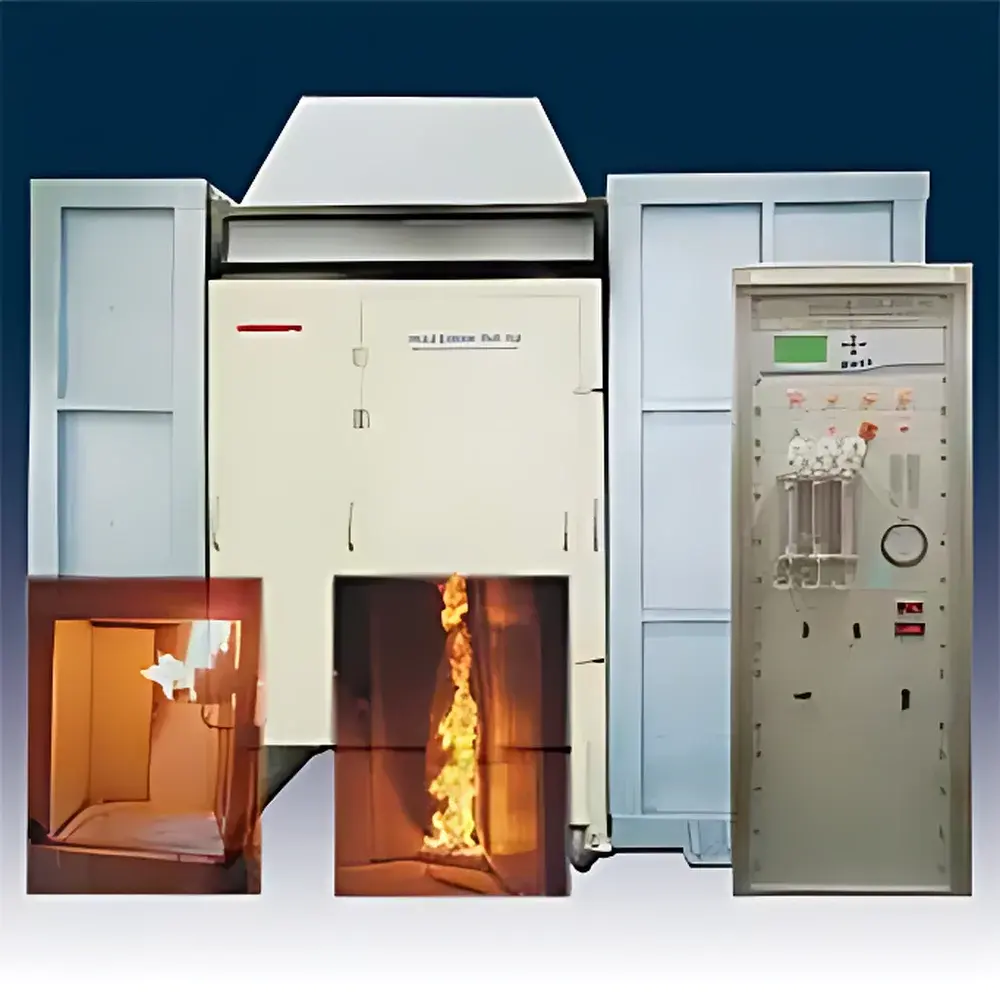
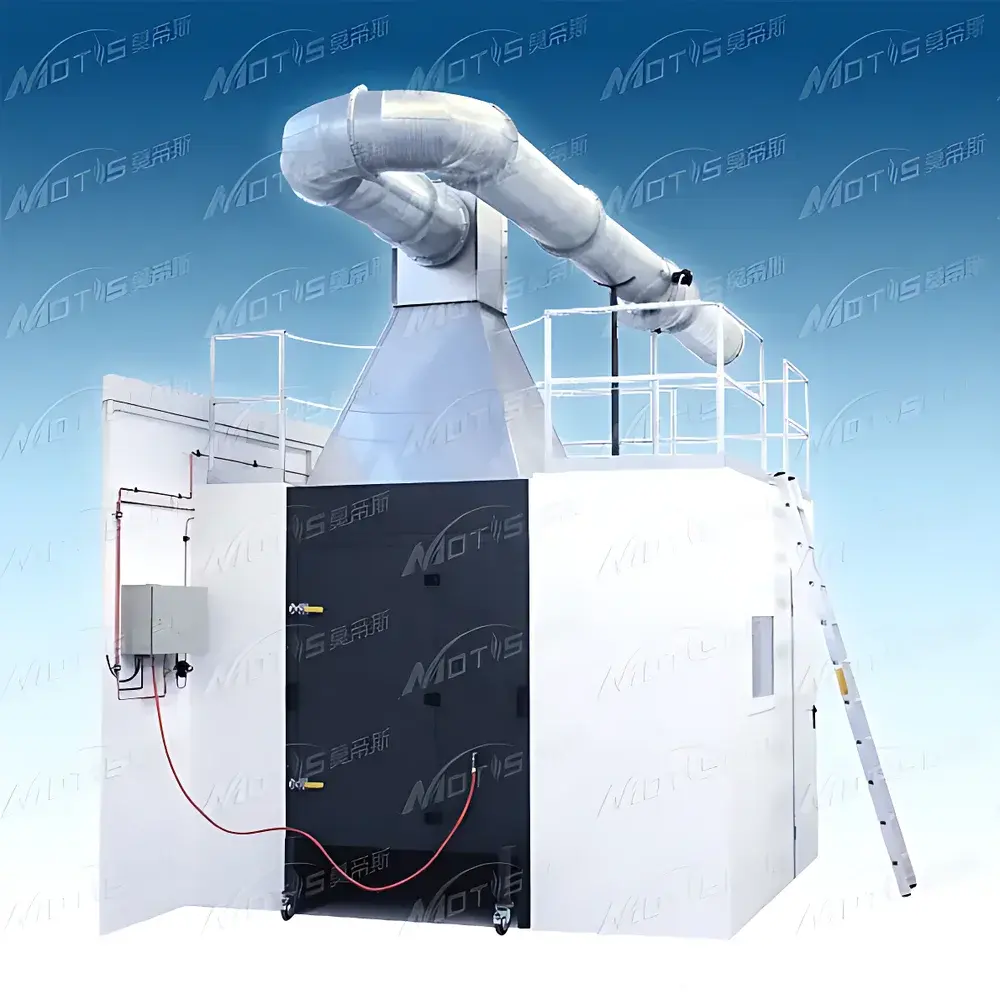
FESTEC SBI Single Burning Item Test Apparatus
| Brand | FESTEC |
|---|---|
| Origin | South Korea |
| Model | SBI |
| Compliance | EN 13823, GB/T 20284 |
| Measurement Principle | Oxygen Consumption Calorimetry & Optical Smoke Density Analysis |
| Heat Flux | 31 kW Propane Corner Burner (250 mm × 250 mm × 80 mm) |
| Test Chamber | 3 m × 3 m × 2.4 m (L × W × H) |
| Sampling Duct | Integrated multi-sensor zone for O₂, CO, CO₂, temperature, smoke obscuration (via light extinction), and volumetric flow |
| Data Acquisition | Analog inputs for thermocouples (K-type), differential pressure sensors, gas analyzers |
| Gas Analysis System | Siemens OXYMAT 61 (paramagnetic O₂, 0–25% vol, ±1% FS/week drift, <3 s response) + U23 NDIR (CO: 0–1%, CO₂: 0–10%, ±1% FS/week, <3 s response) |
| Smoke Measurement | Laser-based optical density (OD) at 532 nm, calibrated per ISO 5659-2 |
| Flame Spread Assessment | Lateral Flame Spread (LFS) time to 1.5 m × 1.0 m specimen edge |
| Key Outputs | FIGRA (Fire Growth Rate Index), THR (Total Heat Release), SMOGRA (Smoke Growth Rate Index), TSP (Total Smoke Production), LFS, Droplet Formation Observation |
Overview
The FESTEC SBI Single Burning Item Test Apparatus is a fully integrated, standards-compliant fire testing system engineered for the quantitative assessment of non-load-bearing building products under realistic intermediate-scale fire exposure. It operates on the principle of oxygen consumption calorimetry—where heat release rate (HRR) is derived from precise measurement of oxygen depletion in the exhaust stream—and concurrent optical smoke density analysis via laser light extinction. The apparatus subjects vertically mounted specimens (up to 1.5 m height × 1.0 m width) to a controlled 31 kW propane corner burner located at the base of the specimen frame, simulating localized ignition in wall or ceiling assemblies. All combustion products—including thermal effluent, gaseous species (O₂, CO, CO₂), and aerosolized particulates—are captured in a dedicated extraction duct connected to a ceiling-mounted hood. This configuration enables real-time calculation of critical fire performance indices defined in EN 13823 and GB/T 20284, including FIGRA (kW/s), THR (MJ), SMOGRA (m²/s), TSP (m²), and lateral flame spread (LFS) time.
Key Features
- Modular test chamber (3 m × 3 m × 2.4 m) with refractory-lined walls and sealed access doors for repeatable thermal boundary conditions
- Calibrated 31 kW propane burner assembly with precision-machined stainless steel sand-filled corner geometry (250 mm × 250 mm × 80 mm)
- Dual-burner configuration: primary ignition source + auxiliary burner for extended flame stabilization during prolonged tests
- Integrated sampling duct with standardized sensor mounting zones compliant with ISO 5659-2 and ASTM E1354 positioning requirements
- Siemens OXYMAT 61 paramagnetic oxygen analyzer (0–25% v/v, ±0.5% FS linearity, <3 s T₉₀) and U23 NDIR gas analyzers for CO (0–1%) and CO₂ (0–10%) with trace-level stability
- K-type thermocouple array (IEC 60584-1 Class 2) for flue gas temperature profiling across duct cross-section
- PTFE-lined gas sampling train with cryogenic cold trap, mass flow-controlled sampling pump, and corrosion-resistant PTFE tubing (ISO 13943-compliant)
- Stainless steel bi-directional Pitot-static probe with micro-differential pressure transducer for volumetric flow rate validation (±1.5% reading)
- Automated data acquisition system with synchronized 20-channel analog input board supporting thermocouple, pressure, and 4–20 mA gas analyzer signals
- Pre-validated test software with embedded calibration routines, real-time curve plotting, and automated index computation (FIGRA, THR, SMOGRA, TSP, LFS)
Sample Compatibility & Compliance
The SBI apparatus accommodates rigid, semi-rigid, and flexible building products—including insulation boards, decorative panels, suspended ceiling tiles, and cladding systems—mounted on a standardized steel trolley with orthogonal non-combustible backing plates. Specimen dimensions conform strictly to EN 13823 Annex A (1.5 m × 1.0 m vertical orientation). All hardware, sensor placement, airflow management, and data reduction algorithms are validated against the reference method described in CEN/TS 15102 and ISO/TR 13943. The system supports full auditability for GLP and GMP environments: raw sensor outputs are timestamped and stored in binary format with metadata (calibration dates, operator ID, ambient conditions); software enforces user authentication and provides electronic signature-capable reporting. Test reports include traceable uncertainty budgets per ISO/IEC 17025 requirements and comply with regulatory submission formats for CE marking, China CCC certification, and U.S. ICC-ES evaluations.
Software & Data Management
The proprietary SBI Control & Analysis Suite runs on Windows OS with deterministic real-time kernel extensions for sub-second data synchronization. It implements dual-data-path architecture: primary path acquires raw sensor voltages at 10 Hz with hardware timestamping; secondary path ingests pre-processed gas concentration values via Modbus TCP. All acquired parameters are logged in HDF5 format with embedded schema definitions (HDF5 Group: /raw_data, /calibrated_values, /computed_indices). The software includes built-in validation checks per EN 13823 Clause 7.4 (e.g., minimum O₂ depletion threshold, stable baseline criteria prior to ignition) and flags anomalous events (e.g., flame lift-off, sooting instability) with annotated event markers. Export modules generate PDF reports compliant with ISO/IEC 17025 documentation requirements, CSV files for third-party statistical analysis, and XML schemas compatible with LIMS integration (ASTM E1482, ISO 15197). Audit trails record all user actions—including parameter edits, calibration initiations, and report generation—with immutable SHA-256 hashes.
Applications
- Classification of construction products under Euroclass system (B-s1, d0 through F) per EN 13501-1
- Development and validation of intumescent coatings, mineral wool composites, and bio-based insulation materials
- Comparative fire performance benchmarking of alternative cladding systems in façade engineering studies
- Supporting fire safety engineering analyses (e.g., zone modeling input data for HRR and smoke production profiles)
- Regulatory submissions to national authorities including KATS (Korea), CNCA (China), and notified bodies accredited to ISO/IEC 17065
- Research into flame inhibition mechanisms, char formation kinetics, and toxic gas evolution pathways during polymeric decomposition
FAQ
What standards does the FESTEC SBI apparatus fully support?
EN 13823 (Single Burning Item), GB/T 20284 (Chinese national equivalent), and technical prerequisites of ISO 5659-2 for smoke measurement.
Is the system suitable for testing combustible façade systems with air gaps?
Yes—the trolley design and chamber ventilation profile allow evaluation of ventilated curtain wall mock-ups when configured per Annex B of EN 13823.
Can the apparatus be upgraded to meet future revisions of EN 13823?
All firmware, software, and sensor modules are field-upgradable via secure OTA protocol; mechanical interfaces adhere to CEN/TS 15102 dimensional tolerances to accommodate future metrological enhancements.
What level of operator training is required to achieve ISO/IEC 17025-compliant results?
FESTEC provides certified technician training covering burner calibration, gas analyzer verification, data integrity protocols, and uncertainty budgeting—valid for 24 months per ISO/IEC 17025:2017 Clause 6.2.5.
Are spare parts and service support available outside South Korea?
Global service network includes authorized calibration laboratories in Germany, USA, Singapore, and Shanghai, with 72-hour response SLA for critical component replacement (O₂ sensor cells, IR source lamps, thermocouple assemblies).



