
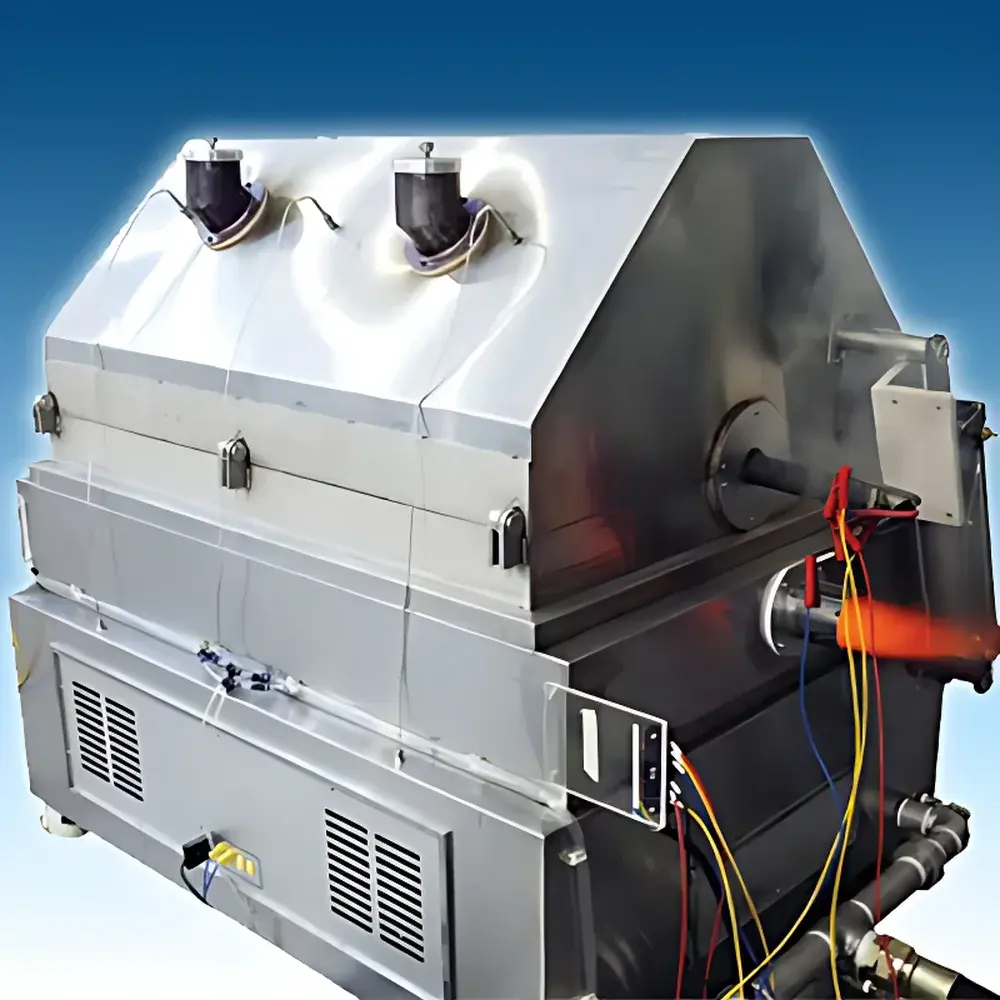
FESTEC HCF-NEK606 Fire Resistance Testing Chamber for Marine and Industrial Cables
| Brand | FESTEC |
|---|---|
| Origin | South Korea |
| Model | HCF-NEK606 |
| Chamber Dimensions (W×D×H) | 1220 × 1045 × 1100 mm |
| External Dimensions (W×D×H) | 1300 × 1125 × 950 mm |
| Frame Material | 50×50×t3 mm Stainless Steel 304 |
| Burner Tube ID | Ø36 mm, SS304 |
| Venturi Mixer | Air/Propane Premixing |
| Air MFC | 77.7 ± 4.8 SLPM (180 L/min) |
| Propane MFC | 15 SLPM (13.5 ± 0.5 L/min) |
| Temperature Sensors | K-type (Ø8.0 mm) & R-type (Ø8.0 mm) Thermocouples |
| Data Acquisition | PC-connected DAQ with Bluetooth antenna pair |
| Control Rack Dimensions | 730 × 650 × 1600 mm, Aluminum Alloy |
| Safety System | Automated Ignition, Interlocked Door, Flame-Out Detection |
Overview
The FESTEC HCF-NEK606 Fire Resistance Testing Chamber is a purpose-engineered combustion test system designed to evaluate the fire endurance performance of electrical cables under standardized hydrocarbon-fueled fire conditions—specifically aligned with NEK 606:2018, the Norwegian Electrotechnical Committee standard for non-halogenated and mud-resistant cables used in offshore platforms, marine vessels, and petrochemical facilities. Unlike generic vertical flame tests, the HCF-NEK606 replicates the rapid temperature rise characteristic of hydrocarbon pool fires (e.g., crude oil or LNG ignition), where temperatures exceed 1000 °C within 5 minutes and stabilize near 1100 °C after 20 minutes. The chamber employs a controlled premixed propane–air flame generated via a Venturi mixer and regulated by dual mass flow controllers (MFCs), ensuring precise stoichiometric delivery and high reproducibility across sequential test cycles. Its robust 304 stainless steel construction—including structural framing, burner assembly, and internal chamber lining—ensures long-term dimensional stability and resistance to thermal oxidation during repeated exposure to peak flame temperatures.
Key Features
- Compliance-ready design validated against NEK 606:2018 Annex A (hydrocarbon fire curve) and compatible with IEC 60332-3, IEC 60331, and UL 2196 fire endurance protocols.
- Dual high-accuracy mass flow control: independent regulation of air (77.7 ± 4.8 SLPM) and propane (15 SLPM), enabling strict adherence to the prescribed gas composition and heat flux profile.
- Integrated thermocouple suite: two 8.0 mm-diameter mineral-insulated thermocouples—K-type for general chamber ambient monitoring and R-type for high-temperature flame zone measurement—mounted per NEK 606 spatial requirements.
- Automated ignition sequence with flame supervision logic, including real-time flame-out detection and emergency gas shutoff, meeting functional safety requirements per IEC 61508 SIL 2.
- Modular aluminum control rack housing DAQ hardware, programmable logic controller (PLC), and interface modules; supports remote operation via Ethernet or Bluetooth (dual-antenna configuration).
- Full interlock system: door position sensing, overtemperature cutoff, and gas leak monitoring integrated into the safety circuitry per EN 50121-3-2 and EN 61000-6-4 EMC compliance.
Sample Compatibility & Compliance
The HCF-NEK606 accommodates single-core and multi-core cables up to 60 mm outer diameter, with vertical mounting configurations supporting both insulated conductor and armored cable types. Test specimens are secured using non-combustible ceramic clamps and subjected to mechanical load simulation (optional weight suspension) as specified in NEK 606 Clause 7.3. All materials in direct flame contact—including burner tube, chamber liner, and support fixtures—are fabricated from AISI 304 stainless steel (EN 10088-1), certified to resist scaling and creep deformation at sustained 1100 °C exposure. The system is supplied with calibration certificates traceable to NIST standards for MFCs and thermocouples, and includes documentation packages suitable for GLP audits and third-party certification body submissions (e.g., DNV GL, Bureau Veritas, UL).
Software & Data Management
Data acquisition is managed through a Windows-based control application running on an industrial PC, interfacing with the embedded DAQ module via USB or Ethernet. Real-time parameters—including gas flow rates, chamber temperature (recorded at 1 Hz), flame stability status, and elapsed test time—are logged in CSV and binary formats compliant with ASTM E178-22 data integrity guidelines. Audit trails record all operator actions, parameter modifications, and system alarms with timestamps and user IDs—supporting FDA 21 CFR Part 11 electronic signature readiness when deployed in regulated environments. Exported datasets include synchronized thermocouple readings referenced to the NEK 606 time–temperature curve, enabling automated pass/fail evaluation per Clause 8.2 (voltage maintenance criteria) and Clause 9.1 (integrity verification post-test).
Applications
- Qualification testing of low-smoke zero-halogen (LSZH) cables for offshore drilling rigs and FPSOs.
- Fire resistance validation of instrumentation and power cables installed in refinery hazardous zones (Zone 1/2, Class I Div 1/2).
- R&D evaluation of intumescent coatings, mica tape barriers, and ceramic fiber wraps under dynamic hydrocarbon fire exposure.
- Third-party certification testing per DNV-ST-0362, API RP 14F, and IMO FTP Code Annex 1 requirements.
- Comparative analysis of cable failure modes—including insulation charring depth, conductor oxidation, and sheath delamination—using post-test macroscopic and cross-sectional examination.
FAQ
What international standards does the HCF-NEK606 fully support?
The system is configured and validated for NEK 606:2018 (primary), with hardware and control logic also enabling execution of IEC 60331-21 (fire resistance with mechanical shock) and UL 2196 (circuit integrity) when paired with optional accessories.
Is the temperature profile actively regulated during testing?
No—temperature is governed by open-loop gas flow control per the NEK 606 hydrocarbon curve; however, real-time thermocouple feedback enables deviation alerting and automatic test abort if >±25 °C tolerance is exceeded for >30 seconds.
Can the chamber be integrated into an existing laboratory LIMS or MES platform?
Yes—via OPC UA server integration or custom REST API endpoints provided under FESTEC’s LabLink™ connectivity framework.
What maintenance intervals are recommended for MFCs and thermocouples?
MFCs require annual recalibration; R-type thermocouples are rated for 50 cycles at 1100 °C and must be replaced after 30 full-duration tests or visible tip erosion.
Does the system include CE marking and Declaration of Conformity?
Yes—the HCF-NEK606 carries CE marking under the Machinery Directive 2006/42/EC and EMC Directive 2014/30/EU, with full technical documentation available upon order confirmation.



