
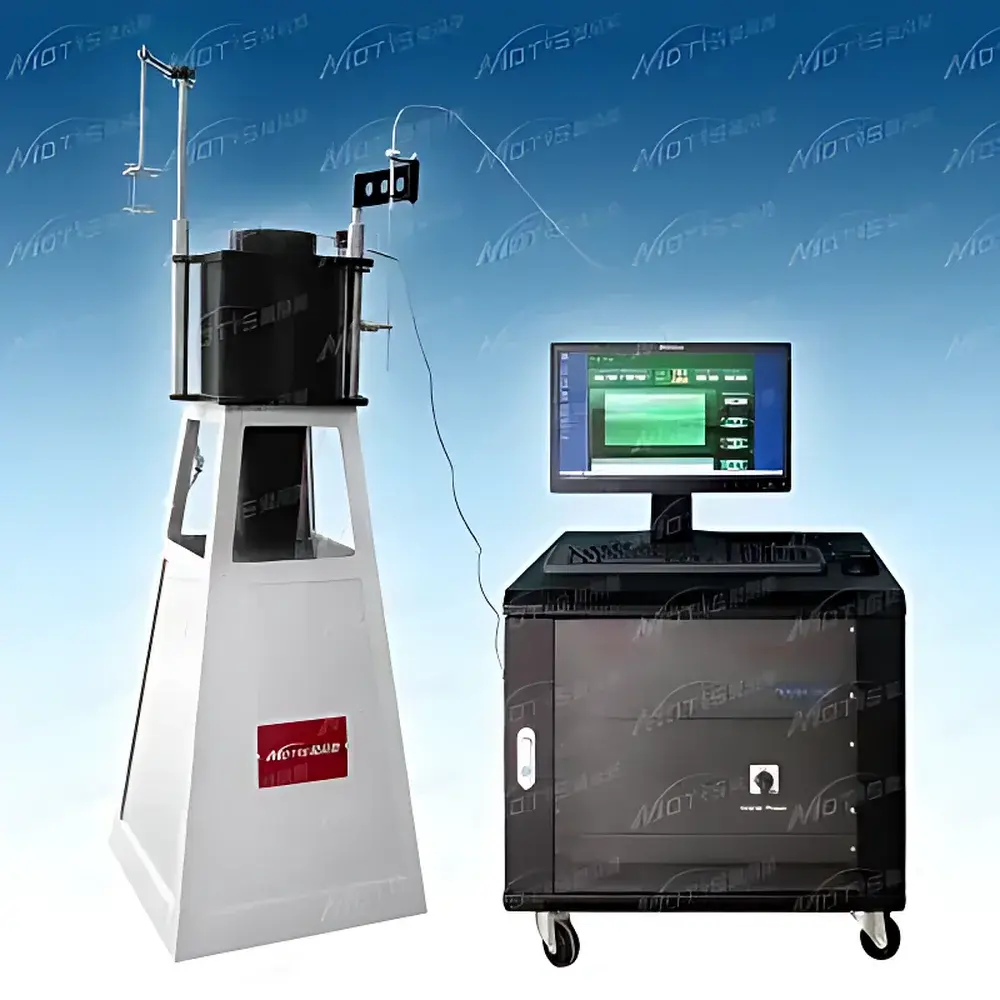
MOTIS NCF Non-Combustibility Test Furnace for Building Materials
| Brand | MOTIS |
|---|---|
| Origin | Shanghai, China |
| Model | NCF |
| Temperature Control | PID + Constant-Power Hybrid Mode |
| Operating Temperature | 750 ± 5 °C |
| Calibration | Dual Thermocouple System (360° Circumferential Wall Scan + Adjustable Internal Probe) |
| Data Interface | RS-232C with Dedicated Acquisition Card |
| Compliance | GB/T 5464–2010, GB 8624–2011 |
| Software | Integrated Calibration Curve Generation, Auto-Judgment Logic, Report Generation & Printing |
| Structural Design | Modular Furnace Assembly for Simplified Maintenance |
Overview
The MOTIS NCF Non-Combustibility Test Furnace is a purpose-built thermal testing system engineered to evaluate the non-combustibility performance of construction materials in strict accordance with Chinese national standards GB/T 5464–2010 and GB 8624–2011. It implements a controlled vertical furnace methodology based on the principle of sustained high-temperature exposure under defined thermal conditions—specifically maintaining a nominal furnace core temperature of 750 ± 5 °C for a standardized duration. Unlike generic muffle furnaces, the NCF integrates dual-zone thermal validation: real-time monitoring of both internal specimen zone temperature and circumferential furnace wall temperature, enabling precise assessment of thermal uniformity and compliance with the spatial temperature gradient requirements specified in Clause 6.2 of GB/T 5464–2010. Its design addresses critical metrological traceability gaps observed in legacy systems by embedding automated calibration verification into routine operation—not as a separate pre-test procedure, but as an integral part of each test cycle.
Key Features
- Hybrid thermal control architecture: PID-regulated ramp phase followed by automatic transition to constant-power mode upon reaching 750 ± 5 °C—ensuring stable thermal equilibrium without operator intervention.
- Dual thermocouple calibration system: A motorized 360° rotating thermocouple traverses the inner furnace wall circumference to map radial temperature distribution; a vertically adjustable internal thermocouple verifies axial thermal profile at defined heights per GB/T 5464–2010 Annex B.
- Modular furnace assembly: Refractory lining, heating elements, and insulation layers are mechanically decoupled for rapid replacement and recalibration—minimizing downtime during GLP-mandated maintenance intervals.
- Embedded acquisition hardware: Dedicated RS-232C-compatible data acquisition card synchronizes time-stamped readings from all thermocouples at 1 Hz resolution, storing raw values in IEEE 754 double-precision format.
- Automated pass/fail logic engine: Software applies the acceptance criteria defined in GB/T 5464–2010 Section 7.3—including maximum allowable temperature rise (ΔT ≤ 50 K), flame duration threshold (< 10 s), and mass loss limit (≤ 50 %)—to generate immediate compliance flags.
Sample Compatibility & Compliance
The NCF accommodates standard test specimens measuring 45 mm × 45 mm × 50 mm (L × W × H), conforming to dimensional tolerances outlined in GB/T 5464–2010 Section 5.1. Specimen holders are fabricated from high-purity alumina ceramic (Al2O3 ≥ 99.5 %) to prevent catalytic interference or unintended exothermic reactions. All thermal validation procedures align with ISO/IEC 17025:2017 clause 7.8.2 for equipment calibration, and software-generated reports include full audit trails compliant with GLP Annex 11 and GB/T 27025–2019 requirements for data integrity. The system supports traceable calibration via NIST-traceable reference thermocouples (Type S, Class 1) certified to JJG 75–1995.
Software & Data Management
The proprietary MOTIS NCF Control Suite operates on Windows 10/11 (64-bit) and provides full 21 CFR Part 11–compliant user access control, electronic signatures, and immutable audit logs. During calibration, it overlays measured wall temperature profiles against the ±5 K uniformity envelope required by GB/T 5464–2010 Figure 2, highlighting deviations in real time. Test reports export in PDF/A-1b format with embedded metadata: instrument ID, operator ID, calibration certificate numbers, environmental ambient data (recorded via optional external sensor input), and digital signatures. Raw data files (.csv) retain full timestamp resolution and are stored in a write-once/read-many (WORM) directory structure to satisfy long-term archival mandates.
Applications
This furnace serves accredited testing laboratories conducting fire classification assessments for mineral wool, calcium silicate boards, fiber-cement composites, gypsum-based panels, and other inorganic building substrates. It supports certification workflows for CE marking under EN 13501–1 (via harmonized conversion protocols), CCC certification in China, and third-party verification for LEED MR credits requiring ASTM E136-equivalent non-combustibility evidence. Research institutions utilize its calibrated thermal environment for comparative studies on intumescent coating degradation kinetics and refractory binder stability under prolonged 750 °C exposure.
FAQ
Does the NCF meet international equivalents such as ASTM E136 or ISO 1182?
Yes—the thermal profile, specimen geometry, and observation protocols are functionally equivalent to ASTM E136–22 and ISO 1182:2010; however, formal cross-standard equivalency statements require laboratory-specific validation per ILAC-G8:2022.
Can the system be integrated into a LIMS environment?
Yes—via configurable ODBC drivers and RESTful API endpoints supporting JSON-formatted query responses for test status, calibration history, and report metadata.
What is the recommended recalibration interval for the thermocouple system?
Per GB/T 27025–2019, annual full-system calibration is mandatory; field verification using reference blocks must be performed before each test batch.
Is furnace wall temperature mapping required before every test?
No—mapping is performed during initial commissioning and after any structural modification; routine tests rely on the validated 360° scan archive unless drift exceeds ±2 K across three consecutive runs.
How is software validation documented for regulated environments?
A complete IQ/OQ/PQ protocol package—including installation checks, operational boundary testing, and performance qualification against NIST SRM 734a—is supplied with each unit and updated annually per MOTIS’s internal software lifecycle policy.



