
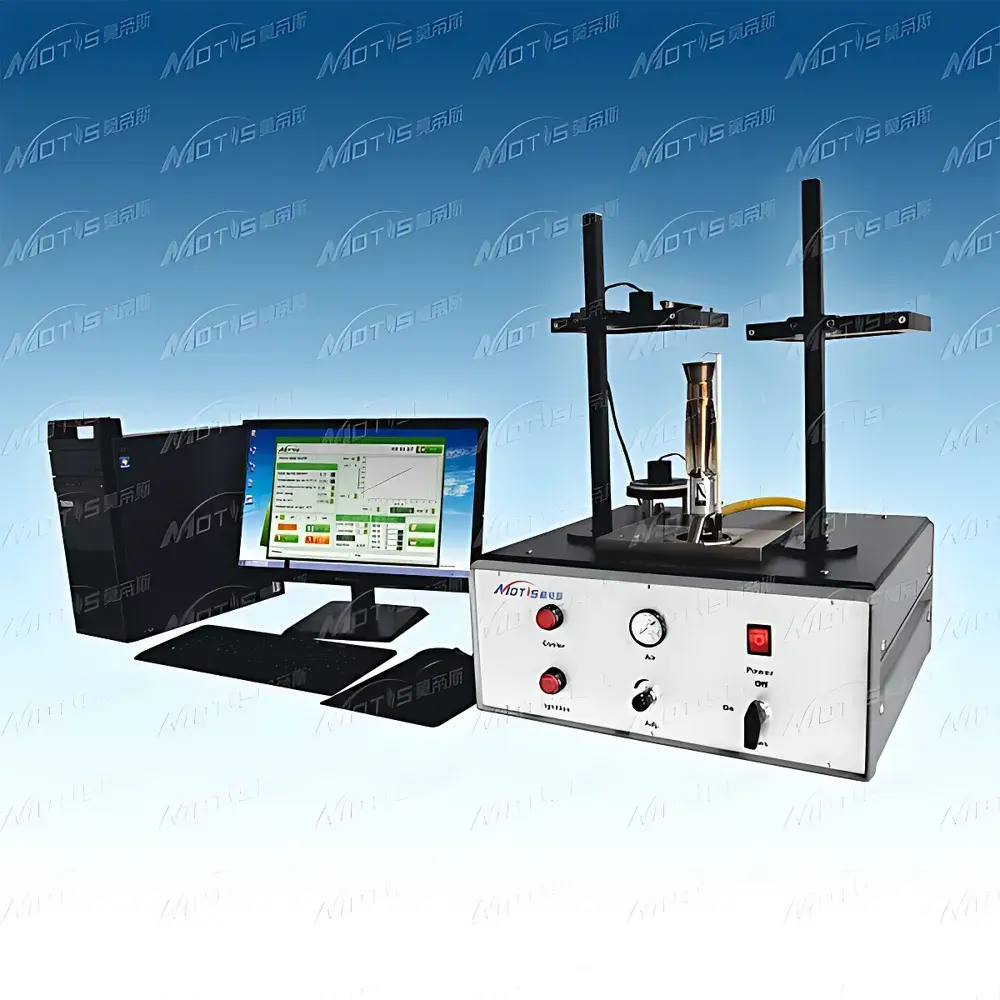
MOTIS HTI Convection Heat Resistance Tester
| Brand | MOTIS |
|---|---|
| Origin | Jiangsu, China |
| Manufacturer Type | Authorized Distributor |
| Country of Origin | China |
| Model | HTI |
| Pricing | Available Upon Request |
| Standard Compliance | EN 367, ISO 9151, AQ 6103–2007 |
| Heat Flux | 80 kW/m² |
| Thermocouple Type | Copper Disc Calorimeter (ISO 9151-compliant) |
| Temperature Rise Thresholds | 12 °C and 24 °C above baseline (25 °C) |
| Cooling | Forced-air cooling for calorimeter |
| Control | Pneumatic actuation + PC-based software automation |
| Power Supply | 220 V, 50 Hz |
| Gas Supply | Propane + compressed air |
| Dimensions (W×H×D) | 500 × 500 × 500 mm |
| Ambient Test Environment | 25 ± 5 °C |
Overview
The MOTIS HTI Convection Heat Resistance Tester is a precision-engineered instrument designed to quantify the thermal protective performance (TPP) of flame-resistant textiles and personal protective equipment (PPE), specifically under controlled convective heat exposure. It operates in strict accordance with internationally recognized test standards—including EN 367 (Protective clothing — Determination of convective heat resistance), ISO 9151 (Clothing for protection against heat and flame — Determination of convective heat transmission), and the Chinese occupational safety standard AQ 6103–2007 (Safety requirements for welding gloves). The system applies a calibrated, propane-fueled laminar flame at a nominal incident heat flux of 80 kW/m² to the underside of a horizontally mounted fabric specimen. A copper disc calorimeter—mounted in direct thermal contact with the specimen’s reverse surface—continuously monitors temperature rise. The instrument calculates the Heat Transfer Index (HTI) as the average time required for the calorimeter to register a temperature increase of either 12 °C or 24 °C above the initial stabilized baseline (25 °C), based on three consecutive, independently executed trials. This HTI value serves as a quantitative metric for comparative thermal barrier efficacy and forms the basis for material classification, regulatory compliance documentation, and end-use suitability assessment in high-risk industrial environments.
Key Features
- ISO 9151-compliant copper disc calorimeter with integrated forced-air cooling—reducing thermal recovery time between tests by up to 60% compared to passive cooling systems.
- Pneumatically actuated heat shield and specimen holder ensure repeatable positioning, precise flame alignment, and operator safety during ignition and extinction cycles.
- Automated flame initiation, exposure duration control, and real-time calorimeter signal acquisition via embedded microcontroller and USB-connected PC interface.
- Software-driven calibration routine for calorimeter heat flux response, compensating for emissivity variations, ambient drift, and sensor aging per ASTM E1530 and ISO 13577-3 guidelines.
- Integrated gas flow regulation and pressure monitoring for propane and compressed air supply lines, ensuring stable combustion stoichiometry across extended testing sessions.
- Compliance-ready data logging: timestamps, raw thermocouple voltage, derived temperature curves, HTI calculation steps, and pass/fail flags—all stored in CSV and PDF report formats with audit-trail metadata.
Sample Compatibility & Compliance
The HTI tester accommodates flat, non-stretch textile specimens measuring 100 mm × 100 mm, including single-layer fabrics, multi-layer composites, laminated membranes, and coated substrates used in firefighting turnout gear, arc-flash suits, and welder’s gloves. Specimens are clamped without tension using stainless-steel frames conforming to EN 367 Annex A geometry requirements. All mechanical and thermal components—including burner nozzle geometry, calorimeter mass (100 g ± 0.5 g), and mounting depth—are validated against ISO/IEC 17025 traceable reference standards. The system supports full GLP/GMP-aligned operation when paired with optional 21 CFR Part 11-compliant software modules, enabling electronic signatures, user access controls, and immutable record retention for regulatory submissions.
Software & Data Management
The proprietary HTI Control Suite runs on Windows OS and provides real-time visualization of calorimeter temperature vs. time curves, live heat flux estimation, and dynamic HTI projection during exposure. Each test session generates a structured dataset containing pre-test ambient validation, flame stability logs, raw thermocouple readings sampled at 10 Hz, interpolated 12 °C/24 °C crossing points, and final HTI mean ± standard deviation. Export options include Excel-compatible .csv, printable PDF certificates with lab header/footer, and XML files compatible with LIMS integration (e.g., LabWare, Thermo Fisher SampleManager). Calibration history, user login events, and parameter change logs are retained indefinitely with SHA-256 hashing for integrity verification.
Applications
- Qualification testing of flame-resistant workwear per NFPA 2112, EN ISO 11612, and GB 8965.1–2020.
- R&D evaluation of novel insulative fiber blends, aerogel-integrated composites, and phase-change material (PCM) coatings.
- Batch release verification for PPE manufacturers supplying to oil & gas, electric utility, and metallurgical sectors.
- Root-cause analysis of thermal degradation mechanisms in multi-layer assemblies under sustained convective loading.
- Inter-laboratory proficiency testing and round-robin studies coordinated under ILAC MRA frameworks.
FAQ
What standards does the MOTIS HTI tester fully support?
EN 367, ISO 9151, and AQ 6103–2007 — all implemented with hardware geometry, calorimeter specifications, and procedural logic aligned to the latest published editions.
Is the copper disc calorimeter NIST-traceable?
Yes — each unit ships with a factory calibration certificate referencing NIST SRM 1462 (thermocouple wire) and ISO 8503-2 surface roughness standards; annual recalibration services are available.
Can the system be integrated into an existing quality management system (QMS)?
Yes — through configurable API endpoints and standardized output formats, the HTI Control Suite supports automated data ingestion into QMS platforms compliant with ISO 9001:2015 Clause 8.5.2.
What maintenance is required between tests?
Post-test, the calorimeter surface must be cleaned with ethanol and inspected for oxidation; burner nozzles require quarterly ultrasonic cleaning; compressed air filters should be replaced every 200 operational hours.
Does the instrument meet electrical safety requirements for laboratory use?
It complies with IEC 61010-1:2010 for measurement/control laboratory equipment, including overcurrent protection, grounding continuity, and dielectric strength testing per clause 6.4.



