
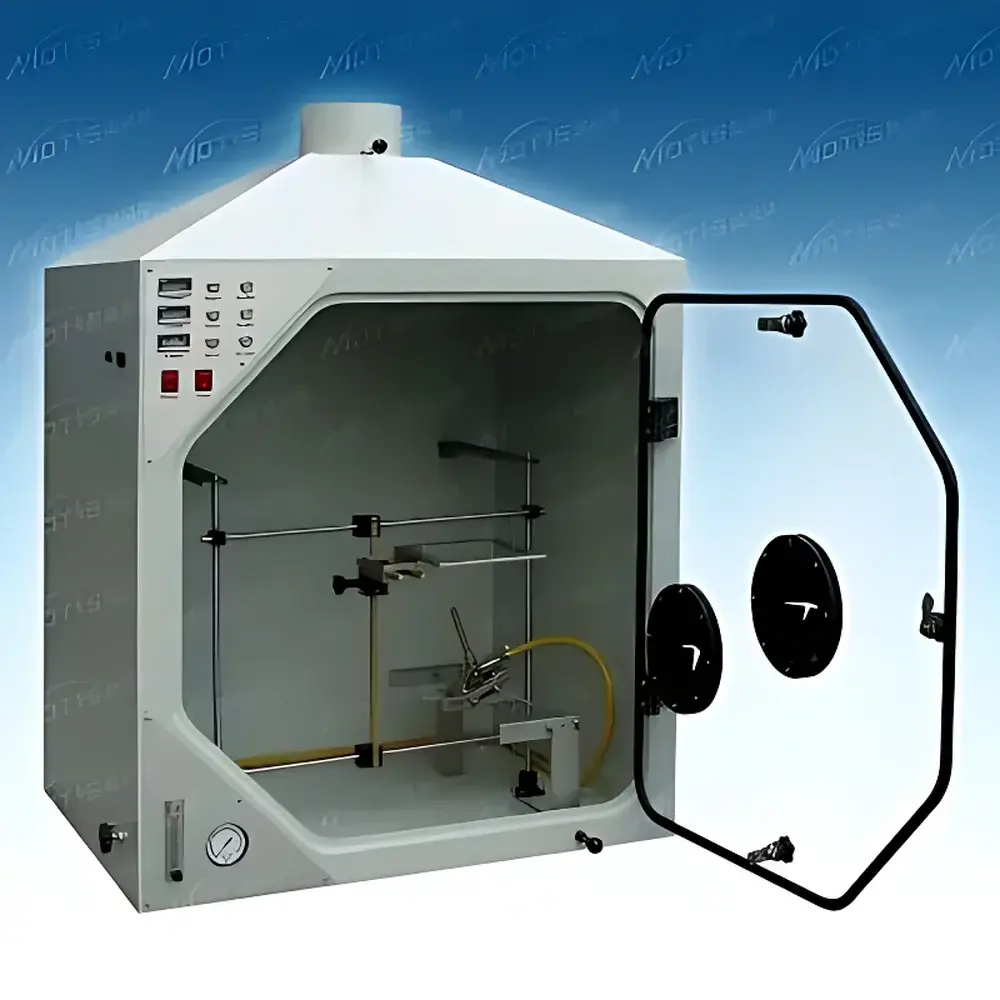
MOTIS UL94-X Horizontal & Vertical Combustion Test Chamber
| Brand | MOTIS |
|---|---|
| Origin | Shanghai, China |
| Model | UL94-X |
| Compliance | UL 94 (HB, V-0/V-1/V-2, 5VA/5VB, VTM-0/1/2, HF-1/HF-2/HBF) |
| Chamber Volume | ≥0.75 m³ |
| Interior Finish | Matte Black |
| Viewing Window | Extra-Large Tempered Glass |
| Burner Adjustment | 0°, 20°, 45° |
| Gas Supply | Precision Regulated Propane or Methane |
| Flow Control | Rotameter with ±1% Full-Scale Accuracy |
| Pressure Regulation | High-Accuracy Dual-Stage Pressure Reducer |
| Burner Types | Bunsen (ASTM D5025), Ribbon (ASTM D4986) |
| Exhaust System | Top-Mounted Forced Ventilation |
| Optional | ASTM D5207 Burner Calibration Kit |
| Standards Supported | UL 94, IEC 60695-11-10/-20, ISO 1210/9770/9772/9773, GB/T 2408/5169.17/8332 |
Overview
The MOTIS UL94-X Horizontal & Vertical Combustion Test Chamber is an engineered platform for standardized flammability assessment of polymeric materials, electrical enclosures, and component-level assemblies in accordance with globally recognized fire safety protocols. It operates on the principle of controlled flame impingement under precisely defined thermal flux, orientation, and timing conditions—enabling quantitative evaluation of ignition resistance, flame propagation behavior, afterflame duration, drip ignition potential, and char formation. Designed to execute all major UL 94 test configurations—including horizontal burning (HB), vertical burning (V-0, V-1, V-2), high-flame (5VA, 5VB), thin-film (VTM-0, VTM-1, VTM-2), and foam (HF-1, HF-2, HBF)—the chamber integrates mechanical, pneumatic, and thermal subsystems into a single, validated architecture compliant with ASTM, IEC, ISO, and GB/T regulatory frameworks.
Key Features
- Chamber volume exceeds 0.75 m³ and features matte black interior walls to minimize optical interference during flame observation and ensure consistent radiometric background per ISO 1210 and UL 94 requirements.
- Extra-large tempered glass viewing window provides unobstructed real-time visual access to specimen behavior across all test orientations without compromising containment integrity.
- Front-access door with ergonomic opening geometry allows safe, repeatable placement and retrieval of specimens up to 125 mm × 13 mm × 13 mm (standard UL 94 dimensions) while maintaining operator separation from thermal hazards.
- Multi-angle burner mounting system supports rapid reconfiguration between 0° (horizontal), 20° (tilted), and 45° (intermediate) flame incidence—essential for cross-standard validation and method transfer.
- Dual-burner capability: interchangeable Bunsen-type burner (conforming to ASTM D5025) for general-purpose vertical/horizontal tests, and ribbon-type burner (ASTM D4986) for high-flame 5VA/5VB assessments requiring uniform 20 mm flame width.
- Precision gas delivery system includes dual-stage pressure regulator, calibrated rotameter (±1% FS accuracy), and dedicated propane/methane supply lines—ensuring stable 50W or 500W thermal input as specified in UL 94 Clauses 6.1 and 6.2.
- Integrated digital timer panel records pre-ignition dwell, flame application duration (10 s ± 0.5 s or 30 s ± 0.5 s), afterflame time, and afterglow time with millisecond resolution and automatic event logging.
- Top-mounted exhaust manifold with adjustable airflow rate removes combustion byproducts continuously, maintaining ambient CO₂ and smoke concentration below OSHA PEL thresholds during extended test sequences.
Sample Compatibility & Compliance
The UL94-X accommodates rigid and semi-rigid plastics, laminates, foams, films, and composite substrates conforming to dimensional tolerances outlined in UL 94 Section 4. Specimens are mounted vertically or horizontally using standardized clamping fixtures that replicate fixture geometry defined in IEC 60695-11-10 Annex A. All test modes comply with traceable calibration protocols: burner tip temperature verified per ASTM D5207 (optional calibration kit available), flame height adjusted to 20 mm ± 1 mm (50W) or 125 mm ± 5 mm (500W), and gas flow rates validated against certified reference standards. The system supports full audit readiness for GLP and GMP environments, including hardware-based event timestamps, non-editable test logs, and configurable user access levels aligned with FDA 21 CFR Part 11 electronic record requirements.
Software & Data Management
While the base UL94-X operates via embedded electromechanical controls for regulatory simplicity, optional PC-based software enables automated test sequencing, parameter logging, pass/fail decision logic per UL 94 Table 5.1, and PDF report generation compliant with ISO/IEC 17025 documentation standards. Data fields include specimen ID, thickness, orientation, flame duration, afterflame time, drip occurrence, ignition of cotton indicator, and final classification (e.g., “V-0” or “HB”). Audit trails record operator ID, timestamp, parameter modifications, and system error codes—supporting laboratory accreditation under CNAS, UKAS, or A2LA frameworks.
Applications
This instrument serves quality control laboratories in electronics manufacturing (PCB substrates, connector housings), automotive interiors (dashboards, wiring harnesses), aerospace cabin components (seat shells, ducting), medical device packaging, and building material certification. It is routinely deployed to verify conformance prior to UL listing, CE marking under Directive 2014/68/EU, or compliance with RoHS-restricted substance declarations where halogen-free flame retardants are mandated. Test data directly inform material selection, formulation optimization, and failure mode analysis in root cause investigations related to field-reported fire incidents.
FAQ
Does the UL94-X support both propane and methane fuel gases?
Yes—the system is configured for either propane or methane, with dedicated pressure regulation and flow calibration for each, per UL 94 Clause 6.1.3.
Is third-party certification available for this chamber?
MOTIS provides factory calibration certificates traceable to NIST standards; independent verification per ISO/IEC 17025 can be arranged through authorized testing laboratories.
Can the chamber be used for non-UL standards such as GB/T 2408 or IEC 60695-11-20?
Yes—all referenced national and international variants are implemented via mechanical configuration and procedural adjustments documented in the operator manual.
What maintenance is required to sustain compliance?
Monthly verification of burner alignment, quarterly calibration of rotameter and pressure regulator, and annual full-system performance qualification per ASTM E162 are recommended.
Is remote monitoring supported?
The optional software package includes Ethernet connectivity for real-time status monitoring and secure log export, though no cloud storage is enabled by default to preserve data sovereignty.



