
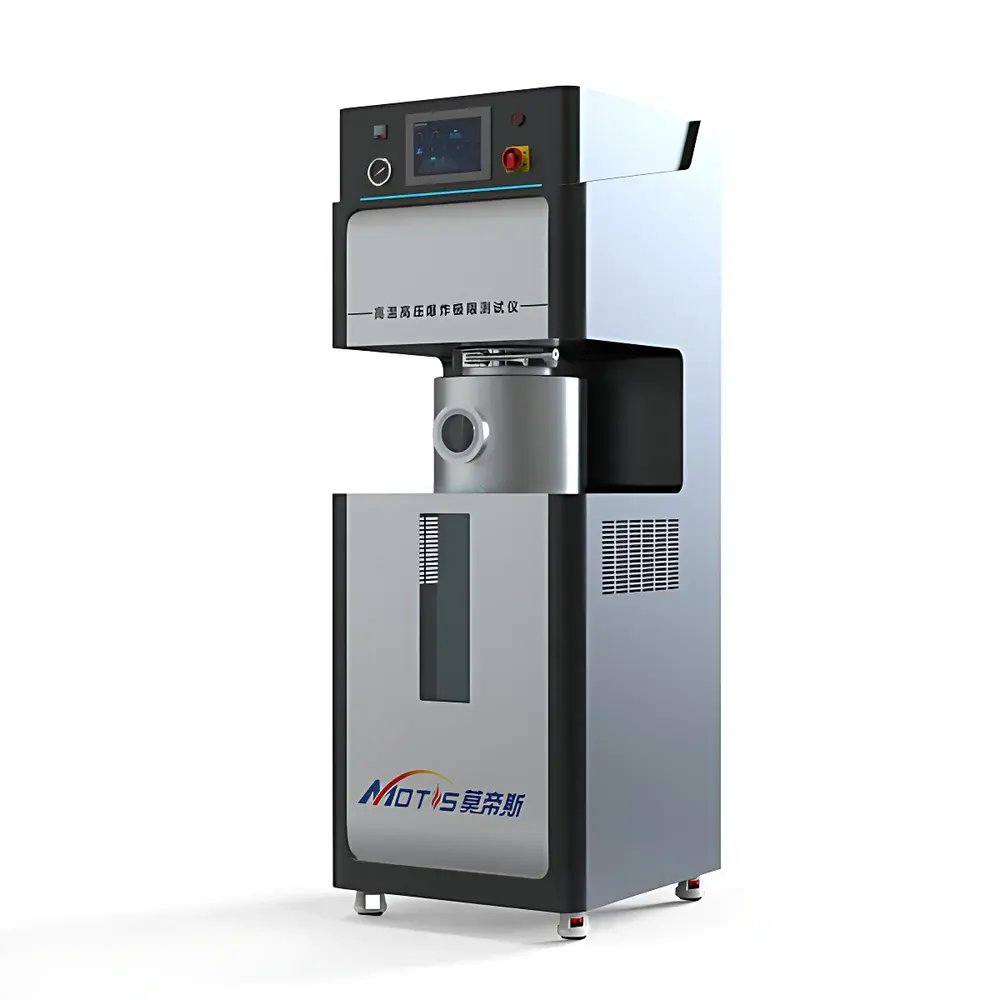
MOTIS LEL-5L High-Temperature and High-Pressure Flammability Limit Tester
| Brand | MOTIS |
|---|---|
| Origin | Jiangsu, China |
| Model | LEL-5L |
| Explosion Chamber Volume | 5 L ± 0.25 L |
| Maximum Operating Pressure | 2 MPa |
| Design Pressure | 3 MPa |
| Heating Furnace Max Temp | 200 °C (Design: 250 °C) |
| Temp Control Accuracy | ±0.1 °C |
| Ignition Voltage | 13–15 kV |
| Pressure Gauge Range | 0–3 MPa (Accuracy: ≤2% FS) |
| K-Type Thermocouple | ≥1100 °C Rated, Class II Accuracy |
| Vacuum Pump | ≥1 L/s Pumping Speed, Ultimate Vacuum ≤1.0 kPa, 6 mm OD Inlet |
| Control System | Advantech Industrial PC with Dedicated Flammability Testing Software |
Overview
The MOTIS LEL-5L High-Temperature and High-Pressure Flammability Limit Tester is a purpose-built experimental system engineered for the precise determination of lower and upper flammability limits (LFL/UFL) of combustible gases and vapors under elevated temperature and pressure conditions. It operates on the fundamental principle of controlled ignition within a calibrated, sealed explosion chamber—adhering to standardized test methodologies aligned with ASTM E681, ISO 10156, and EN 1839. The instrument is specifically designed to address critical safety assessment needs in battery thermal runaway studies, chemical process hazard analysis, and high-pressure gas handling systems. By enabling reproducible ignition events at defined initial temperatures (up to 200 °C) and pressures (up to 2 MPa), the LEL-5L supports quantitative evaluation of how thermodynamic boundary conditions shift flammability envelopes—a key parameter for hazard classification, safety interlock design, and vent sizing per NFPA 68 and CCPS guidelines.
Key Features
- 5-liter precision-machined explosion chamber with ASME-stamped pressure vessel certification (design pressure: 3 MPa; operating limit: 2 MPa), fabricated from stainless steel for corrosion resistance and mechanical integrity.
- Integrated electrically actuated vertical lift mechanism with quick-opening closure system—ensuring repeatable sealing performance and minimizing operator exposure during sample loading and post-test venting.
- High-stability heating furnace with PID-controlled temperature regulation (±0.1 °C accuracy) and dual-zone thermal profiling capability, validated across the full 25–200 °C operational range.
- Dual high-voltage ignition electrodes powered by a regulated 13–15 kV transformer, delivering consistent spark energy independent of gas composition or pressure.
- Redundant instrumentation: calibrated digital pressure transducer (0–3 MPa, ≤2% FS error) and Class II K-type thermocouple (rated to 1100 °C) mounted at multiple axial positions to capture transient thermal gradients during deflagration.
- Integrated vacuum subsystem featuring a dry scroll pump (≥1 L/s nominal speed) capable of achieving ≤1.0 kPa base pressure—critical for residual gas removal and inert purging prior to each test cycle.
Sample Compatibility & Compliance
The LEL-5L accommodates gaseous and volatile liquid samples—including hydrogen, methane, propane, ethylene oxide, ammonia, and battery electrolyte vapors—via standardized gas blending using mass flow controllers (MFCs) and certified calibration gases traceable to NIST standards. All test protocols comply with internationally recognized flammability testing frameworks: ASTM E681 (Standard Test Method for Determination of Flammability Limits of Chemicals at Elevated Temperature and Pressure), ISO 10156 (Gases and Gas Mixtures — Determination of Fire Potential and Oxidizing Ability), and EN 1839 (Determination of Explosion Limits). The system architecture supports GLP-compliant operation, with hardware-level audit trails, electronic signature capability, and data immutability features meeting FDA 21 CFR Part 11 requirements when configured with validated software modules.
Software & Data Management
Control and data acquisition are managed via an embedded Advantech industrial PC running proprietary MOTIS Flammability Analysis Suite. The software provides real-time visualization of pressure rise rate (dP/dt), peak overpressure, maximum temperature, and time-to-ignition—each synchronized with gas concentration profiles. Automated test sequencing includes vacuum purge, gas mixing, thermal equilibration, ignition trigger, and post-event depressurization. Raw sensor data (1 kHz sampling) is stored in HDF5 format with metadata embedding test ID, operator credentials, environmental conditions, and instrument calibration status. Export options include CSV, PDF test reports (with configurable templates), and direct integration with LIMS platforms via OPC UA or RESTful API interfaces.
Applications
- Thermal runaway propagation analysis in lithium-ion battery modules, focusing on off-gas composition flammability under simulated cell rupture conditions.
- Hazard evaluation of process streams in petrochemical, pharmaceutical, and semiconductor manufacturing where elevated temperature/pressure operations increase ignition risk.
- Development and validation of explosion suppression and venting systems per NFPA 69 and VDI 3673.
- Regulatory submission support for UN GHS Classification, CLP Regulation (EC No. 1272/2008), and transport safety assessments (ADR/RID/IMDG).
- Fundamental combustion research on pressure- and temperature-dependent flame propagation mechanisms in confined geometries.
FAQ
What safety certifications does the LEL-5L explosion chamber hold?
The pressure vessel conforms to GB/T 150 (Chinese equivalent of ASME BPVC Section VIII Div. 1) and carries third-party inspection certification from a CNAS-accredited body.
Can the system be integrated with external gas chromatography or FTIR analyzers?
Yes—standard 4–20 mA and RS485 communication ports allow bidirectional control and data exchange with external analytical instruments for real-time composition verification.
Is remote operation supported for hazardous area deployment?
The system supports optional explosion-proof enclosure (Ex d IIB T4) and fiber-optic isolation for control signals, enabling safe operation outside classified zones.
How is calibration traceability maintained for pressure and temperature sensors?
All primary sensors are calibrated annually against NIST-traceable references; calibration certificates and uncertainty budgets are stored electronically within the software audit log.
Does the software support automated pass/fail evaluation against regulatory LFL/UFL thresholds?
Yes—the analysis module includes configurable acceptance criteria per substance class and allows rule-based flagging of non-conforming results with annotated deviation reports.






