
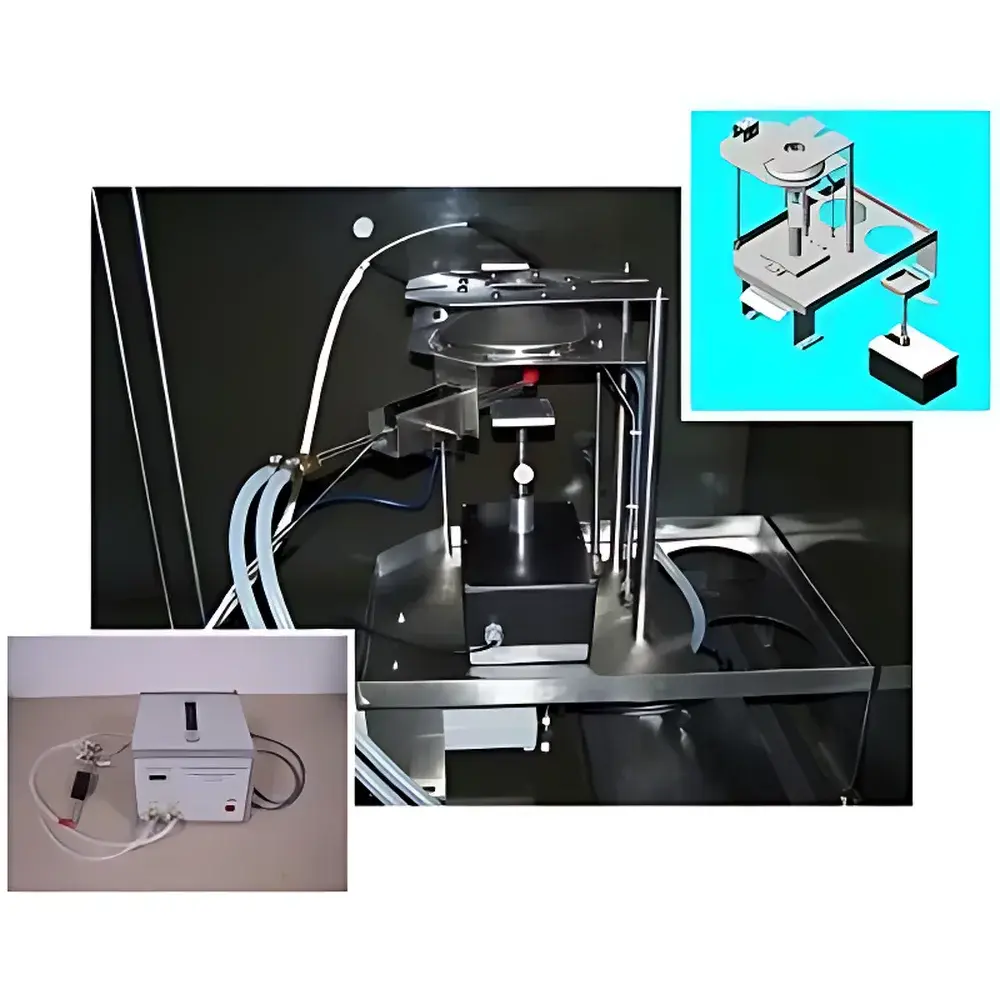
ISO 5659-2 Cone Calorimeter Radiant Heater Assembly
| Brand | MOTIS |
|---|---|
| Model | 5659-2 |
| Conical Heater Heat Flux Range | 10–70 kW/m² |
| Shield Shutter | Motorized Radiation Blocker for Pre-Test Isolation |
| Compliance | ISO 5659-2 (Fire Tests — Reaction to Fire Tests — Part 2: Room/Corner Test) |
| Origin | Jiangsu, China |
| Distribution Type | Authorized Distributor |
Overview
The MOTIS ISO 5659-2 Cone Calorimeter Radiant Heater Assembly is a precision-engineered thermal radiation source designed exclusively for standardized fire reaction testing in accordance with ISO 5659-2:2017, “Fire tests — Reaction to fire tests — Part 2: Room/corner test”. This conical heater functions as the primary radiant energy delivery system within full-scale or intermediate-scale room-corner test configurations. It operates on the principle of controlled convective-radiative heat transfer, delivering a spatially uniform and temporally stable heat flux over the specimen surface via a water-cooled, gold-plated conical emitter. The heater is calibrated to produce a precisely adjustable radiant heat flux ranging from 10 kW/m² to 70 kW/m²—enabling simulation of real-world fire exposure conditions, including early-stage flame impingement and post-flashover thermal environments. Its integration into ISO 5659-2-compliant test chambers ensures reproducible ignition timing, consistent mass loss rate (MLR) derivation, and reliable smoke production index (SPI) calculation—all critical parameters for evaluating material flammability, fire growth potential, and smoke toxicity under regulatory assessment frameworks.
Key Features
- Water-cooled conical heater geometry engineered for optimal thermal uniformity and long-term stability across the specified 10–70 kW/m² operational range.
- Integrated motorized shield shutter providing automated, repeatable radiation isolation prior to test initiation—ensuring zero pre-ignition thermal loading and strict adherence to ISO 5659-2 Section 7.3 procedural requirements.
- Gold-plated emitter surface for high emissivity (>0.95) and minimal spectral deviation in the 1–5 µm infrared band, supporting accurate radiant heat flux calibration traceable to national metrology institutes.
- Modular mechanical interface compatible with standard ISO 5659-2 test chamber configurations, including alignment fixtures for precise specimen-to-heater distance (typically 500 mm ± 5 mm).
- Real-time thermocouple feedback loop integrated with external power supply controllers for closed-loop heat flux regulation and drift compensation during extended-duration tests.
Sample Compatibility & Compliance
The radiant heater assembly supports specimens up to 1000 mm × 1000 mm in planar dimension and accommodates materials with thicknesses ranging from 1 mm to 100 mm—including rigid composites, flexible foams, coated textiles, and laminated building products. All operational protocols conform to ISO 5659-2 Annex A (Calibration Procedure), Annex B (Heat Flux Uniformity Verification), and ISO 5660-1 for complementary cone calorimetry correlation. The system meets essential requirements for GLP-compliant fire testing laboratories, supporting audit-ready documentation of calibration history, shutter actuation timestamps, and heat flux verification logs. While not itself a standalone test chamber, this heater module is validated for use in facilities accredited to ISO/IEC 17025 for fire reaction testing.
Software & Data Management
The heater operates in synchronization with third-party data acquisition systems (e.g., LabVIEW-based or custom SCADA platforms) that record time-stamped heat flux setpoints, shutter open/close events, and thermocouple readings at ≥1 Hz sampling resolution. All shutter control signals are timestamped with microsecond precision to support temporal alignment with video recording, oxygen depletion, and CO/CO₂ gas analysis subsystems. Data export formats include CSV and HDF5, enabling direct import into fire modeling tools such as FDS (Fire Dynamics Simulator) or CFAST for validation against experimental heat release rate (HRR) curves. Full audit trails—including operator ID, calibration certificate numbers, and firmware revision logs—are retained per FDA 21 CFR Part 11 and ISO/IEC 17025 data integrity guidelines when deployed in regulated quality assurance environments.
Applications
- Evaluation of flame spread behavior and fire growth index (FGI) for interior wall and ceiling finishes per EN 13501-1 and ASTM E84.
- Regulatory qualification of polymeric insulation materials used in rail, marine, and aerospace interiors under EN 45545-2, IMO FTP Code, and FAR 25.853.
- Development and validation of intumescent coatings and fire-retardant additives through comparative radiant exposure trials.
- Correlation studies between small-scale cone calorimetry (ISO 5660-1) and full-scale room-corner fire dynamics.
- Smoke obscuration and toxic gas yield assessment when coupled with optical density meters and FTIR gas analyzers.
FAQ
Is this heater certified to ISO 5659-2, or does it require third-party verification?
This assembly is designed and manufactured to meet all dimensional, thermal, and functional specifications defined in ISO 5659-2:2017. Final compliance validation—including heat flux uniformity mapping and shutter timing accuracy—must be performed by the end-user laboratory in accordance with Annexes A and B.
Can the heater be retrofitted into existing non-MOTIS test chambers?
Yes, provided the chamber features standardized mounting interfaces, cooling water supply lines (≥2 L/min at 15–25°C), and compatible electrical feedthroughs (230 VAC, 32 A). Mechanical and control signal integration support documentation is available upon request.
What calibration documentation is supplied with the unit?
Each unit ships with a factory calibration report referencing NIST-traceable heat flux sensor measurements, shutter actuation latency test results, and conical surface emissivity characterization data.
Does MOTIS provide installation and commissioning services outside China?
Yes—MOTIS partners with ISO 17025-accredited service providers in North America, EU, and APAC regions to deliver on-site installation, operational qualification (OQ), and preventive maintenance contracts.



