
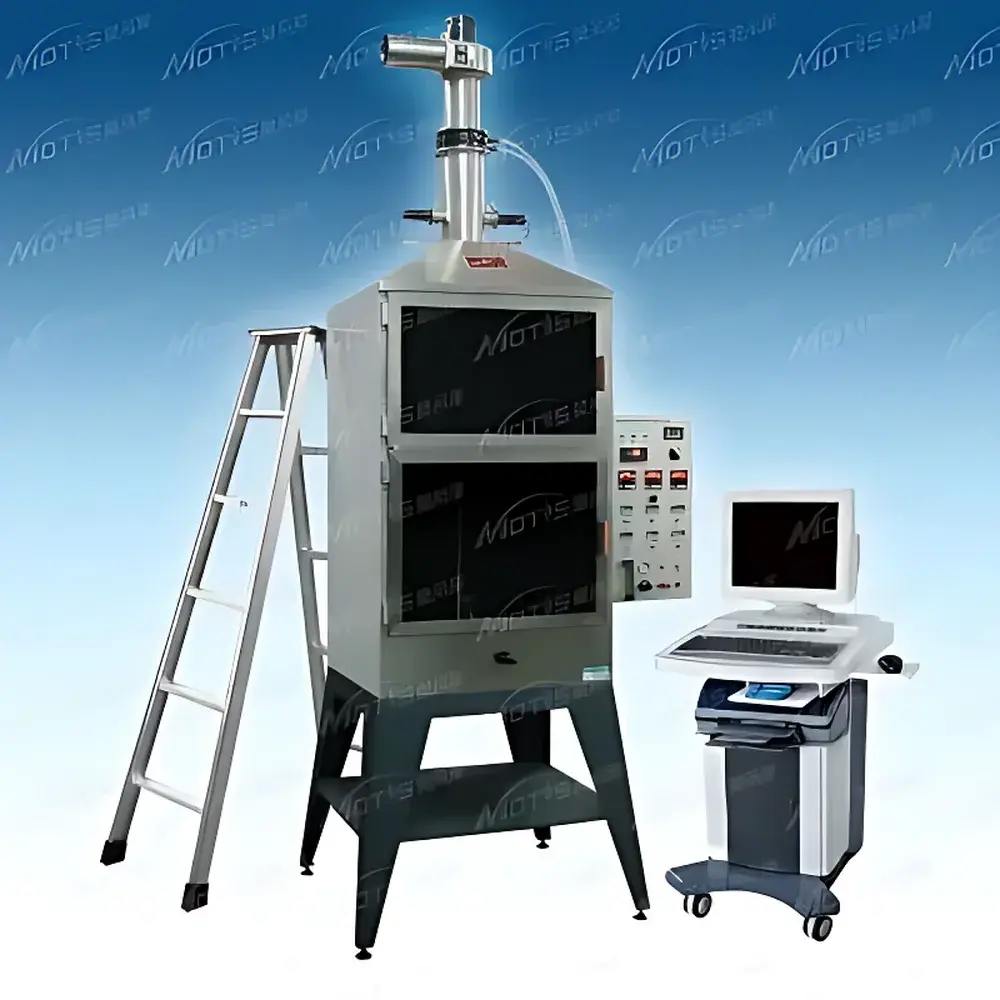
MOTIS BCC DIN 54837 Large-Scale Combustion Test Chamber
| Brand | MOTIS |
|---|---|
| Origin | Shanghai, China |
| Model | BCC |
| Internal Chamber Dimensions | 1350 × 800 × 800 mm |
| Overall Height | 3.2 m |
| Grating Aperture | 30 × 30 mm, Height: 30 mm |
| Airflow Velocity Range | 0–10 m/s, Accuracy: ±0.1 m/s |
| Exhaust Duct Thermocouples | 3 × K-type, Range: 0–300 °C, Accuracy: ±0.1 °C |
| Calibration Plate Thermocouples | 3 × K-type, Range: 0–900 °C, Accuracy: ±0.1 °C |
| Light Source | Tungsten filament lamp, CCT: 2896 K |
| Photodetector | Cosine-corrected silicon photodiode with spectral filter for CIE photopic luminosity match |
| Data Interface | RS-232 |
| Timer Resolution | 0.1 s across 6 independent channels |
| Compliance | DIN 54837:2007, DIN 5510-2:2007, DIN 50055:1989 |
Overview
The MOTIS BCC DIN 54837 Large-Scale Combustion Test Chamber is a rigorously engineered apparatus designed to evaluate the fire performance of materials and components used in railway rolling stock, in strict accordance with DIN 54837:2007. This standard specifies a bench-scale combustion test method employing a wide-port gas burner to simulate realistic flame impingement conditions on vertically oriented specimens. The chamber quantifies critical fire reaction parameters—including flame spread length, time to sustained flaming (afterglow), total combustion duration, smoke development rate (via optical density), and molten droplet formation and ignitability—under controlled ventilation and thermal boundary conditions. These measurements directly feed into the classification framework defined in DIN 5510-2:2007, enabling assignment of materials to flammability classes S2–S5, smoke density classes SR1–SR2 (based on integrated light attenuation), and dripping behavior classes ST1–ST2. The system operates on the principle of radiant–convective heat transfer coupling, where flame geometry, air entrainment, and specimen orientation are precisely maintained to ensure inter-laboratory reproducibility and regulatory acceptance.
Key Features
- Structurally robust stainless-steel chamber with internal dimensions of 1350 mm (W) × 800 mm (D) × 800 mm (H), mounted on an 800 mm cube base for mechanical stability and alignment consistency.
- Dual tempered glass observation windows conforming to DIN 50050-2 for real-time visual monitoring without compromising thermal or optical integrity.
- Perforated stainless-steel floor grating (30 × 30 mm apertures, 30 mm height) enabling uniform natural draft airflow beneath the specimen—critical for simulating under-ventilated fire scenarios typical in railcar compartments.
- Integrated anemometry system with calibrated vane anemometer (0–10 m/s range, ±0.1 m/s accuracy) positioned upstream of the test zone to verify and document ambient airflow per DIN 54837 clause 6.2.
- Triple-point K-type thermocouple array (0–300 °C, ±0.1 °C) installed in the exhaust duct to capture dynamic temperature profiles during smoke effluent generation; readings averaged and displayed via digital indicator.
- Six independent high-resolution timers (0.1 s resolution), each dedicated to a standardized event: ignition delay, afterglow onset/duration, flame propagation timing, peak flame height occurrence, droplet fall initiation, and total burn time.
- Traceable calibration subsystem including a stainless-steel reference plate instrumented with three embedded K-type thermocouples (0–900 °C, ±0.1 °C), used to verify burner flame temperature profile prior to each test series per DIN 54837 Annex A.
- Optically characterized smoke measurement system comprising a stabilized 2896 K tungsten-halogen light source, cosine-corrected silicon photodiode detector, and spectrally matched filter aligned to the CIE V(λ) luminosity function—ensuring metrological compliance with DIN 50055:1989.
Sample Compatibility & Compliance
The BCC chamber accommodates rigid and semi-rigid flat specimens up to 1000 mm in height and 200 mm in width, mounted vertically in one of three standardized stainless-steel holders. Specimen thickness is unrestricted within mechanical clamping limits, though dimensional conformity to DIN 54837 Section 5.1 (e.g., edge preparation, conditioning per ISO 291) is mandatory. The system supports full traceability workflows required for certification under EN 45545-2 (railway fire safety) via direct alignment with its foundational German standards. All hardware and software functions comply with GLP-aligned data integrity principles: audit trails, user access control, electronic signatures, and raw data immutability are enforced through the RS-232-linked acquisition module and validated test software. Calibration records, thermocouple verification logs, and airflow validation reports are automatically timestamped and exportable for regulatory submission.
Software & Data Management
The chamber interfaces via RS-232 to proprietary Windows-based acquisition software compliant with FDA 21 CFR Part 11 requirements for electronic records and signatures. During testing, the software synchronously captures transmittance (%T), absorbance (A = –log10(%T/100)), and derived smoke density (Ds = –log10(%T/100) × L, where L is optical path length in meters). Real-time plots update at 1 Hz resolution, with auto-saved CSV files containing all raw sensor inputs, timer events, and metadata (operator ID, sample ID, ambient RH/T, calibration timestamps). Post-test analysis tools compute key metrics per DIN 54837: maximum flame height, flame spread rate (mm/min), time to critical smoke density (Ds ≥ 1.0), and droplet ignition confirmation logic. All data files include cryptographic hash verification to prevent post-acquisition tampering.
Applications
This chamber is deployed primarily by Tier-1 rail equipment manufacturers (e.g., Siemens Mobility, Alstom, CRRC), notified bodies (such as TÜV Rheinland and Dekra), and national railway research institutes for pre-certification screening of interior linings, cable sheaths, seat foams, flooring composites, and HVAC ducting materials. It also serves academic fire safety laboratories conducting fundamental studies on flame–material interaction dynamics under constrained ventilation. Its design enables correlation with full-scale fire modeling inputs (e.g., HRRPUA estimation, soot yield calibration) and supports comparative assessment across material families—thermoplastics vs. thermosets, halogenated vs. phosphorus-based flame retardants, and nanocomposite-enhanced polymers. The system’s repeatability (CV < 4.2% for flame spread length across 10 replicate tests on PVC/NBR blend) meets ISO/IEC 17025 proficiency requirements for accredited testing labs.
FAQ
What rail-specific standards does the BCC chamber fully support?
It is purpose-built for DIN 54837:2007 and directly enables classification per DIN 5510-2:2007; it also satisfies technical prerequisites for EN 45545-2:2013 Annex A test method selection.
Is the smoke measurement system NIST-traceable?
Yes—the photometric chain (lamp spectral power distribution, detector responsivity, filter transmission curve) is calibrated against NIST-traceable standards, with full uncertainty budget documented per ISO/IEC 17025.
Can the system be upgraded to meet future revisions of DIN 5510-2?
Firmware and software updates are provided free of charge for two years post-delivery; hardware retrofits (e.g., enhanced thermal imaging integration) are available under extended service agreements.
Does the chamber include validation protocols for daily operational checks?
Yes—built-in startup routines verify thermocouple linearity, timer synchronization, airflow stability, and photodiode baseline drift, generating a PDF-compliant QC report prior to test initiation.
What documentation is supplied for regulatory audits?
Factory calibration certificates (including as-found/as-left data), ISO 17025-accredited verification reports, software validation summary (IQ/OQ/PQ), and full electrical safety certification (IEC 61010-1) are delivered with each unit.



