
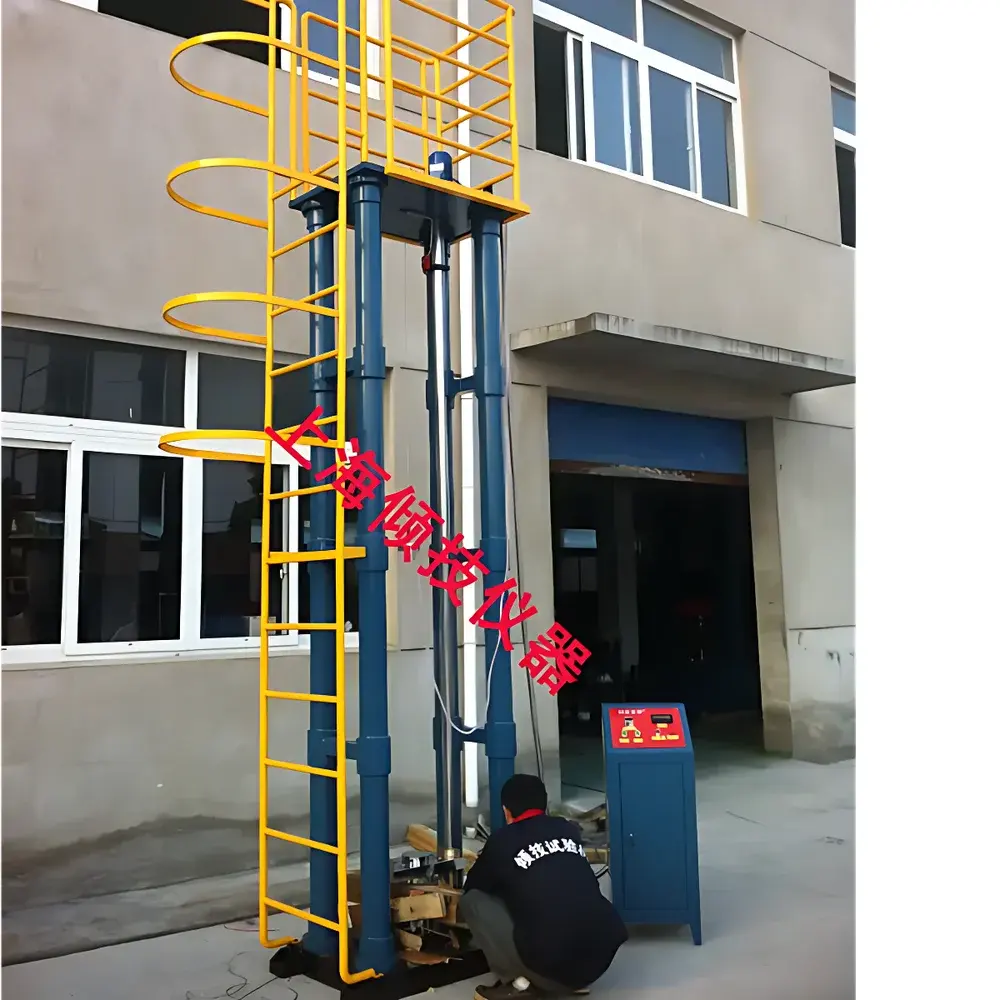
Dynamic Impact Testing Machine QJBC- by Qingji
| Brand | Qingji |
|---|---|
| Origin | Shanghai, China |
| Model | QJBC- |
| Maximum Load Capacity | 500 kN |
| Test Range | 20–500 kN (Accuracy: ±1%) |
| Drop Height Adjustment | 0–10,000 mm (Resolution: 0.1 mm) |
| Standard Weights | 2, 3, 4, 5, 10, 20, 50, 100 kg (AISI 1045 steel |
| Mass Tolerance | ±1%) |
| Compliance | ISO 148-1, ASTM E23, GB/T 229 |
| Control & Data System | QJLC17.7.Ttest — Integrated High-Speed Acquisition, Real-Time Force/Displacement/Energy Synchronization, Curve-Based Material Characterization |
Overview
The Qingji Dynamic Impact Testing Machine QJBC- is a high-precision mechanical testing system engineered for quantitative evaluation of material response under transient, high-strain-rate loading conditions. Based on the principle of free-fall impact energy conversion, the system delivers controlled kinetic energy to test specimens via calibrated drop weights falling from precisely adjustable heights. Unlike quasi-static testers, this machine captures the full dynamic load-displacement-time history during impact events—enabling derivation of key parameters including peak impact force, instantaneous deformation, absorbed energy, time-to-peak force, and post-yield energy dissipation. Designed specifically for brittle and semi-brittle materials—including diamond compacts, geological rock cores, tungsten carbide inserts, graphite electrodes, structural steels, and engineering thermoplastics—the QJBC- meets the metrological requirements of international standards for instrumented Charpy and drop-weight impact testing.
Key Features
- Modular weight configuration with certified AISI 1045 steel masses (2–100 kg), each traceable to national mass standards and verified within ±1% tolerance.
- Motorized height adjustment mechanism with digital linear encoder feedback, enabling repeatable drop height control from 0 to 10,000 mm at 0.1 mm resolution.
- Integrated high-speed data acquisition subsystem sampling at ≥1 MHz, synchronized across force (piezoelectric load cell), displacement (LVDT or laser triangulation), and time domains.
- QJLC17.7.Ttest software platform supporting real-time curve overlay, multi-parameter correlation analysis (e.g., energy vs. deflection slope), and export of ASCII/CSV-compatible datasets compliant with laboratory information management systems (LIMS).
- Rigid C-frame architecture with reinforced base plate and guided drop column to minimize lateral oscillation and ensure axial impact alignment per ISO 148-1 Annex B.
- Comprehensive calibration suite including sensor linearity verification, cross-talk assessment, and time-base synchronization validation—documented in accordance with ISO/IEC 17025 guidelines.
Sample Compatibility & Compliance
The QJBC- accommodates standardized Charpy V-notch (10 × 10 × 55 mm), Izod, and custom-sized specimens up to 150 mm in width and 100 mm in thickness. Specimen clamping utilizes dual-point hydraulic vise actuation with adjustable jaw geometry to prevent slippage during high-acceleration impact. All mechanical and software functions conform to the essential requirements of ISO 148-1:2016 (Metallic materials — Charpy pendulum impact testing), ASTM E23-22 (Standard Test Methods for Notched Bar Impact Testing of Metallic Materials), and GB/T 229-2020 (Metallic materials — Charpy pendulum impact test). Instrumented output data supports traceability to NIST-traceable reference standards and satisfies audit requirements under GLP and GMP environments where impact performance qualification is part of material release protocols.
Software & Data Management
QJLC17.7.Ttest is a Windows-based, standalone application developed in accordance with IEC 62304 Class B software safety requirements. It provides role-based user access control, electronic signature capability, and full audit trail logging—including operator ID, timestamp, parameter changes, calibration events, and raw data modification history. Data files are stored in encrypted binary format with SHA-256 checksum integrity verification. Export modules support direct integration with statistical process control (SPC) platforms and comply with FDA 21 CFR Part 11 for electronic records and signatures when deployed in regulated manufacturing settings. Raw waveform data is archived with metadata tags covering environmental conditions (temperature, humidity), specimen ID, test sequence number, and operator credentials.
Applications
- Quantification of ductile-to-brittle transition temperature (DBTT) in pipeline steels and pressure vessel alloys.
- Evaluation of fracture toughness anisotropy in sintered tungsten carbide grades used in mining tools.
- Validation of thermal shock resistance in CVD diamond coatings subjected to rapid thermal cycling.
- Comparative impact absorption profiling of carbon fiber-reinforced polymer (CFRP) laminates versus aluminum 7075-T6 under identical energy input.
- Quality assurance screening of graphite anode materials for lithium-ion battery cells prior to electrode calendaring.
- Research-grade characterization of strain-rate sensitivity in additively manufactured Inconel 718 components.
FAQ
What standards does the QJBC- impact tester support for calibration and reporting?
It supports ISO 17025-compliant calibration procedures aligned with ISO 148-1, ASTM E23, and GB/T 229. Calibration certificates include uncertainty budgets per ILAC-P14 requirements.
Can the system perform both unnotched and notched specimen testing?
Yes—interchangeable anvil and striker assemblies allow seamless transition between Charpy V-notch, U-notch, and plain-bar configurations without recalibration.
Is remote diagnostics and firmware update supported?
Yes—via secure TLS 1.2-enabled Ethernet connection; updates require dual-operator authentication and generate immutable version-log entries.
What is the recommended maintenance interval for the drop-weight guidance system?
Lubrication and runout verification every 500 test cycles or biannually, whichever occurs first; documented in the included maintenance log template.
Does the QJLC17.7.Ttest software meet 21 CFR Part 11 requirements?
Yes—when configured with network authentication, electronic signatures, and audit trail archiving enabled, it satisfies predicate rule requirements for regulated pharmaceutical and medical device testing labs.



