
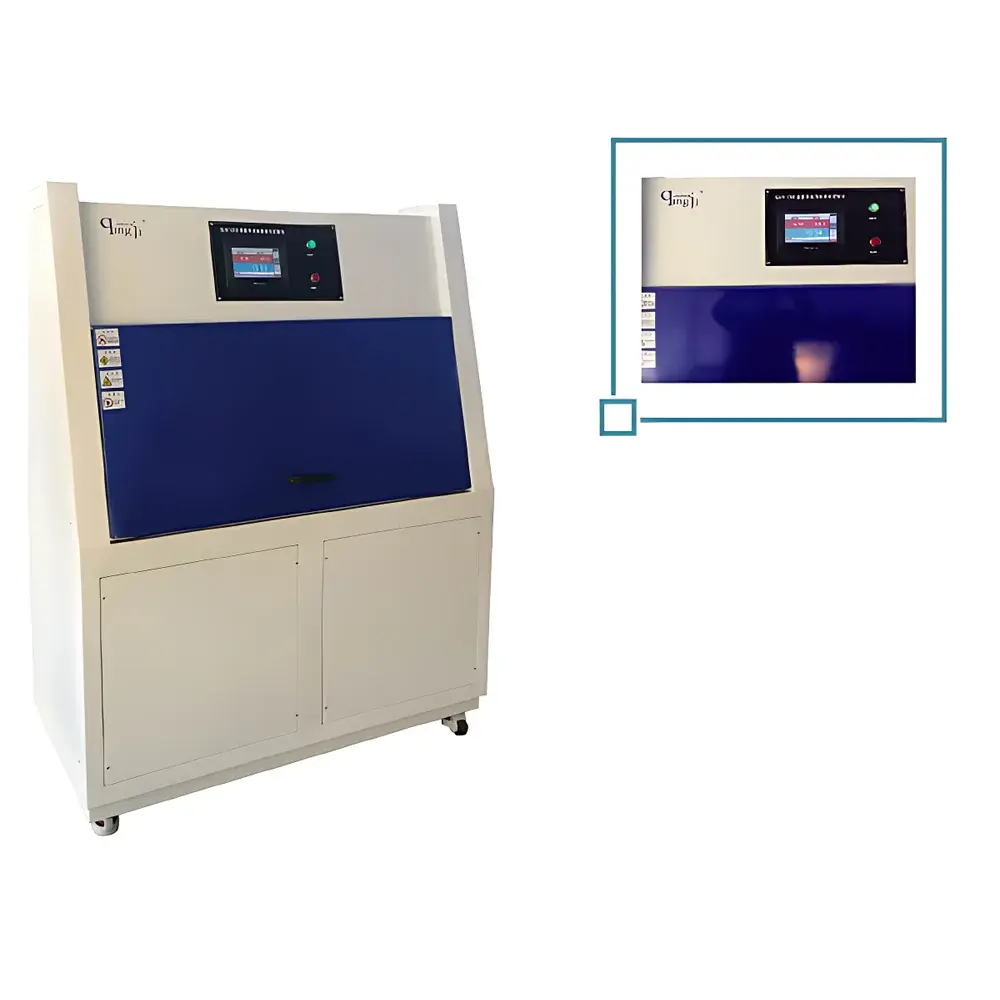
Qingji QUV1003 Pharmaceutical UV Light Exposure Chamber
| Brand | Qingji |
|---|---|
| Origin | Shanghai, China |
| Model | QUV1003 (Spray-type) |
| Illumination Temperature Range | 50, 60, 70 °C |
| Black Panel Temperature Range | 50, 60, 70 °C |
| UV Wavelength Range | 280–315 nm (UV-B) |
| Internal Chamber Dimensions (L×W×H) | 450 × 1165 × 500 mm |
| Temperature Uniformity | ±3 °C |
| Humidity During Condensation | ≥75 %RH |
| Cycle Options | 4 h UV irradiation + 4 h condensation or 8 h UV + 4 h condensation |
| Lamp Center-to-Center Spacing | 65–70 mm |
| Specimen-to-Lamp Distance | 55 mm |
| Standard Specimen Size | 75 × 150 mm |
| Water Consumption | 8 L/day (deionized or distilled water required) |
| External Dimensions (D×W×H) | 600 × 1325 × 1480 mm |
Overview
The Qingji QUV1003 Pharmaceutical UV Light Exposure Chamber is an engineered environmental test system designed to accelerate photochemical degradation of pharmaceutical packaging materials, excipients, and solid dosage forms under controlled ultraviolet radiation, temperature, and humidity conditions. Based on the fundamental principles of UV-B photodegradation (280–315 nm), this chamber replicates the most damaging spectral region of terrestrial solar radiation—specifically targeting bond cleavage in organic molecules such as polymers, dyes, and active pharmaceutical ingredients (APIs). It operates via a cyclic protocol combining controlled UV irradiation with high-humidity condensation phases, simulating diurnal weathering mechanisms including photo-oxidation, hydrolysis, and thermal stress. The system complies with core regulatory expectations for photostability testing outlined in ICH Q1B (Photostability Testing of New Drug Substances and Products) and aligns with methodological frameworks referenced in USP , EP 2.2.7, and ISO 11341 (Paints and varnishes — Artificial weathering and exposure to artificial radiation). Its design supports GLP-compliant data generation for regulatory submissions.
Key Features
- UV-B fluorescent lamp array emitting within the standardized 280–315 nm range, calibrated per ASTM G154 Annex A1 for spectral output consistency
- Dual-phase cycling control: programmable UV irradiation (4 h or 8 h) followed by condensation (4 h) at 50 °C and ≥75 %RH, enabling reproducible simulation of dew formation and moisture-assisted degradation
- Black panel thermometer integration for precise surface temperature monitoring—critical for correlating thermal load with photoreaction kinetics
- Uniform irradiance distribution achieved through optimized lamp geometry (65–70 mm center-to-center spacing) and fixed 55 mm specimen-to-lamp distance, ensuring compliance with ICH Q1B positioning requirements
- Stainless steel 316L interior chamber with seamless welds and corrosion-resistant hardware, supporting long-term exposure to humid UV environments without particulate shedding
- Independent temperature control for irradiation and condensation phases, with ±3 °C uniformity across the 450 × 1165 × 500 mm test volume
Sample Compatibility & Compliance
The QUV1003 accommodates standard 75 × 150 mm flat specimens—compatible with blister packs, aluminum-polymer laminates, HDPE bottles, gelatin capsules, and coated tablets mounted on inert carriers. Sample racks are configurable to maintain consistent orientation relative to the UV source. The chamber meets essential mechanical and operational criteria defined in GB/T 14522–1993 (Chinese national standard for accelerated aging of polymeric materials) and supports traceable validation per ISO/IEC 17025:2017 for laboratory accreditation. While not FDA-registered as a medical device, its operational parameters and documentation structure facilitate audit readiness for FDA 21 CFR Part 11–compliant electronic records when paired with validated third-party data acquisition software.
Software & Data Management
The chamber operates via a microprocessor-based controller with real-time display of UV intensity (relative units), black panel temperature, chamber humidity, and elapsed cycle time. All setpoints and runtime logs are stored internally with timestamping. For enhanced traceability, optional RS-485/Modbus RTU interface enables integration with LIMS or SCADA systems. When deployed in regulated environments, users may implement external validated software (e.g., LabVIEW-based or ELN-integrated platforms) to enforce electronic signature workflows, audit trails, and data integrity controls aligned with ALCOA+ principles (Attributable, Legible, Contemporaneous, Original, Accurate, Complete, Consistent, Enduring, Available).
Applications
- ICH Q1B-compliant photostability screening of new drug substances and products
- Comparative evaluation of UV barrier performance among primary packaging materials (e.g., amber glass vs. UV-stabilized PET)
- Accelerated aging studies for shelf-life prediction under light-exposed storage conditions
- Investigation of photolytic impurity formation pathways in APIs exposed to UV-B stress
- Validation of protective coatings applied to polymer-based delivery devices
- Supporting stability-indicating method development by generating stressed degradation products
FAQ
Does the QUV1003 meet ICH Q1B requirements for photostability testing?
Yes—the system delivers UV-B irradiation (280–315 nm) at controlled black panel temperatures and supports defined irradiation/condensation cycles, fulfilling the core technical provisions of ICH Q1B Option 2.
Is calibration certification included with shipment?
Factory calibration reports for black panel temperature sensors and UV lamp output (at installation) are provided; users must perform periodic recalibration per internal SOPs or ISO/IEC 17025 guidelines.
Can the chamber operate without the condensation phase?
No—the QUV1003 is configured exclusively for UV/condensation cycling; dry-heat-only or UV-only protocols require alternative QUV models with independent humidity control.
What maintenance is required for long-term reliability?
UV lamps must be replaced every 1,600–2,000 hours of operation; stainless steel chamber surfaces require periodic cleaning with deionized water to prevent mineral deposits; condensate reservoirs must be refilled daily with 8 L of purified water.
Is remote monitoring supported?
Standard configuration includes local HMI only; Ethernet or Wi-Fi connectivity requires optional hardware add-ons and third-party middleware integration.



