
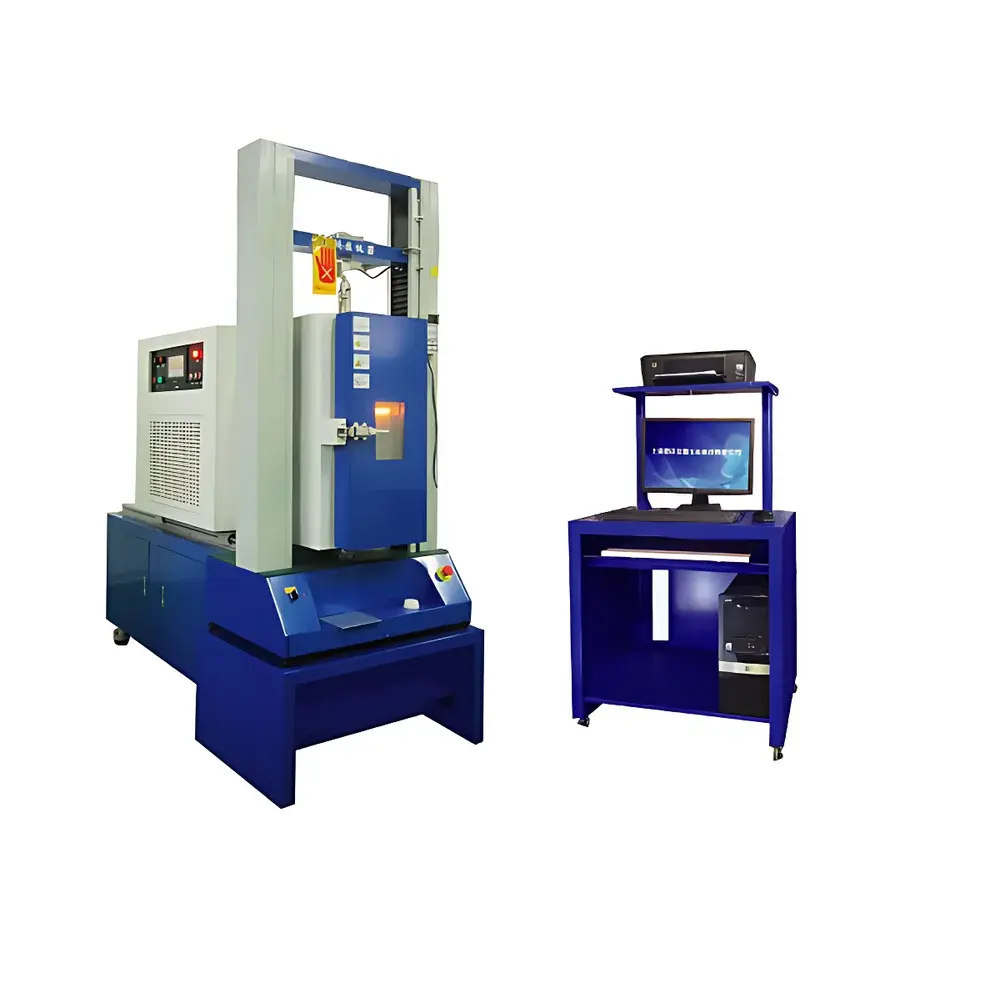
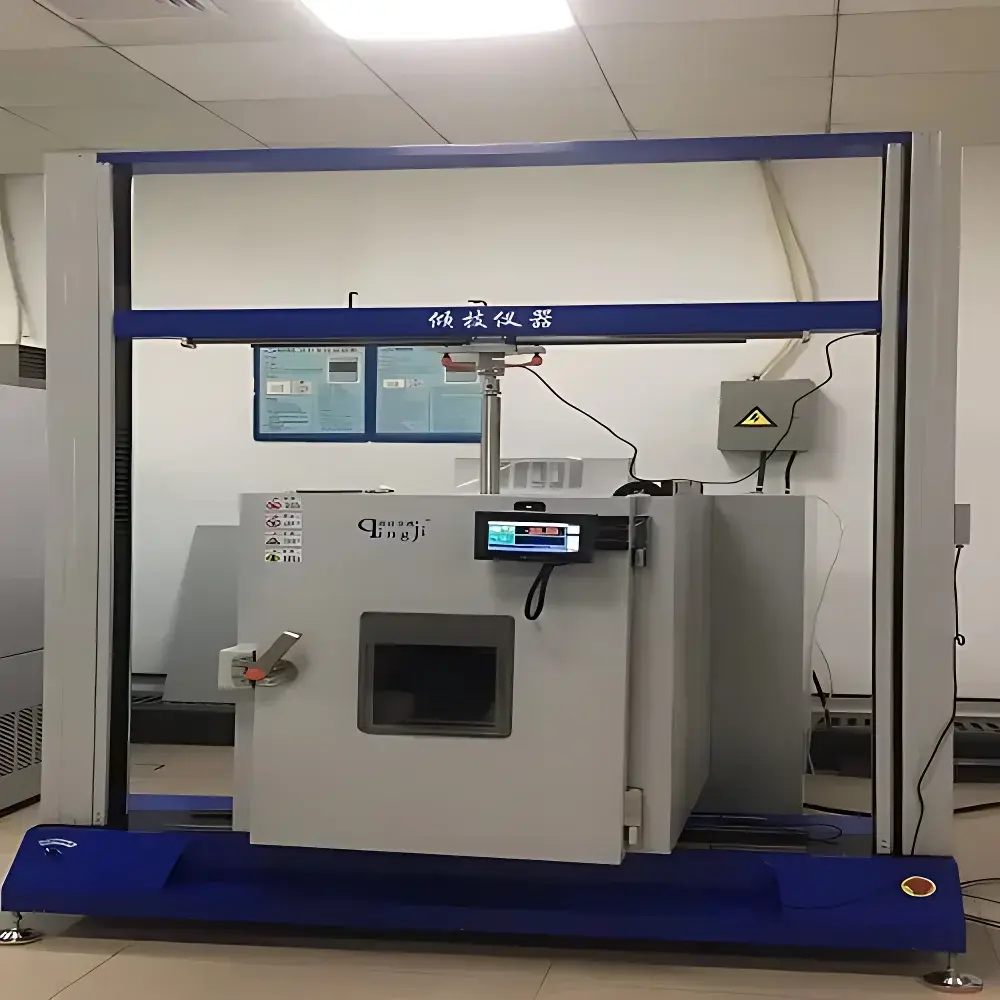
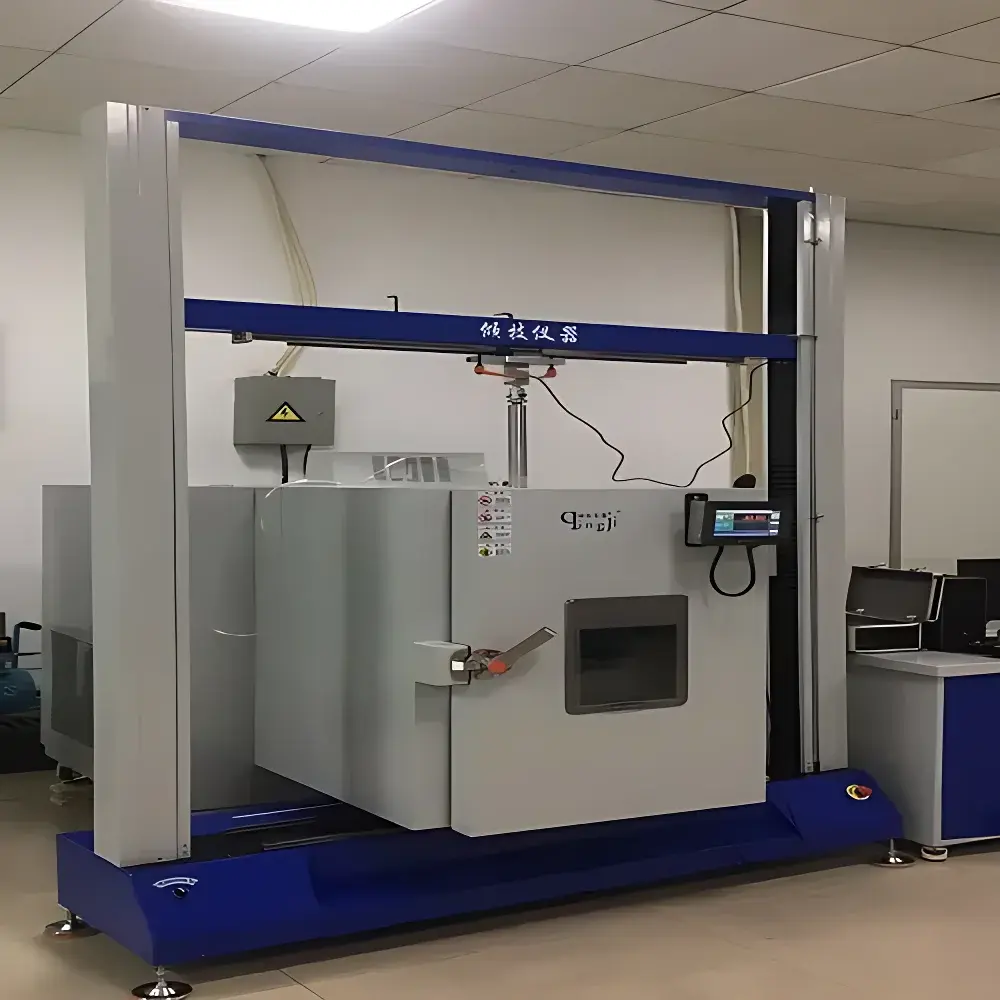
Qinsun QJ211B High-Low Temperature Tensile Testing Machine
| Brand | Qinsun |
|---|---|
| Origin | Shanghai, China |
| Model | QJ211B |
| Max Test Load | 30 kN |
| Load Range | 0–30 kN (adjustable) |
| Load Cell Accuracy | ±0.01% FS |
| Force Measurement Accuracy | ±0.5% or ±1% |
| Crosshead Travel | 800 mm (extendable) |
| Displacement Resolution | 0.01 mm |
| Displacement Accuracy | ±0.5% |
| Strain Measurement Accuracy | ±0.5% |
| Speed Range | 0.01–500 mm/min (optional up to 1000 mm/min) |
| Speed Accuracy | ±0.5% |
| Temperature Range | −40 °C to +350 °C (isothermal at 350 °C) |
| Heating/Cooling Rate | ≥5 °C/min |
| Temperature Controller Resolution | 0.1 °C |
| Effective Width | 420 mm |
| Safety Features | Electronic travel limit switches, emergency stop button |
| Net Weight | 265 kg |
| Compliance | GB/T, ISO 527, ISO 6892, ASTM D638, ASTM D3039, ASTM D790, JIS K7113, DIN 53455 |
Overview
The Qinsun QJ211B High-Low Temperature Tensile Testing Machine is a dual-environment electromechanical testing system engineered for precise uniaxial mechanical characterization of polymeric, metallic, composite, and elastomeric materials across a broad thermal spectrum. It integrates a servo-controlled universal testing frame with a fully insulated, forced-air-circulated environmental chamber capable of stable operation from −40 °C to +350 °C. The system operates on the principle of controlled displacement-driven loading, where force is measured via high-stability load cells (0.01% FS accuracy) and displacement via high-resolution linear encoders (0.01 mm resolution), enabling compliant execution of tensile, compression, flexural, peel, tear, shear, puncture, and low-cycle fatigue tests per international standards. Its modular chamber design allows rapid detachment for ambient-temperature-only testing—optimizing lab footprint and workflow flexibility without hardware reconfiguration.
Key Features
- Thermally integrated dual-zone architecture: Independent control of chamber temperature and crosshead thermal shielding ensures minimal thermal drift during extended high-temperature tests (e.g., 350 °C isothermal holds).
- Precision load measurement: Dual-range or single-range load cells calibrated to ISO 7500-1 Class 0.5, traceable to national metrology institutes, supporting full-scale ranges from 1 kN to 30 kN.
- High-fidelity motion control: AC servo motor with planetary gearbox delivers speed stability of ±0.5% across 0.01–500 mm/min; optional high-speed configuration extends range to 1000 mm/min for dynamic compliance assessment.
- Robust mechanical frame: Rigid two-column steel structure with preloaded ball screws and linear guide rails ensures axial alignment ≤0.05 mm/m and minimizes parasitic bending moments during high-load testing.
- Comprehensive safety redundancy: Dual-channel electronic limit switches, hardware-based emergency stop circuit (EN 60204-1 compliant), and software-configurable overload thresholds protect both operator and specimen integrity.
- Modular chamber interface: Quick-release flange coupling enables tool-free chamber removal in <90 seconds, converting the system to a standard ambient tensile tester while preserving calibration validity.
Sample Compatibility & Compliance
The QJ211B accommodates specimens conforming to standardized geometries per ASTM D638 Type I–V, ISO 527-2, GB/T 1040.2, and ISO 6892-1. Grip options include pneumatic wedge, hydraulic, and custom fixture interfaces (e.g., arc grips for wire, vise-type for brittle ceramics). Environmental chamber compatibility supports specimens up to 420 mm wide and 800 mm gauge length (extendable to 1200 mm with auxiliary column extension kit). The system meets essential requirements of ISO/IEC 17025 for test method validation and supports audit-ready documentation for GLP and GMP environments. All thermal and mechanical calibrations are documented per ISO/IEC 17025:2017 Annex A.2, with traceable certificates available upon request.
Software & Data Management
Control and analysis are executed via Qinsun’s proprietary TestMaster Pro v4.2 software, a Windows-based platform compliant with FDA 21 CFR Part 11 for electronic records and signatures. Software features include real-time multi-channel plotting (force, displacement, strain, temperature), automated test sequence scripting, pass/fail criterion evaluation against user-defined limits, and export to CSV, PDF, and XML formats. Audit trail logs capture all user actions, parameter changes, and calibration events with time stamps and operator IDs. Raw data files retain native 1 kHz sampling resolution and support post-test reprocessing—including modulus calculation using secant, tangent, or polynomial fit methods per ASTM D638 Annex A3.
Applications
- Thermo-mechanical property mapping of thermoplastics (e.g., PP, PC, PEEK) across crystallization and glass transition regimes.
- Evaluation of adhesive bond strength under thermal cycling per ASTM D3163 and ISO 4587.
- High-temperature creep and stress relaxation behavior of aerospace composites (e.g., carbon fiber/epoxy laminates).
- Mechanical aging studies of elastomers and silicone rubbers at elevated service temperatures.
- Validation of weld integrity in stainless steel and aluminum alloys under sub-zero conditions per AWS D1.1.
- Quality control of medical device polymers (e.g., catheter tubing, suture anchors) per ISO 10993-12 and USP .
FAQ
What temperature uniformity is maintained inside the chamber at 350 °C?
At isothermal 350 °C, axial and radial uniformity is ±2.5 °C over the central 100 × 100 mm test zone, verified per ASTM E2203.
Can the system perform closed-loop strain control at elevated temperatures?
Yes—when equipped with high-temperature extensometers (e.g., clip-on or non-contact video extensometer), the controller supports displacement-, strain-, or load-controlled ramp-hold profiles with PID tuning optimized per thermal setpoint.
Is third-party calibration certification included with delivery?
A factory-as-built calibration report (including load cell, encoder, and temperature sensor verification) is provided. ISO/IEC 17025-accredited calibration by an external body is available as an optional service.
What maintenance intervals are recommended for long-term accuracy retention?
Load cell and encoder verification every 12 months; lubrication of ball screws and guides every 6 months; chamber seal inspection and replacement every 24 months or after 500 thermal cycles.
Does the software support automated reporting for ISO/IEC 17025-compliant labs?
Yes—templates comply with ISO/IEC 17025 clause 7.8.2; reports include uncertainty budgets calculated per GUM (JCGM 100:2008) and instrument-specific Type A/B uncertainty components.



