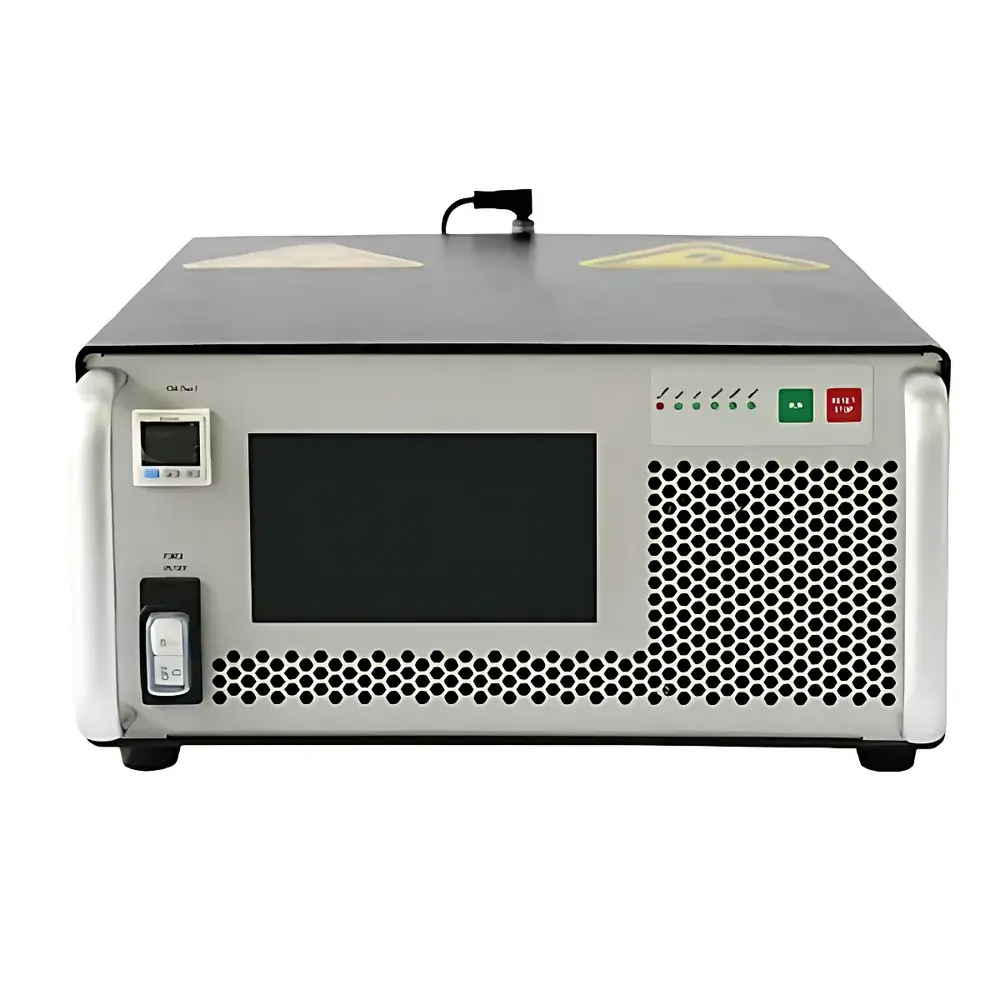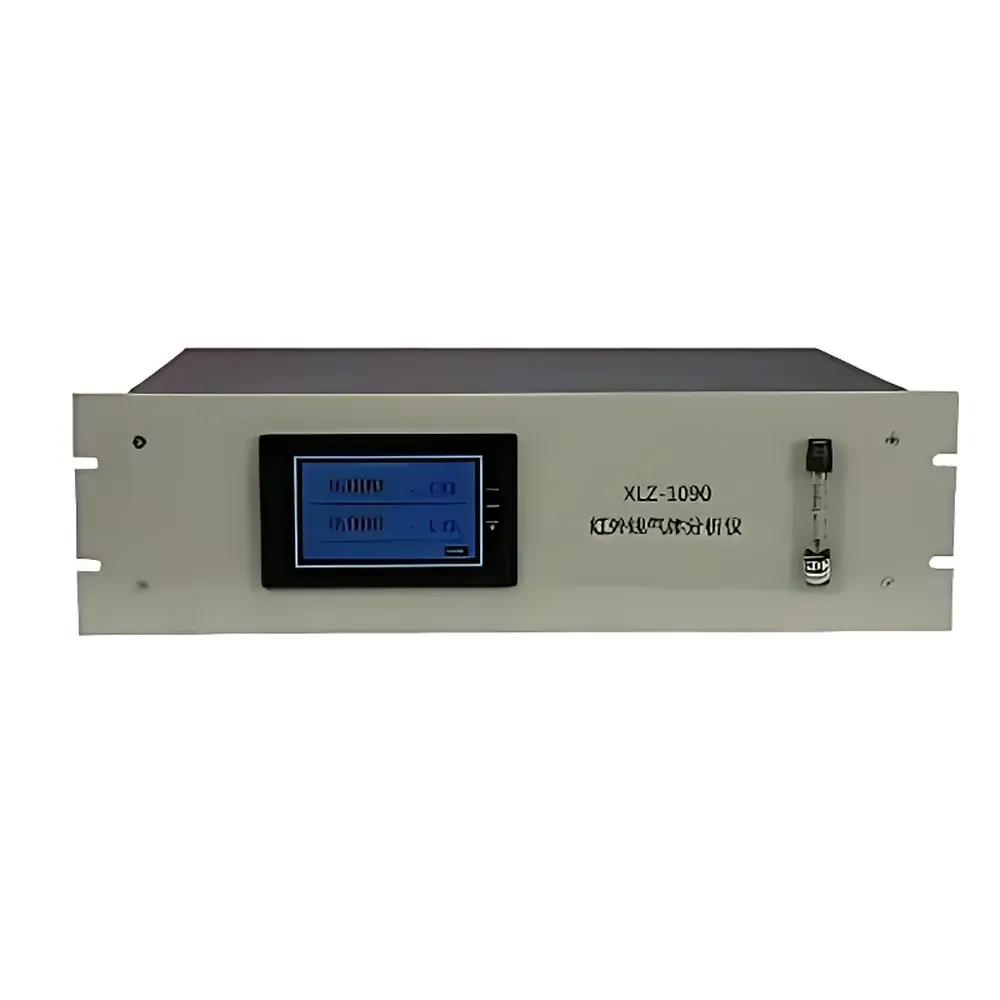
SIELINS XLZ-1090A NDIR Multi-Gas Analyzer
| Brand | SIELINS |
|---|---|
| Model | XLZ-1090A |
| Detection Principle | Non-Dispersive Infrared (NDIR) |
| Gas Channels | Up to 3 simultaneous analytes (e.g., CO, CO₂, CH₄, SO₂, NO + optional O₂) |
| Measurement Range (typ.) | CO: 0–2000 ppm |
| CO₂ | 0–1000 ppm |
| O₂ | 0–1% vol |
| Display | Color TFT LCD with capacitive touch interface |
| Output | 4–20 mA analog (isolated), 8 relay outputs (SPDT), RS232 (field-upgradable to RS485) |
| Response Time (T90) | ≤15 s (IR channels) |
| Stability | ±1% FS / 7 days |
| Repeatability | ±0.5% FS |
| Linearity Error | ±1% FS |
| Temp. Drift | ±1% FS (5–45 °C) |
| Pressure Compensation | Yes |
| Enclosure | 19″ (483 mm) rack-mount chassis |
| Certifications | Non-explosive (non-ATEX/IECEx) |
| Operating Ambient | 5–45 °C |
| Interference Rejection | ±1% FS under cross-gas interference |
Overview
The SIELINS XLZ-1090A is a high-stability, multi-channel non-dispersive infrared (NDIR) gas analyzer engineered for continuous, real-time quantitative analysis of industrial process streams and environmental emissions. It operates on the fundamental physical principle of selective infrared absorption—where diatomic and polyatomic gases exhibit characteristic vibrational-rotational absorption bands in the mid-infrared region (typically 2–14 µm). By applying the Lambert–Beer law, the instrument correlates the attenuation of modulated IR radiation at specific wavelengths to the concentration of target analytes. Unlike dispersive spectrometers, the XLZ-1090A employs MEMS-based pulsed infrared sources and dual-channel pyroelectric detectors, eliminating moving optical components and enhancing long-term reliability. Its architecture supports up to three concurrent gas measurements—including CO, CO₂, CH₄, SO₂, NO—and integrates an electrochemical or paramagnetic O₂ sensor as an optional fourth channel. Designed for unattended operation in demanding environments, it delivers robust performance across fluctuating ambient temperatures (5–45 °C), atmospheric pressure variations, and chemically aggressive sample matrices typical of cement kilns, ammonia synthesis loops, sintering furnaces, and CEMS ducts.
Key Features
- MEMS-integrated pulsed IR source with high-frequency modulation (>10 Hz), optimized for thermal detector response and signal-to-noise ratio.
- Dual-channel differential detection architecture minimizes zero drift and improves baseline stability over extended calibration intervals.
- Active temperature stabilization of optical path and detector housing reduces thermal coefficient impact to ±1% FS across full operating range.
- Real-time barometric pressure compensation algorithm corrects for density-dependent absorbance deviations without external transducer integration.
- Galvanically isolated 4–20 mA analog outputs and eight SPDT relay outputs ensure electromagnetic immunity in electrically noisy plant environments.
- 19″ rack-mount chassis (483 mm width) conforms to EIA-310-D standards; front-panel color TFT display with capacitive touch interface enables intuitive local configuration and diagnostics.
- RS232 serial interface supports Modbus RTU protocol; firmware-upgradable to RS485 for daisy-chain network deployment in distributed control systems.
Sample Compatibility & Compliance
The XLZ-1090A is validated for use with dry, non-corrosive, particle-free gas samples having dew point < 5 °C and particulate loading < 1 mg/m³. Sample conditioning—via heated sampling lines, particulate filters, and permeation dryers—is recommended for wet or high-dust applications (e.g., flue gas, syngas, biogas). The analyzer complies with EN 61326-1 (EMC for industrial environments) and EN 61000-6-2/6-4 (immunity and emission limits). While not certified for hazardous areas (non-ATEX, non-IECEx), its electrical isolation and low-energy circuit design meet general-purpose industrial safety requirements per IEC 61010-1. For regulated applications—including EPA Method 3A, EN 15267-3, and ISO 14064-1 verification—the instrument supports audit-ready data logging when paired with compliant SCADA or DCS platforms.
Software & Data Management
Local operation is managed via embedded firmware with menu-driven calibration routines (zero/span), alarm threshold setup, and diagnostic self-tests (lamp intensity, detector responsivity, temperature stability). All configuration parameters and measurement logs are timestamped and stored in non-volatile memory. When integrated into larger automation infrastructures, the XLZ-1090A exports linearized concentration values, status flags (e.g., “out-of-range”, “sensor fault”), and maintenance alerts via Modbus registers. Raw analog outputs can be fed directly into PLC analog input modules with 16-bit resolution; relay outputs are configurable as latching or momentary for process interlocks or maintenance notifications. Though the device does not include built-in FDA 21 CFR Part 11 compliance features (e.g., electronic signatures, audit trails), its deterministic output behavior and traceable calibration procedures align with GLP/GMP documentation workflows when deployed alongside validated data acquisition systems.
Applications
- Continuous emission monitoring (CEMS) for combustion flue gas—CO, CO₂, SO₂, NOₓ—in power plants, waste incinerators, and industrial boilers.
- In-process gas analysis in nitrogen fertilizer production (NH₃ synthesis loop purge gas), methanol synthesis, and hydrogen reforming units.
- Raw mill and clinker cooler off-gas analysis in cement manufacturing for O₂ optimization and NOₓ precursor tracking.
- Secondary air/fuel ratio control in metallurgical furnaces using CO/CO₂/O₂ triad measurements.
- Research-grade gas mixture validation and reaction kinetics studies in university and national laboratory settings where stable, low-drift NDIR baselines are required.
FAQ
What gases can the XLZ-1090A measure simultaneously?
It supports up to three infrared-active gases (e.g., CO, CO₂, CH₄, SO₂, NO) plus one electrochemical or paramagnetic O₂ channel—totaling four independent concentration outputs.
Is the analyzer suitable for explosive atmospheres?
No. The XLZ-1090A is rated for non-hazardous locations only and must not be installed in Zone 0, 1, or 2 classified areas per IEC 60079.
Does it require periodic calibration with certified gas standards?
Yes. Zero calibration is performed with N₂ or synthetic air; span calibration requires traceable certified gas mixtures matching the target range and matrix (e.g., 1000 ppm CO in N₂). Recommended interval: every 30–90 days depending on application severity.
Can it interface with Siemens PCS7 or Honeywell Experion DCS?
Yes—via RS485 Modbus RTU or isolated 4–20 mA signals, both natively supported by major DCS I/O modules and configurable through standard device description (DD) files.
What is the minimum detectable concentration for CO?
At the 0–2000 ppm range, the practical limit of detection (LOD) is approximately 10 ppm (S/N ≥ 3), consistent with NDIR performance under optimal sample conditions.
Related Products