
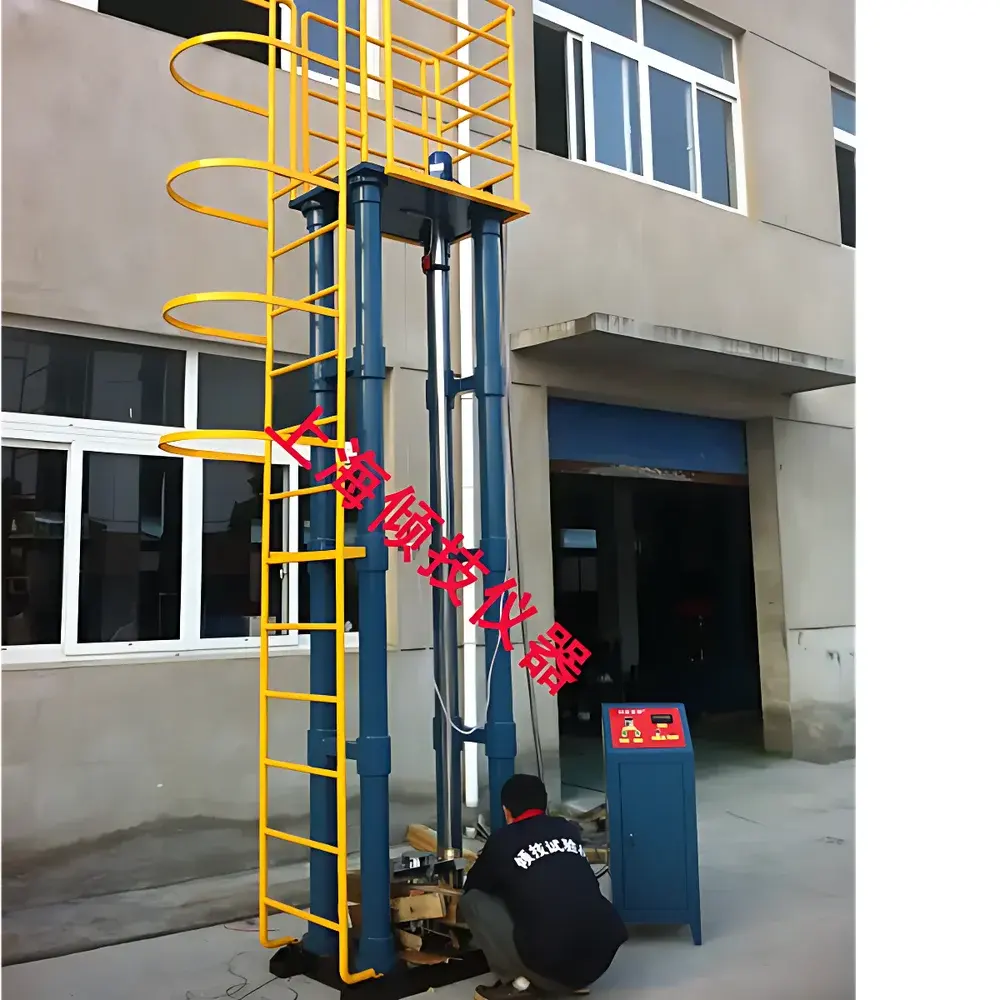
Qingji QJLC-2 Instantaneous Impact Force Tester
| Brand | Qingji |
|---|---|
| Origin | Shanghai, China |
| Model | QJLC-2 |
| Maximum Load Capacity | 500 kN |
| Test Range | 20–500 kN (Accuracy: ±1%) |
| Drop Height Adjustment Range | 0–10,000 mm (Resolution: 0.1 mm) |
| Standard Weights | 2, 3, 4, 5, 10, 20, 50, and 100 kg (AISI 1045 steel |
| Mass Tolerance | ±1%) |
| Accuracy Class | Class 1 (per ISO 7500-1) |
Overview
The Qingji QJLC-2 Instantaneous Impact Force Tester is a high-resolution mechanical impact testing system engineered for the quantitative characterization of dynamic mechanical response under controlled free-fall impact conditions. Based on the principle of energy conversion in vertical drop-weight impact—where gravitational potential energy is converted into kinetic energy upon release—the instrument measures transient force, displacement, time-of-impact, and energy dissipation during the contact event. It is designed specifically for evaluating impact resistance, fracture initiation behavior, and deformation kinetics of rigid and quasi-brittle materials including diamond compacts, geological rock specimens, tungsten carbide tooling, graphite electrodes, structural steels, and engineering thermoplastics. Unlike conventional Charpy or Izod pendulum testers, the QJLC-2 employs direct load-cell-based force measurement synchronized with high-speed displacement sensing and microsecond-level temporal resolution, enabling full reconstruction of the F–t (force–time), F–δ (force–displacement), and E–t (energy–time) curves.
Key Features
- High-precision load cell calibrated to ISO 7500-1 Class 1 accuracy, rated at 500 kN with operational range from 20 kN to 500 kN and linearity error ≤ ±1% of full scale.
- Motorized, programmable height adjustment mechanism with 0.1 mm positional resolution across a 0–10,000 mm vertical travel range, ensuring repeatable impact energy delivery (E = m·g·h).
- Modular weight set comprising AISI 1045 steel masses (2 kg to 100 kg) with certified mass tolerance ≤ ±1%, enabling precise energy tuning from sub-kJ to multi-kJ impact levels.
- Integrated high-speed data acquisition system sampling at ≥100 kHz, capturing transient mechanical events with sufficient temporal fidelity to resolve elastic wave propagation and plastic yield onset.
- Rigid C-frame structural architecture with reinforced base plate and guided drop column to minimize lateral deviation and ensure axial loading alignment per ASTM E23 and ISO 148-1 requirements.
- Real-time synchronization of force, displacement, and time channels with hardware-triggered start/stop logic to eliminate post-processing interpolation artifacts.
Sample Compatibility & Compliance
The QJLC-2 accommodates specimens up to 300 mm × 300 mm × 250 mm (L × W × H) and supports both notched and unnotched geometries per ASTM E23, ISO 148, and GB/T 229 standards. Fixture adaptability includes V-notch, U-notch, and flat-bar configurations with interchangeable anvil and tup assemblies. The system complies with ISO/IEC 17025 calibration traceability requirements when operated with accredited load cell verification. All mechanical components meet CE machinery directive (2006/42/EC) safety provisions, and software execution adheres to principles aligned with FDA 21 CFR Part 11 for audit trail generation and electronic signature support in regulated environments.
Software & Data Management
The proprietary QJLC17.7.Ttest software platform provides real-time visualization, post-test curve analysis, and automated report generation. It supports dual-mode operation: manual test sequencing and script-driven batch protocols. Key functionalities include automatic peak force detection, energy integral calculation (area under F–t curve), elastic modulus estimation from initial slope, and plastic deformation quantification via residual displacement. Raw data export is available in CSV, TXT, and HDF5 formats; metadata tagging includes operator ID, environmental conditions (optional sensor input), calibration certificate reference, and timestamped audit logs. Software validation documentation is provided to support GLP/GMP laboratory implementation.
Applications
- Quantitative assessment of impact toughness in cemented carbides used in mining drill bits and cutting inserts.
- Evaluation of thermal shock resistance in refractory graphite components exposed to rapid temperature gradients.
- Fracture mechanics studies on polycrystalline diamond compacts (PDCs) under simulated downhole impact loading.
- Quality control of structural steel plates for offshore platforms, verifying minimum absorbed energy thresholds at low temperatures.
- Comparative analysis of polymer composite laminates subjected to ballistic precursor loading scenarios.
- Validation of additive manufacturing process parameters through impact-induced delamination threshold mapping.
FAQ
What standards does the QJLC-2 comply with for impact testing?
The system supports test methodologies defined in ASTM E23, ISO 148-1, GB/T 229, and EN 10045-1, with mechanical configuration and calibration traceability aligned to ISO 7500-1 Class 1 requirements.
Can the system be integrated into an existing LIMS or MES environment?
Yes—via configurable OPC UA or TCP/IP API endpoints, raw data streams and summary metrics can be routed to enterprise systems while preserving full audit trail integrity.
Is third-party calibration certification available?
Qingji provides factory calibration certificates traceable to NIM (National Institute of Metrology, China); optional UKAS or DAkkS-accredited calibration services are arranged through authorized regional partners.
What maintenance intervals are recommended for long-term accuracy?
Annual recalibration of the load cell and height encoder is advised; routine verification using certified reference weights and gauge blocks should be performed quarterly per ISO/IEC 17025 internal quality procedures.



